TCP 3Way Handshake Process (original) (raw)
Last Updated : 13 Oct, 2025
The TCP 3-Way Handshake is a process used by the Transmission Control Protocol (TCP) to establish a reliable connection between a client and a server before data transfer. It ensures that both sides are synchronized and ready to communicate.
TCP Segment Structure
A TCP segment consists of data bytes to be sent and a header that is added to the data by TCP as shown:

The header of a TCP segment can range from 20-60 bytes. 40 bytes are for options. If there are no options, a header is 20 bytes else it can be of upmost 60 bytes. Header fields:
1. **Source Port / Destination Port (16 bits each): Identify sending and receiving applications.
2. **Sequence Number (32 bits): Position of the first byte in this segment, used for ordering.
3. **Acknowledgement Number (32 bits): Next byte expected by the receiver (confirms data received).
4. **Header Length (HLEN): Size of the header (5–15 words, i.e., 20–60 bytes).
5. **Control Flags (1 bit each):
- **URG: Urgent data
- **ACK: Acknowledgement valid
- **PSH: Push data immediately
- **RST: Reset connection
- **SYN: Synchronize sequence numbers
- **FIN: Terminate connection
6. Window Size: Receiver’s buffer size (for flow control).
7. Checksum: Error detection (mandatory).
8. **Urgent Pointer: Position of urgent data (if URG flag is set).
TCP 3-way Handshake Process
Communication over the internet follows the TCP/IP model. Applications like web browsers use the Application Layer, and their data is passed to the Transport Layer, where TCP and UDP work.
- TCP is widely used because it provides reliable communication.
- UDP is faster but unreliable (e.g., used in DNS lookups).
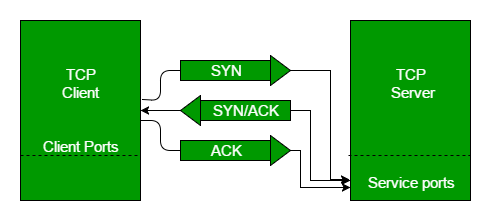
TCP ensures reliability using Positive Acknowledgement with Retransmission (PAR):
- Each segment sent must be acknowledged.
- If a segment is lost or corrupted (detected using the checksum), the receiver discards it, and the sender retransmits.
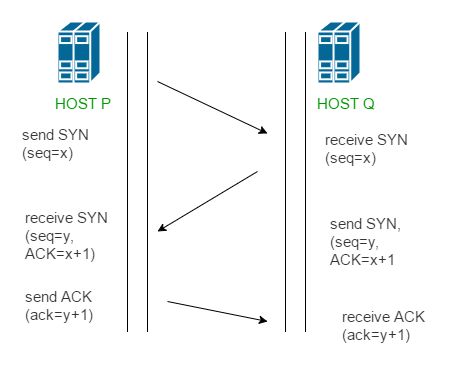
- **Step 1 (SYN): In the first step, the client wants to establish a connection with a server, so it sends a segment with SYN(Synchronize Sequence Number) which informs the server that the client is likely to start communication and with what sequence number it starts segments with
- **Step 2 (SYN + ACK): Server responds to the client request with SYN-ACK signal bits set. Acknowledgement(ACK) signifies the response of the segment it received and SYN signifies with what sequence number it is likely to start the segments with
- **Step 3 (ACK): In the final part client acknowledges the response of the server and they both establish a reliable connection with which they will start the actual data transfer.