TCP/IP Packet Format (original) (raw)
Last Updated : 23 Feb, 2026
A TCP/IP packet is the smallest unit of data transmitted over a network. It contains both user data and control information, allowing devices to communicate reliably and efficiently.
- Packets are used for sending data across networks.
- TCP and IP add headers to handle different responsibilities
- TCP header manages application-to-application communication.
- IP header ensures delivery from source to destination device.
- Understanding packet structure is essential for networking, troubleshooting, and protocol analysis.
**Why Packet Format is Needed in TCP/IP
A structured packet format is essential in TCP/IP because it allows data to be organized, transmitted, and processed correctly across networks. Headers provide the necessary information for identifying, delivering, and handling data efficiently.
- Headers act like labels, telling the network how to handle each packet.
- Packet format ensures identification of individual packets within a communication session.
- It enables delivery of data to the correct destination device.
- It supports error handling, allowing detection of corrupted or lost packets.
- Proper structure is fundamental for reliable and efficient network communication.
TCP Packet Format
A TCP packet, also called a TCP segment, is created at the transport layer to ensure reliable and ordered delivery of data between applications. It carries both the user’s data and control information, which helps manage communication, detect errors, and control data flow.
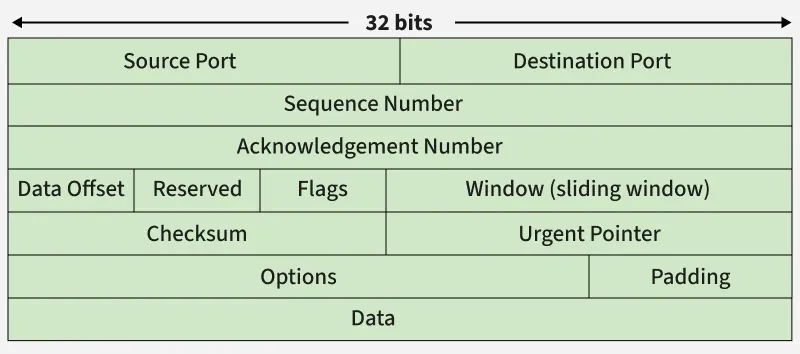
TCP packet Format
- **Source Port: This port identifies the port number of the application that sends the data.
- **Destination Port: Identify the port number of the application that should receive the data.
- **Sequence Number: Specifies the position of the first byte of data in this segment, ensuring that data can be reassembled in the correct order at the receiver.
- **Acknowledgment Number: Confirms the successful receipt of data and indicates the next byte the sender should transmit.
- **Data Offset (Header Length): Indicates where the actual data begins in the packet, allowing the receiver to separate headers from user data.
- **Control Flags: Include bits like SYN, ACK, FIN, RST that control connection setup, maintenance, and termination.
- **Window Size: Determines the amount of data the receiver can accept at a time, providing flow control to prevent overwhelming the receiver.
- **Checksum: Used to detect errors in the header and data, ensuring integrity during transmission.
- **Urgent Pointer: Points to urgent data that should be processed immediately, if any.
- **Options: Provides additional features such as maximum segment size (MSS) or timestamps to improve performance.
- **Data (Payload): The actual application data being sent, like a message, file, or web content.
IP Packet Format
An IP packet is created at the Internet layer to deliver data from the source device to the destination device across networks. It carries the TCP segment or other transport-layer data along with control information for addressing, routing, and error checking.
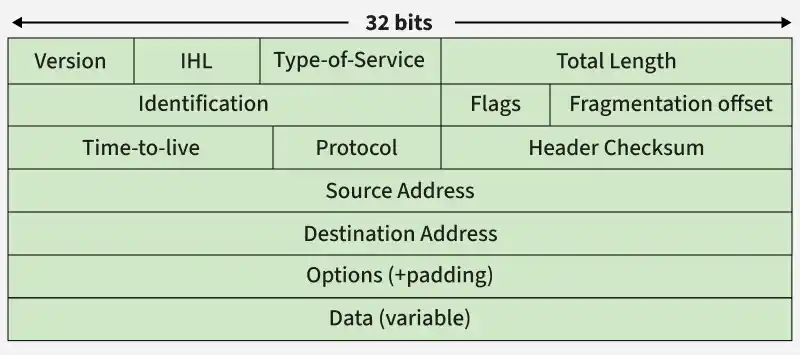
- **Version (4 bits): Indicates the IP version (IPv4 or IPv6).
- **Header Length (4 bits): Specifies the size of the IP header, helping the receiver separate header from data.
- **Type of Service (8 bits): Marks the packet for prioritization and quality of service (QoS).
- **Total Length (16 bits): Total size of the IP packet, including header and data.
- **Identification (16 bits): Unique ID used when packets are fragmented for reassembly.
- **Flags (3 bits): Control fragmentation, such as “Don’t Fragment” or “More Fragments” indicators.
- **Fragment Offset (13 bits): Indicates the position of this fragment in the original packet.
- **Time to Live (TTL) (8 bits): Limits the number of hops a packet can travel to prevent infinite circulation.
- **Protocol (8 bits): Specifies the transport protocol (e.g., TCP = 6, UDP = 17) carried in the data field.
- **Header Checksum (16 bits): Detects errors in the IP header for integrity verification.
- **Source IP Address (32 bits): Logical address of the sender device.
- **Destination IP Address (32 bits): Logical address of the receiver device.
- **Options (Variable length): Optional features like security, routing, and timestamps.
- **Data/Payload: Encapsulates the TCP segment or other transport-layer data.
The IP packet structure contains essential components that work together to route data efficiently and reliably across networks, ensuring correct delivery and proper error handling.
TCP Packet vs IP Packet
| **TCP Packet | **IP Packet |
|---|---|
| TCP packets operate at the transport layer of the OSI model. | IP packets operate at the internet layer of the TCP/IP model. |
| TCP ensures reliable and ordered delivery of data between applications. | IP delivers packets from the source device to the destination device across networks. |
| TCP uses port numbers to identify source and destination applications. | IP uses IP addresses to identify source and destination devices. |
| TCP provides error detection and retransmission to ensure reliable data delivery. | IP detects errors only in the header using a checksum. |
| TCP is connection-oriented and requires a handshake to establish communication. | IP is connectionless and delivers packets independently. |
| TCP manages flow control using the window size mechanism. | IP does not provide flow control. |
| TCP divides data into segments before transmission. | IP handles packet fragmentation for routing purposes. |
| TCP packets contain the actual application data being transmitted. | IP packets carry TCP/UDP segments or other transport-layer data. |
Advantages of TCP/IP Packet Design
- **Reliable Communication: TCP ensures data is delivered accurately and in the correct order using acknowledgments and retransmissions.
- **Efficient Data Delivery: IP enables packets to travel across multiple networks and reach the correct destination using logical addressing.
- **Scalability: The packet-based structure supports communication in small networks as well as large-scale networks like the Internet.
- **Error Detection: Checksums in TCP and IP help detect corrupted data during transmission.
- **Flow Control: TCP controls the rate of data transfer to prevent the receiver from being overloaded.
- **Flexibility: TCP/IP packet design supports multiple applications and protocols on the same network.
- **Interoperability: Standardized packet formats allow devices from different vendors to communicate seamlessly.