Traditional Symmetric Ciphers (original) (raw)
Last Updated : 14 Oct, 2019
The two types of traditional symmetric ciphers are Substitution Cipher and Transposition Cipher. The following flowchart categories the traditional ciphers: 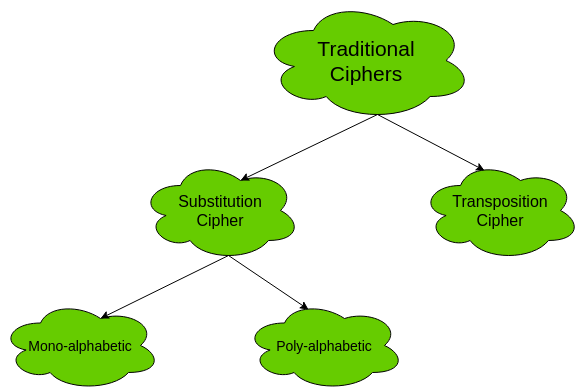 **1. Substitution Cipher:**Substitution Ciphers are further divided into Mono-alphabetic Cipher and Poly-alphabetic Cipher. First, let's study about mono-alphabetic cipher.
- **Mono-alphabetic Cipher -**In mono-alphabetic ciphers, each symbol in plain-text (eg; 'o' in 'follow') is mapped to one cipher-text symbol. No matter how many times a symbol occurs in the plain-text, it will correspond to the same cipher-text symbol. For example, if the plain-text is 'follow' and the mapping is :
- f -> g
- o -> p
- l -> m
- w -> x
The cipher-text is 'gpmmpx'. Types of mono-alphabetic ciphers are: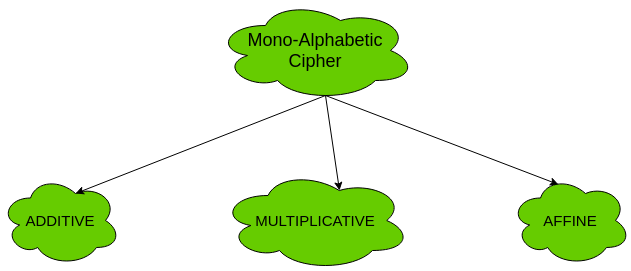 **(a). Additive Cipher (Shift Cipher / Caesar Cipher) -**The simplest mono-alphabetic cipher is additive cipher. It is also referred to as 'Shift Cipher' or 'Caesar Cipher'. As the name suggests, 'addition modulus 2' operation is performed on the plain-text to obtain a cipher-text. C = (M + k) mod n M = (C - k) mod n where, C -> cipher-text M -> message/plain-text k -> key The key space is 26. Thus, it is not very secure. It can be broken by brute-force attack. For more information and implementation see Caesar Cipher **(b). Multiplicative Cipher -The multiplicative cipher is similar to additive cipher except the fact that the key bit is multiplied to the plain-text symbol during encryption. Likewise, the cipher-text is multiplied by the multiplicative inverse of key for decryption to obtain back the plain-text. C = (M * k) mod n M = (C * k-1) mod n where, k-1 -> multiplicative inverse of k (key) The key space of multiplicative cipher is 12. Thus, it is also not very secure.(c). Affine Cipher -**The affine cipher is a combination of additive cipher and multiplicative cipher. The key space is 26 * 12 (key space of additive * key space of multiplicative) i.e. 312. It is relatively secure than the above two as the key space is larger. Here two keys k1 and k2 are used. C = [(M * k1) + k2] mod n M = [(C - k2) * k1-1 ] mod n For more information and implementation, see Affine CipherNow, let's study about poly-alphabetic cipher.
- **Poly-alphabetic Cipher -**In poly-alphabetic ciphers, every symbol in plain-text is mapped to a different cipher-text symbol regardless of its occurrence. Every different occurrence of a symbol has different mapping to a cipher-text. For example, in the plain-text 'follow', the mapping is : f -> q o -> w l -> e l -> r o -> t w -> y Thus, the cipher text is 'qwerty'. Types of poly-alphabetic ciphers are:

**2. Transposition Cipher:**The transposition cipher does not deal with substitution of one symbol with another. It focuses on changing the position of the symbol in the plain-text. A symbol in the first position in plain-text may occur in fifth position in cipher-text. Two of the transposition ciphers are: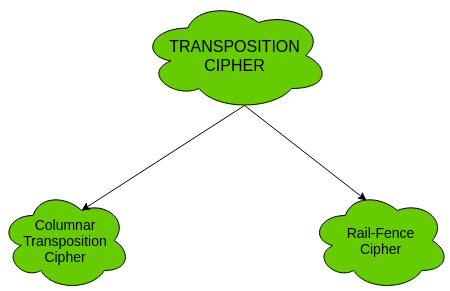
- **Columnar Transposition Cipher -**For information and implementation, see Columnar Transposition Cipher
- **Rail-Fence Cipher -**For information and implementation, see Rail-Fence Cipher