Transport Layer Security (TLS) (original) (raw)
Last Updated : 10 Apr, 2026
Transport Layer Security (TLS) is a cryptographic protocol designed to provide security at the transport layer. It was derived from a security protocol called Secure Socket Layer (SSL). TLS ensures that no third party can eavesdrop on or tamper with any message transmitted between a client and a server.
- It helps to secure transmitted data using encryption, ensuring that sensitive information remains confidential.
- It works seamlessly with most web browsers, including Microsoft Internet Explorer, and operates across a wide range.
- Since TLS/SSL operates beneath the application layer, most of its processes are completely invisible to the client.
Working
SSL/TLS works through a process called a handshake, which establishes a secure and encrypted connection between a client and a server over TCP.
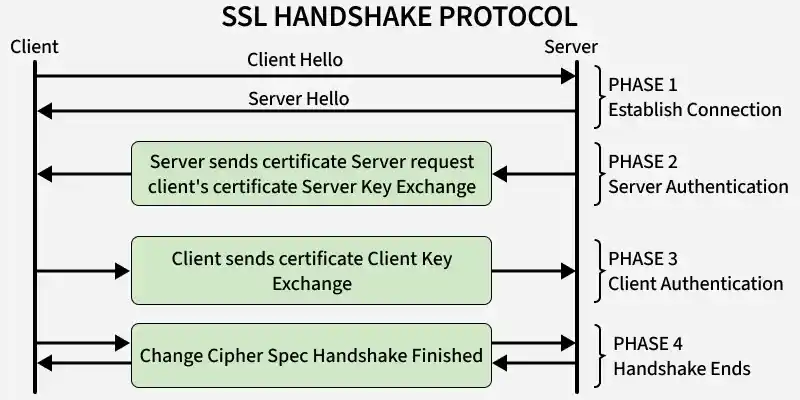
- **Client Hello: The client initiates the connection and sends supported SSL/TLS version, list of cipher suites and compression methods.
- **Server Selection: The server checks the highest compatible SSL/TLS version and selects a suitable cipher suite and compression method from the client’s list.
- **Server Authentication: The server sends its digital certificate to the client, which is verified using a trusted Certificate Authority to confirm the server’s identity.
- **Key Exchange: After verification, both client and server exchange information such as the public key or the PreMasterSecret to securely generate encryption keys.
- **Session Key Generation: Both parties compute the same session key, which will be used for symmetric encryption during communication.
- **Secure Communication: Once the handshake is complete, encrypted communication begins, ensuring the confidentiality and integrity of transmitted data.
- **Connection Termination: If the TCP connection closes improperly, the connection ends securely without compromising the encrypted data.
Enhanced Security Features
- Uses AES (Advanced Encryption Standard) for fast and secure symmetric encryption.
- Uses RSA and Diffie–Hellman for secure key exchange and encryption.
- Supports hash functions such as SHA-256 to maintain message integrity.
- Ensures data remains confidential and protected from unauthorized modification.
- Protects communication from common cyber attacks.
Certificate-Based Authentication
- Server provides a digital certificate containing its public key and identity details.
- Certificate is verified using trusted root certificates.
- Certificate Authority (CA) confirms authenticity of the server.
- Prevents man-in-the-middle attacks.
- Establishes trust between client and server before data transmission.
Enhanced Security Features
- Uses symmetric encryption algorithms such as AES (Advanced Encryption Standard) for fast and secure data protection.
- Uses asymmetric algorithms such as RSA and Diffie–Hellman for secure key exchange.
- Supports hash functions like SHA-256 to maintain message integrity.
- Ensures confidentiality and prevents unauthorized modification of data.
- Protects communication from common cyber threats.
Certificate-Based Authentication
- Server provides a digital certificate containing public key and identity details.
- Certificate is verified using trusted root certificates stored on the client system.
- Certificate Authority (CA) confirms authenticity of the certificate.
- Helps prevent man-in-the-middle attacks.
- Establishes trust between client and server before data exchange.
Forward Secrecy
This is a security feature in TLS that ensures previously transmitted data remains secure even if the server’s private key is compromised in the future. It works by generating temporary session keys for each communication session, which are not stored permanently and cannot be reused.
- Generates unique session keys for every session.
- Prevents attackers from decrypting past communications.
- Uses temporary keys that are not stored permanently.
- Provides stronger protection for sensitive data.
- Reduces impact of private key compromise.
TLS Handshake Protocol
This is the process through which the client and server establish a secure connection by agreeing on encryption methods and exchanging cryptographic information required for secure communication.
- Negotiates TLS version supported by both client and server.
- Selects suitable cipher suite for encryption.
- Exchanges cryptographic parameters securely.
- Generates session keys for encryption and decryption.
- Establishes secure communication channel.
Perfect Forward Secrecy (PFS)
This is an advanced security feature in TLS that protects past communication even if long-term private keys are compromised. It works by generating independent session keys for each connection, ensuring that the compromise of one key does not affect the security of previous sessions.
- Generates separate session keys for each communication session.
- Protects previously transmitted data from decryption.
- Reduces risk caused by private key compromise.
- Provides stronger confidentiality for sensitive information.
TLS Deployment Best Practices
Organizations should follow proper configuration and management practices to ensure maximum security when using TLS.
- Regularly update TLS versions and configurations.
- Disable outdated algorithms and weak cipher suites.
- Use strong key lengths in digital certificates.
- Maintain proper certificate chain and renewal process.
- Ensure secure implementation of cryptographic protocols.
Continual Evolution
TLS continues to improve over time to address new vulnerabilities and emerging cyber threats through ongoing research and development by standard organizations.
- Updated regularly to handle new security risks.
- Developed and maintained by organizations like IETF.
- Adapts to modern cryptographic requirements.
- Provides stronger protection against advanced attacks.
- Ensures secure communication standards remain effective.