Datagram Congestion Control Protocol DCCP (original) (raw)
Last Updated : 14 Oct, 2025
Congestion in networks occurs when routers, CPUs, or buffers are overloaded, leading to packet delays or even total delivery failure. To handle such issues, the Datagram Congestion Control Protocol (DCCP) was introduced. DCCP is a message-based transport layer protocol that provides congestion control, secure connection setup/closure, and feature negotiation, without needing to implement these at the application level.
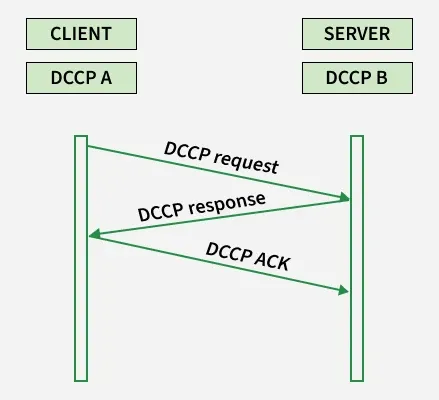
DCCP Connection setup
Key Features of DCCP
- **Message-based transport (like UDP, not byte-stream like TCP).
- Provides **congestion control and ECN (Explicit Congestion Notification).
- Supports **secure handshake for setup and closure.
- Includes **acknowledgment mechanisms to track packet loss, ECN marks, or corruption.
- Allows **negotiation of suitable congestion control algorithms.
- Supports **multiple concurrent streams with data prioritization for **Quality of Service (QoS).
- Works with both **IPv4 and IPv6.
- Supports both **connection-oriented and connectionless modes.
DCCP Packet structure:
DCCP’s generic header adapts to the size of the Extended Sequence Number (X) field:
Let X = 1, the Sequence Number field is 48 bits long, and the generic header takes 16 bytes, which is clearly explained in the below image.
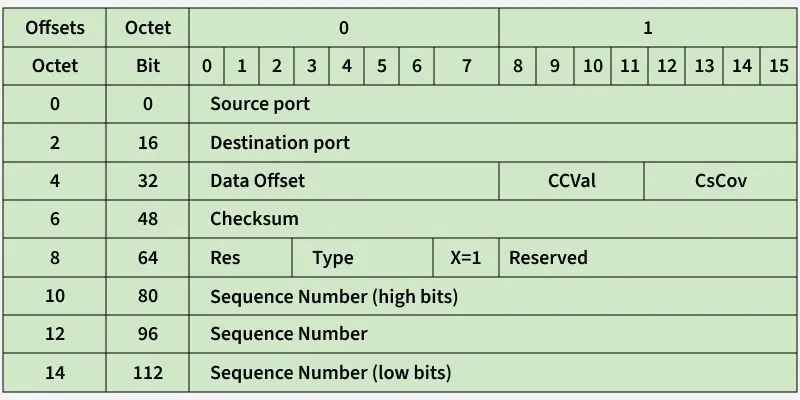
DCCP generic header when X=1
If we change the value of X = 0, only the low 24 bits of the Sequence Number are transmitted, and the generic header is 12 bytes long which is shown in the below image:
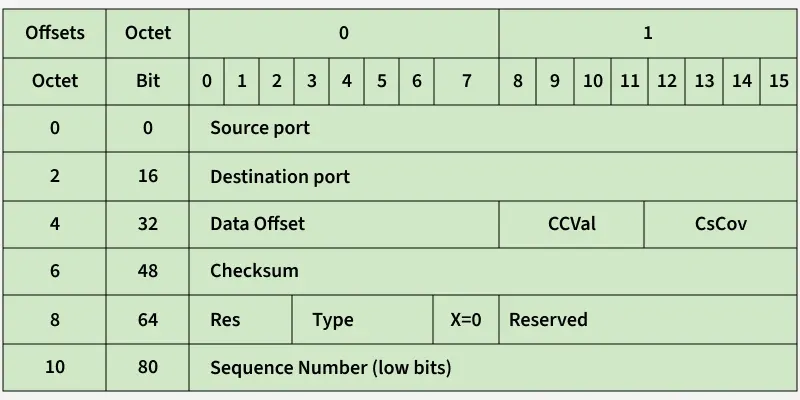
DCCP generic header when X=0
**Advantages
- **Congestion control: Unlike UDP, DCCP prevents network overload with built-in algorithms.
- **QoS support: Prioritizes important traffic (e.g., voice, video).
- **Flexibility: Multiple congestion control mechanisms available.
- **Compatibility: Works with existing IP networks and coexists with TCP/UDP.
**Real-World Applications
- **Streaming Media (audio/video, conferencing): Handles real-time data with low latency.
- **Online Gaming: Ensures fast, reliable delivery of game data.
- **Telemetry: Reliable transmission of large datasets from remote devices.
- **Remote Access: Secure and efficient access to servers/resources.