What is IPv6? (original) (raw)
Last Updated : 31 Jul, 2025
The next generation Internet Protocol (IP) address standard, known as IPv6, is meant to work in cooperation with IPv4. To communicate with other devices, a computer, smartphone, home automation component, Internet of Things sensor, or any other Internet-connected device needs a numerical IP address.
Because so many connected devices are being used, the original IP address scheme, known as IPv4, is running out of addresses. This new IP address version is being deployed to fulfil the need for more Internet addresses. With 128-bit address space, it allows 340 undecillion unique address space. IPv6 support a theoretical maximum of 340, 282, 366, 920, 938, 463, 463, 374, 607, 431, 768, 211, 456.
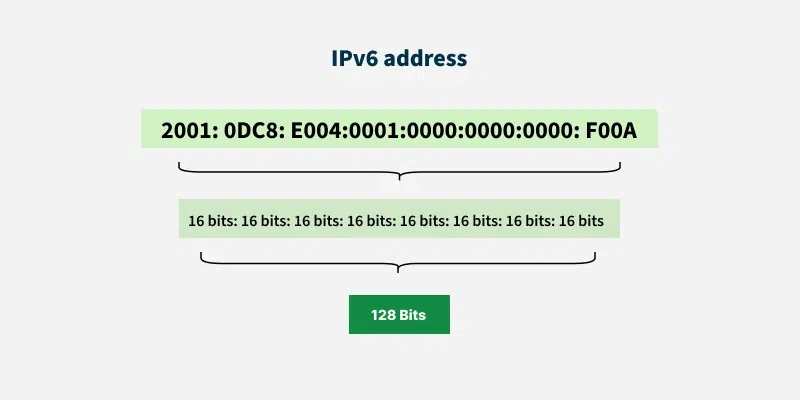
Representation of IPv6
An IPv6 address consists of eight groups of four hexadecimal digits separated by ' . ' and each Hex digit representing four bits so the total length of IPv6 is 128 bits. Structure given below.

IPV6-Representation
gggg.gggg.gggg.ssss.xxxx.xxxx.xxxx.xxxx
The first 48 bits represent Global Routing Prefix. The next 16 bits represent the student ID and the last 64 bits represent the host ID. The first 64 bits represent the network portion and the last 64 bits represent the interface id.
- **Global Routing Prefix: The Global Routing Prefix is the portion of an IPv6 address that is used to identify a specific network or subnet within the larger IPv6 internet. It is assigned by an ISP or a regional internet registry (RIR).
- **Student Id: The portion of the address used within an organization to identify subnets. This usually follows the Global Routing Prefix.
- **Host Id: The last part of the address, is used to identify a specific host on a network.
Example: 3001:0da8:75a3:0000:0000:8a2e:0370:7334
Types of IPv6 Address
Now that we know about what is IPv6 address let’s take a look at its different types.
- **Unicast Addresses : Only one interface is specified by the unicast address. A packet moves from one host to the destination host when it is sent to a unicast address destination.
- **Multicast Addresses: It represents a group of IP devices and can only be used as the destination of a datagram.
- **Anycast Addresses: The multicast address and the anycast address are the same. The way the anycast address varies from other addresses is that it can deliver the same IP address to several servers or devices. Keep in mind that the hosts do not receive the IP address. Stated differently, multiple interfaces or a collection of interfaces are assigned an anycast address.
Difference between IPv6 and IPv4
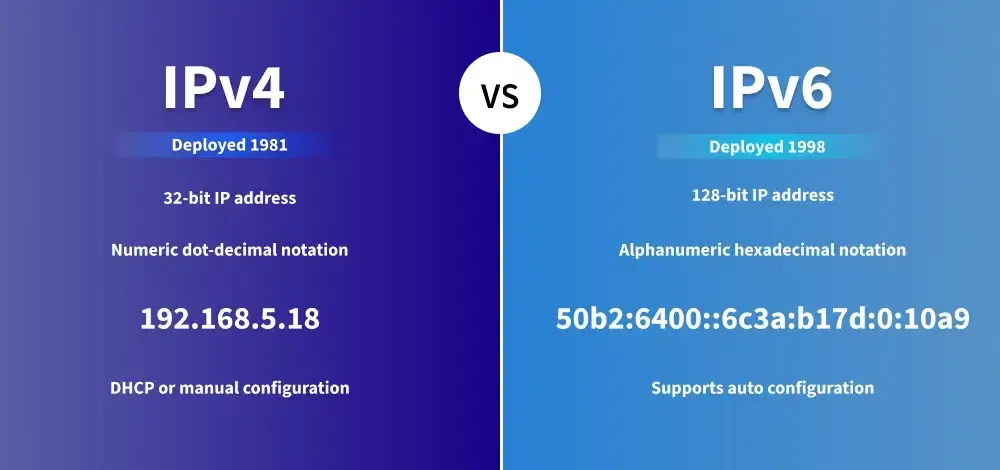
IPv6 was developed to overcome the limitations of IPv4, offering more address space, simplified headers, and improved efficiency.
| IPv6 | IPv4 |
|---|---|
| IPv6 has a 128-bit address length. | IPv4 has a 32-bit address length. |
| It supports Auto and renumbering address configuration. | It Supports Manual and DHCP address configuration. |
| The address space of IPv6 is quite large it can produce 3.4×1038 address space. | It can generate 4.29×10⁹ address space. |
| Address Representation of IPv6 is in hexadecimal. | Address representation of IPv4 is in decimal. |
| In IPv6 checksum field is not available. | In IPv4 checksum field is available. |
| IPv6 has a header of 40 bytes fixed. | IPv4 has a header of 20-60 bytes. |
| IPv6 does not support VLSM. | IPv4 supports VLSM(Variable Length subnet mask). |
Advantages
- **Faster Speeds: IPv6 supports multicast rather than broadcast in IPv4.This feature allows bandwidth-intensive packet flows (like multimedia streams) to be sent to multiple destinations all at once.
- **Stronger Security: IPSecurity, which provides confidentiality, and data integrity, is embedded into IPv6.
- Routing efficiency
- Reliability
- Most importantly it's the final solution for growing nodes in Global-network.
- The device allocates addresses on its own.
- Internet protocol security is used to support security.
- Enable simple aggregation of prefixes allocated to IP networks; this saves bandwidth by enabling the simultaneous transmission of large data packages.
Disadvantages
- **Conversion: Due to widespread present usage of IPv4 it will take a long period to completely shift to IPv6.
- **Communication: IPv4 and IPv6 machines cannot communicate directly with each other.
- **Not Going Backward Compatibility: IPv6 cannot be executed on IPv4-capable computers because it is not available on IPv4 systems.
- **Conversion Time: One significant drawback of IPv6 is its inability to uniquely identify each device on the network, which makes the conversion to IPV4 extremely time-consuming.
- Cross-protocol communication is forbidden since there is no way for IPv4 and IPv6 to communicate with each other.