Proxy Server (original) (raw)
Last Updated : 28 Apr, 2026
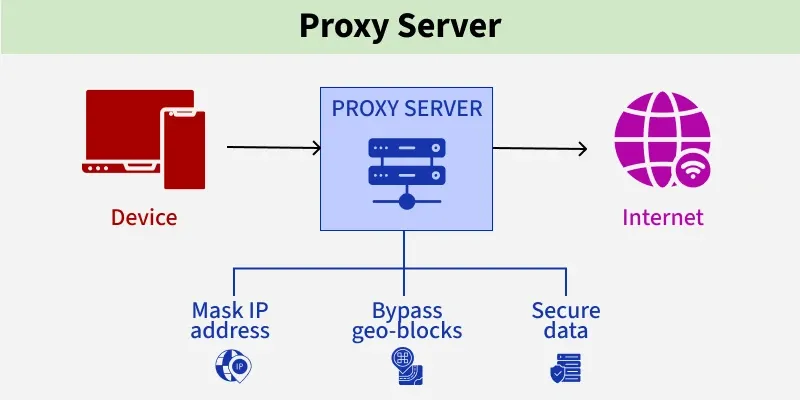
A proxy server is an intermediary that sits between your device and the internet, forwarding your requests through another server to improve privacy and control access. It helps mask your real identity while managing how traffic flows.
- Hides the user’s IP address from websites and external servers
- Filters and controls access to specific websites or content
- Can cache data to improve browsing speed and reduce bandwidth use
- Adds a layer of security by separating users from direct internet exposure
Example
Smartproxy has been offering unique solutions for online anonymity and web data.
- To prevent such misuse of data, proxy servers have been set up for collection since 2018.
- Has a 55M+ residential proxy pool that opens horizons for block-free web scraping and geo-targeting.
- Provide access to 195+ locations worldwide, including city-level and 50 US states targeting.
- You can check out Smartproxy's official website to uncover more of its unique features.
Uses
Mentioned below benefits make private proxies essential for enhancing security, privacy, and network control in both personal and use.
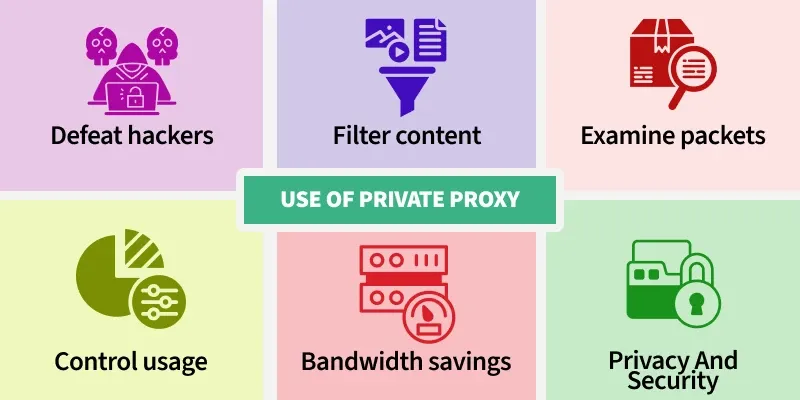
- **Defeat Hackers: To protect an organization's data from malicious use, passwords are used and different architects are set up, but still, there may be a possibility that this information can be hacked in case the IP address is accessible easily.
- **Filtering of Content: By caching the content of the websites, Proxy helps in fast access to the data that has been accessed very often.
- **Examine Packet Headers and Payloads: Payloads and packet headers of the requests made by the user nodes in the internal server to access social websites can be easily tracked and restricted.
- **To control internet usage of employees and children: In this, the Proxy server is used to control and monitor how their employees or kids use the internet. Organizations use it to deny access to specific websites.
- **Bandwidth savings and improved speeds: Proxy helps organizations to get better overall network performance with a good proxy server.
- **Privacy Benefits: Proxy servers are used to browse the internet more privately. It will change the IP address and identify the information the web request contains.
- **Security: Proxy server is used to encrypt your web requests to keep prying eyes from reading your transactions as it provides top-level security.
Types
Explore the different types of proxy servers—residential, datacenter, mobile, and more. Learn how each works, and ideal use cases for privacy, security, and data tasks.
1. Forward Proxy
Sits between users and the internet, hiding the client’s identity.
- Filters outgoing traffic
- Enhances user privacy
- Organizations use it to monitor employee traffic
2. Reverse Proxy
Sits in front of servers to hide and protect them.
- Load balances traffic
- Caches content to reduce server load
- Improves security and performance
3. Web Proxy
Handles only HTTP/HTTPS traffic.
- Processes URL-based requests
- Often used in browsers
- Examples: Apache, HAProxy
4. Anonymous Proxy
Provides partial anonymity, IP is hidden but proxy identity is detectable.
- Basic privacy
- Websites know you’re using a proxy
- Good for bypassing minor restrictions
5. High-Anonymity Proxy (Elite Proxy)
Hides both your IP and the fact you’re using a proxy.
- Best privacy protection
- Hard to detect
- Used for anonymous browsing
6. Transparent Proxy
Does not hide your IP; often used for caching.
- Users may not know it’s running
- Common in schools & offices
- No anonymity, only filtering
7. CGI Proxy
Accesses websites through a web form interface.
- Works without installing anything
- Slow and outdated
- Less private compared to VPNs
8. Suffix Proxy
Adds a suffix to URLs to bypass filters.
- Very easy to use
- Low anonymity
- Mainly for basic restrictions
9. Distorting Proxy
Sends a fake IP address to protect your real one.
- Maintains anonymity through false headers
- Used for bypassing region blocks
- More private than basic proxies
10. Tor Onion Proxy
Routes traffic through multiple encrypted layers for anonymity.
- Hard to track users
- Multi-layer encryption
- Free and open-source
11. I2P Anonymous Proxy
Routes traffic through a distributed encrypted network.
- Very strong anonymity
- Resistant to censorship
- Fully decentralized
12. DNS Proxy
Handles DNS requests on behalf of clients.
- Speeds up DNS responses with caching
- Can block harmful domains
- Used for content filtering
13. Rotating Proxy
Assigns a new IP address for every request or user.
- Best for web scraping
- Hard for websites to block
- Used widely in automation
Working
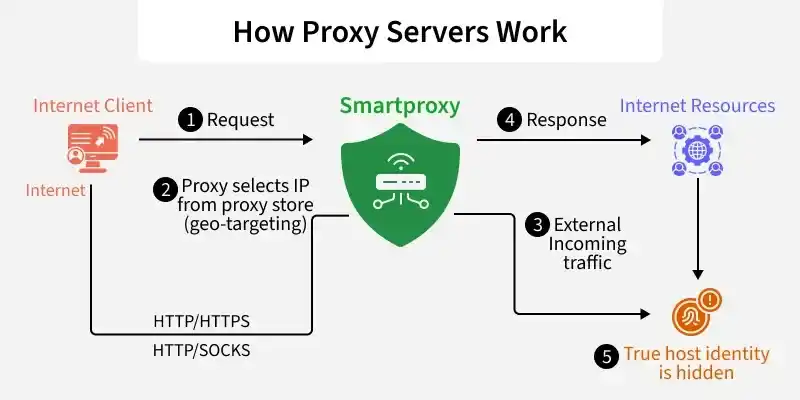
Proxy server processes requests between the client and the internet:
- User sends a request to access a website
- Request goes to the proxy server instead of directly to the internet
- Proxy forwards the request to the target server
- Server sends response back to the proxy
- Proxy checks security and forwards data to the user
**Note: Watch this video for a practical demonstration of proxy server operation.
Importance
There are reasons why everyone should proxy server because it provide following advantages including privacy, web scraping, fast speed, saves bandwidth etc.
- **Improves Your Privacy: Hides your IP address to keep your online activities anonymous.
- **Accesses Geo-restricted Content: Lets you access websites, videos, or services blocked in your region.
- **Enhances Online Security: Adds an extra layer of protection against hackers and malicious sites.
- **Blocks Unwanted Websites: Helps organizations/parents restrict access to harmful or distracting websites.
- **Enables Web Scraping: Allows large-scale data collection without exposing your real IP or getting blocked.
- **Improves SEO Monitoring & Research: Helps check location-based search results, rankings, and competitor data accurately.
- **Provides Faster Speed & Saves Bandwidth: Caches frequently visited sites, reduces load time, and saves network usage.