ServerSide Template Injection (original) (raw)
Server-Side Template Injection
Last Updated : 29 Apr, 2026
Server-Side Template Injection (SSTI) is a web security vulnerability where attackers inject malicious input into server-side templates, allowing unintended code execution on the server. It can lead to data exposure, system compromise, or full server control if not properly secured.
- Occurs on the server side, not in the user’s browser
- Can be more dangerous than XSS since it may execute system-level commands
- Exploits insecure handling of user input in template engines
- Can expose sensitive data or allow server takeover if exploited
Working of Server-Side Templates
Template engines combine static HTML with dynamic data to generate web pages. When an HTTP request arrives, the engine processes template files and injects dynamic content before sending the response to the client.
Template Engines in Web Development
- **Python: Jinja2, Mako, Tornado
- **Java: Freemarker, Velocity
- **PHP: Smarty, Twig
- **JavaScript: Pug, EJS, Handlebars
Template engines are designed for trusted template authors. Allowing untrusted users to create or modify templates creates severe security risks, as they can inject malicious code or access sensitive application variables.
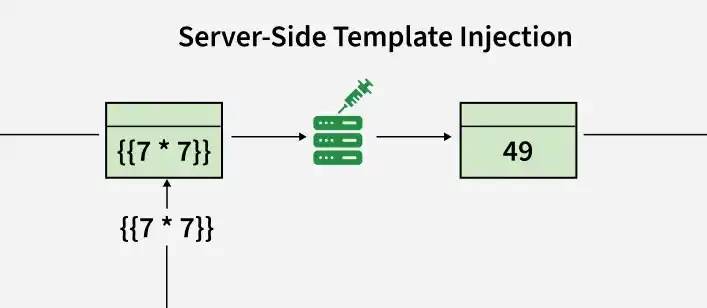
Working of SSTI (Server-Side Template Injection)
Server-Side Template Injection occurs when malicious input uses native template syntax to execute code on the server side.
- Template engines generate web pages by combining fixed templates with dynamic data.
- Vulnerability appears when user input is directly concatenated into templates instead of being passed as structured data.
- Attackers inject template commands that manipulate template engine behavior.
- Exploitation can lead to severe impact, including full control over server system.
**Example of Vulnerable Code:
Template = “UserName:” + Input
render(template)
- In the above example, the “Input” is a part of the template. Hence, a user can input either the username or some other parameter of a web app, like some arbitrary codes. Thus a user can input something like.
Username: {{9*9}}
Username 81
- As can be seen above, the SST engine processes the input {{9*9}} and gives 81 as the output. This demonstrates that the web app is vulnerable.
- And if the web app is found to be vulnerable, an attacker can even enter some malicious code to gain full remote access. For example,
About:{{Malicious Code()}}
Detection of SSTI
SSTI vulnerabilities can be identified using different testing approaches that focus on how template engines process user input.
1. Plain Text Detection Method
The Plain Text Detection Method is the most common starting point for identifying SSTI. It involves injecting simple template expressions into input fields and observing the server’s response. These expressions are designed to test whether the template engine evaluates mathematical or variable-based operations.
**Example payloads:
{{85}}, 7∗7,7/0,{77}, {{7/0}}, 7∗7,7/0,{foobar}, {{9*9}}
**Note: If the application evaluates these expressions or returns errors, it may indicate that user input is being processed by a template engine.
2. Code Context Detection Method
The Code Context Detection Method focuses on understanding how user input is embedded within the template structure and whether it is possible to break out of it.
**Example: consider a template where user input is inserted as follows
Greet_user = username
Hello user_x
- Here, the value of username is dynamically inserted into the output.
**Step 1: Observing baseline behavior
- If the application returns a normal response such as:
Hello user_x
- It indicates that the input is being rendered as expected within the template.
**Step 2: Testing for template disruption
- When a payload is injected and the response changes unexpectedly, such as:
Hello
- It may suggest that the template structure has been broken or the input is affecting template execution.
**Step 3: Breaking out of the template context
At this stage, the tester attempts to escape the template boundary and inject additional content.
**Example payload:
username = user_x}}
**Resulting output:
Hello user_x
**This indicates that:
- The original template context was successfully closed.
- The injected content was rendered in the response.
- The application may be vulnerable to SSTI.
Prevention Strategies
1. Use Sandboxed Environments
- Isolate template execution from critical system resources
- Use built-in sandboxing features where available
**Note: sandboxing alone is not fully secure and can sometimes be bypassed
2. Input Sanitization
- Never concatenate user input directly into templates.
- Pass user data as template parameters only.
- Validate and sanitize all input before processing.
- Use allowlists for permitted characters and patterns.
**Safe example:
template = "Hello {{name}}"
render(template, {"name": sanitized_input})
3. Implement Logic-less Templates
Reducing template complexity lowers the risk of exploitation.
- Use logic-less or minimal-logic template engines such as Mustache.
- Avoid engines that allow arbitrary expressions, loops, or function execution within templates.
- Limit template capabilities so they focus only on presentation, not computation.
4. Content Security Policy (CSP)
CSP does not prevent SSTI directly but helps limit its impact if exploitation occurs.
- Implement strict Content Security Policy headers
- Restrict script execution sources
- Block inline scripts
- Control external resource loading
- Use CSP as a secondary defense layer
5. Regular Security Audits and Testing
Ongoing security evaluation helps identify vulnerabilities early and regular audits ensure that new vulnerabilities are not introduced over time.
- Perform code reviews specifically focused on template usage and rendering logic.
- Use automated vulnerability scanners to detect SSTI risks in codebases.
- Conduct penetration testing on areas where templates handle dynamic input.
- Keep all template engines and dependencies updated with the latest security patches.
6. Developer Best Practices
Secure development habits are essential for long-term protection.
- Avoid user-generated templates entirely whenever possible
- Separate template logic from user input data
- Use parameterized rendering with proper encoding
- Follow the principle of least privilege
- Implement logging and monitoring for template rendering activities