What is Spread Spectrum? (original) (raw)
Last Updated : 23 Jul, 2025
Spread Spectrum is a wireless communication technology that distributes the transmitted signal across a larger bandwidth than the original signal. This approach improves communication security and dependability by increasing the signal's resistance to interference, eavesdropping, and jamming. In this article, we will discuss every point about Spread Spectrum and its types.
What is Spread Spectrum?
Spread spectrum is a method of transmitting radio signals over a wide range of frequencies. It spreads the signal over a broader bandwidth than the minimum required to send the information, which provides advantages such as increased resistance to interference, improved security, and enhanced privacy. The excerpt discusses the use of spread-spectrum techniques in communication to ensure secure transmission. This method uses air as a medium and extends bandwidth to create a protective envelope for signals, reducing the risk of interception or jamming. The 'spread code' is a patterned series of numbers that enlarges the original signal's bandwidth. This method is typically used in situations where secure transmission is crucial.
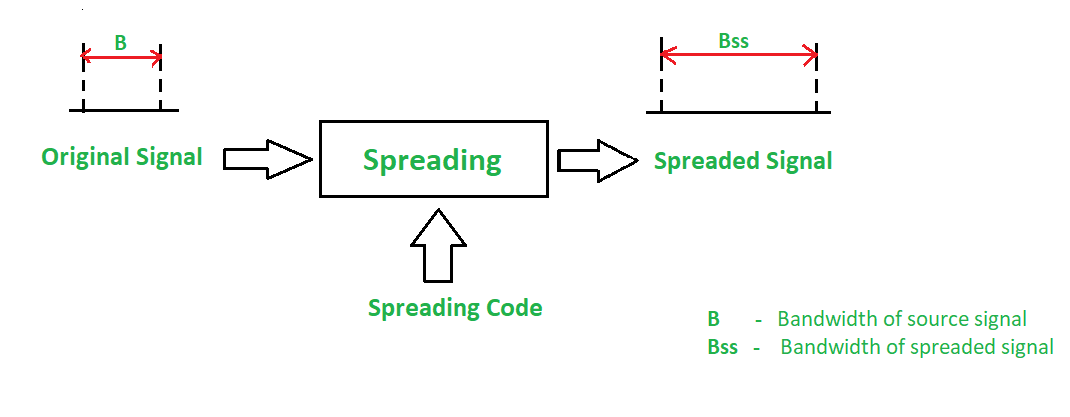
Spread Spectrum
**Principles of Spread Spectrum process
- To allow redundancy, it is necessary that the bandwidth allocated to each station should be much larger than needed.
- The spreading process occurs after the signal is created by the source.
**Conditions of Spread Spectrum are
- The spread spectrum is a type of modulation where modulated signal BW is much larger than the baseband signal BW i.e. spread spectrum is a wide band scheme.
- A special code (pseudo noise) is used for spectrum spreading and the same code is to be used to despread the signal at the receiver.
**Characteristics of Spread Spectrum
- Higher channel capacity.
- Ability to resist multipath propagation.
- They cannot easily intercept any unauthorized person.
- They are resistant to jamming.
- The spread spectrum provides immunity to distortion due to multipath propagation.
- The spread spectrum offers multiple access capabilities.
**Techniques used for Spread Spectrum
- Frequency Hopping Spread Spectrum (FHSS)
- Direct Sequence Spread Spectrum (DSSS)
Frequency Hopping Spread Spectrum (FHSS)
In Frequency Hopping Spread Spectrum (FHSS), different carrier frequencies are modulated by the source signal i.e. M carrier frequencies are modulated by the signal. At one moment signal modulates one carrier frequency and at the subsequent moments, it modulates other carrier frequencies. The general block diagram of FHSS is shown in the below figure.
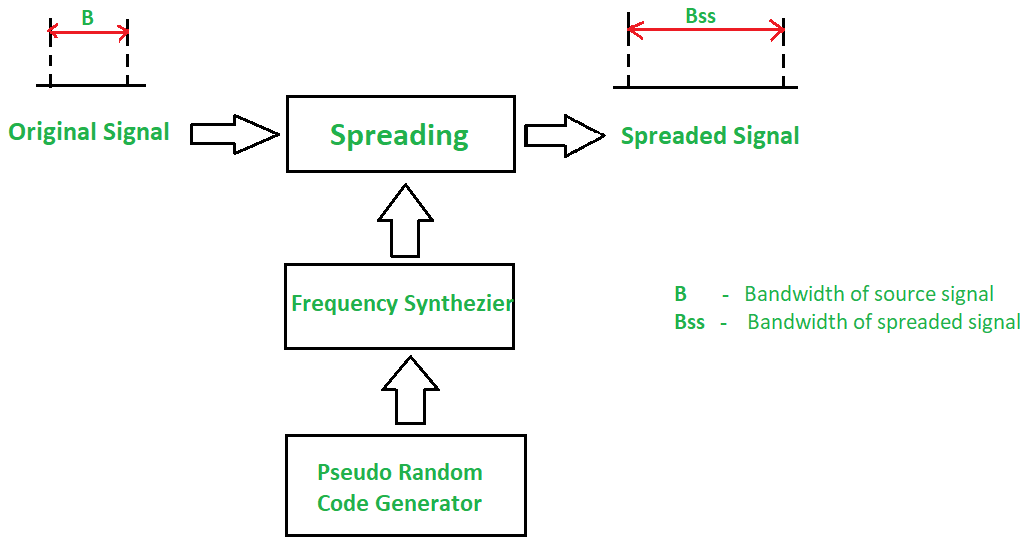
Frequency Hopping Spread Spectrum
A pseudorandom code generator generates Pseudo-random Noise of some pattern for each hopping period **T h. The frequency corresponding to the pattern is used for the hopping period and is passed to the frequency synthesizer. The synthesizer generates a carrier signal of that frequency. The figure above shows the spread signal via FHSS.
**Advantages of FHSS
- Synchronization is not greatly dependent on distance.
- Processing Gain is higher than DSSS.
**Disadvantages of FHSS
- The bandwidth of the FHSS system is too large (in GHz).
- Complex and expensive Digital frequency synthesizers are required.
Applications of FHSS
- FHSS is used in Bluetooth
- Military Communications
- Walkie-Talkies
- Wireless Local Area Networks (WLANs)
- Remote Controls
Direct Sequence Spread Spectrum (DSSS)
In Direct Sequence Spread Spectrum, the bandwidth of the original signal is also expanded by a different technique. Here, each data bit is replaced with n bits using a spreading code called **chips, and the bit rate of the chip is called as **chip-rate. The chip rate is n times the bit rate of the original signal. The below Figure shows the DSSS block diagram.
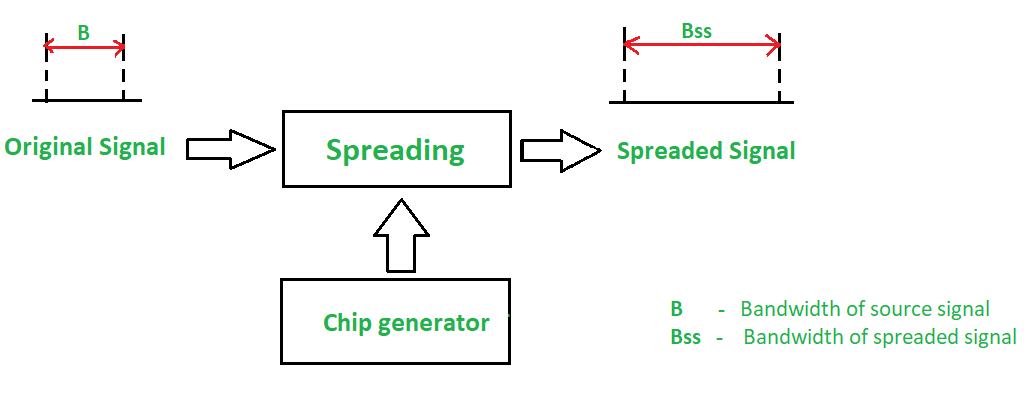
Direct Sequence Spread Spectrum
In wireless LAN, the sequence with n = 11 is used. The original data is multiplied by chips (spreading code) to get the spread signal. The required bandwidth of the spread signal is 11 times larger than the bandwidth of the original signal.
**Advantages of DSSS
- The DSSS System combats the jamming most effectively.
- The performance of DSSS in presence of noise is superior to FHSS.
- Interference is minimized against the signals.
**Disadvantages of DSSS
- Processing Gain is lower than FHSS.
- Channel Bandwidth is less than FHSS.
- Synchronization is affected by the variable distance between the transmitter and receiver.
Applications of DSSS
- GPS (Global Positioning System)
- CDMA (Code Division Multiple Access) Cellular Networks
- Satellite Communication
- Wireless Sensor Networks
Conclusion
Spread Spectrum is a wireless communication technology that distributes the transmitted signal across a larger bandwidth than the original signal. Frequency-hopping spread spectrum (FHSS) and Direct sequence spread spectrum (DSSS) are both types of spread spectrum techniques that are used in a variety of applications, including wireless communication, radar, and GPS. FHSS involves rapid frequency switching of the transmitted signal among a set of specific frequencies, while DSSS involves spreading the spectrum of the original signal over a wider bandwidth by multiplying it with a pseudo-random sequence of bits.