Loosely Coupled vs Tightly Coupled Multiprocessor System (original) (raw)
Last Updated : 23 Mar, 2026
A multiprocessor is a computer system with two or more processors that work together to execute tasks within the same system.
- It includes multiple CPUs within a single computer and supports parallel execution.
- It improves overall processing capability and increases system efficiency and performance.
Tightly Coupled Multiprocessor System
It is a shared-memory architecture in which multiple processors are connected to a common main memory and operate under a single operating system.
- Communication is done through shared memory.
- Cache coherence mechanisms are required to maintain data consistency.
- All processors access the same global memory and are managed by a single operating system.
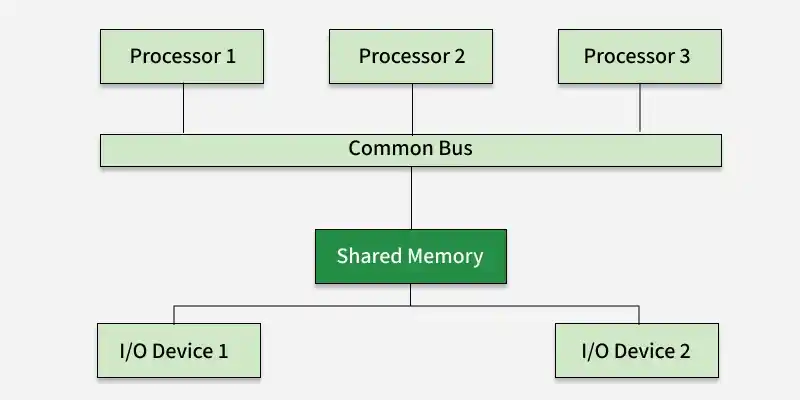
Tightly Coupled Multiprocessor System
Advantages
- Due to shared memory communication between processes is very fast.
- As all processes have the same memory space, data sharing is easy.
- Suitable for parallel applications that require frequent interaction.
- Programming is simplified as no message passing is required.
Disadvantages
- Limited scalability as adding more processors increases memory traffic.
- Multiple processors access shared memory simultaneously, and memory contention occurs.
- Maintaining data consistency is difficult and requires complex cache coherence.
- Implementation of hardware is more complex and expensive.
Working Mechanism
Practically, this works like a modern multi-core computer.
- When a program runs, the operating system divides it into threads.
- These threads are assigned to different processors (or cores).
- All processors access the same RAM to read and write data.
- If Processor 1 updates a variable in memory, Processor 2 can directly access the updated value.
- To avoid conflicts, synchronization techniques (like mutex, semaphore, locks) are used.
- Cache coherence protocols ensure that all processor caches have consistent data.
**Example: In a multi-core desktop CPU, when you run a large software like a video editor, different cores process different parts of the task (rendering, effects, background tasks) while using the same system memory.
Loosely Coupled Multiprocessor System
It is a distributed-memory architecture in which each processor has its own local memory and communicates with other processors through message passing.
- Each processor has its own private memory.
- Processors communicate through a network connection.
- Separate operating systems can run on different processors.
- The system can be expanded by adding more processors.
- The failure of one processor does not affect the entire system.
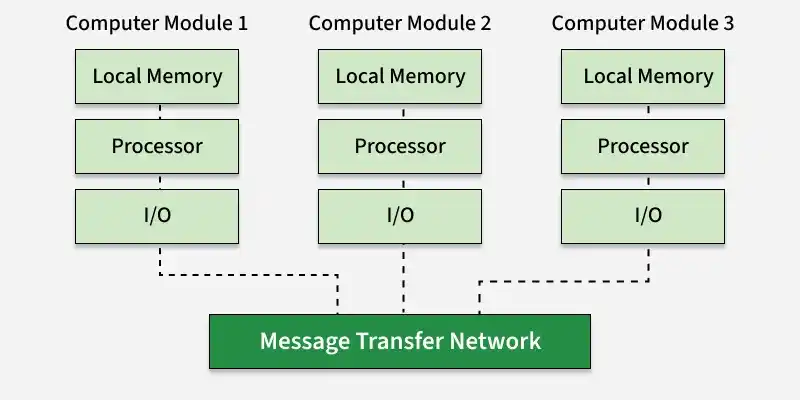
Loosely Coupled Multiprocessor System
Advantages
- As new needs are added easily, it is highly scalable.
- The failure of one node doesn't affect the system, providing fault tolerance.
- Better for distributed and large-scale computing environments.
- Cost-effective because it can be built using independent systems connected through a network.
Disadvantages
- Communication between processors is slower due to network-based message passing.
- Programming is more complex because explicit message passing is required.
- Synchronization and coordination between processors is difficult.
- Sharing of data is not as efficient as a shared memory system.
Working Mechanism
These systems are connected through a communication network.
- Each processor executes its own task using its private memory.
- If one processor needs data from another, it sends a message request over the network.
- The receiving processor processes the request and sends back a response.
- Data sharing does not happen automatically — it must be explicitly communicated.
- Since there is no shared memory, synchronization is handled through communication protocols.
**Example: In a computer cluster (like servers in a data center), each server processes part of a large job (e.g., searching billions of web pages). If needed, servers exchange results over the network instead of accessing the same memory.
Tightly Coupled vs Loosely Coupled Multiprocessor Systems
| **Tightly Coupled System | **Loosely Coupled System |
|---|---|
| All processors share a common main memory. | Each processor has its own local memory. |
| The system is managed by a single operating system. | Each processor can run its own operating system. |
| Communication occurs through shared memory. | Communication occurs through message passing over a network. |
| Communication speed is faster due to direct memory access. | Communication speed is slower because it depends on the network. |
| Scalability is limited because adding processors increases memory contention. | Scalability is high because new processors can be added easily. |
| Fault tolerance is lower because a failure can affect the entire system. | Fault tolerance is higher because the failure of one node does not stop others. |
| The system is generally more expensive due to complex shared-memory hardware. | The system is relatively cheaper because it can be built using separate systems. |