Introduction of Embedded Systems | Set1 (original) (raw)
Last Updated : 15 Jul, 2025
Before going to the overview of Embedded Systems, Let's first know the two basic things i.e., embedded and system, and what actually do they mean.
**System is a set of interrelated parts/components which are designed/developed to perform common tasks or to do some specific work for which it has been created.
Embedded means including something with anything for a reason. Or simply we can say something which is integrated or attached to another thing. Now after getting what actual systems and embedded mean we can easily understand what are Embedded Systems.
What is Embedded System?
Embedded system is a computational system that is developed based on an integration of both hardware and software in order to perform a given task. It can be said as a dedicated computer system has been developed for some particular reason. But it is not our traditional computer system or general-purpose computers, these are the Embedded systems that may work independently or attached to a larger system to work on a few specific functions. These embedded systems can work without human intervention or with little human intervention.
**Components of Embedded Systems
**1. Hardware **2. Software **3. Firmware
Examples of Embedded Systems
- Digital watches
- Washing Machine
- Toys
- Televisions
- Digital phones
- Laser Printer
- Cameras
- Industrial machines
- Electronic Calculators
- Automobiles
- Medical Equipment
Application of Embedded System
- Home appliances
- Transportation
- Health care
- Business sector & offices
- Defense sector
- Aerospace
- Agricultural Sector
Characteristics of an Embedded System
- **Performs specific task: Embedded systems perform some specific function or tasks.
- **Low Cost: The price of an embedded system is not so expensive.
- **Time Specific: It performs the tasks within a certain time frame.
- **Low Power: Embedded Systems don't require much power to operate.
- **High Efficiency: The efficiency level of embedded systems is so high.
- **Minimal User interface: These systems require less user interface and are easy to use.
- **Less Human intervention: Embedded systems require no human intervention or very less human intervention.
- **Highly Stable: Embedded systems do not change frequently mostly fixed maintaining stability.
- **High Reliability: Embedded systems are reliable they perform tasks consistently well.
- **Use microprocessors or microcontrollers: Embedded systems use microprocessors or microcontrollers to design and use limited memory.
- **Manufacturable: The majority of embedded systems are compact and affordable to manufacture. They are based on the size and low complexity of the hardware.
Block Structure of Embedded System
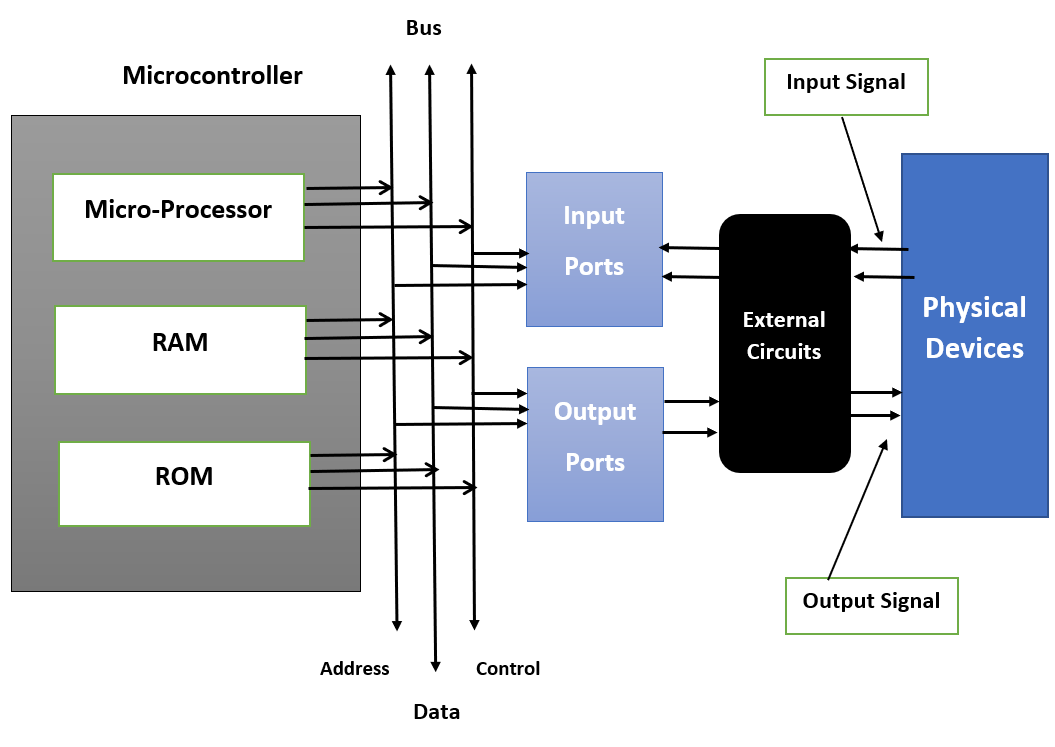
Embedded System
Advantages of Embedded System
- Small size.
- Enhanced real-time performance.
- Easily customizable for a specific application.
Disadvantages of Embedded System
- High development cost.
- Time-consuming design process.
- As it is application-specific less market available.
**Top Embedded Programming Languages: Some of the programming languages used in the development of embedded systems include, Embedded C, Embedded C + +, Embedded Java, Embedded Python etc. But it completely rests on the developer which programming language he selects for the development of the embedded systems.
How does an Embedded System Work?
Embedded systems operate from the combination of hardware and software that focuses on certain operations. An embedded system at its heart has microcontroller or microprocessor hardware on which user writes the code in form of software for control of the system. Here is how it generally works:
- **Hardware Layer: Some of the hardware elements that are incorporated in an embedded system include the sensor, actuator, memory, current I/O interfaces as well as power supply. These components are interfaced with the micro controller or micro processor depending up on the input signals accepted.
- **Input/Output (I/O) Interfaces: They to give the system input in form of data from sensors or inputs made by the users and the microcontroller processes the data received. The processed data is then utilized to coordinate the output devices such as displays, motors or communication modules.
- **Firmware: Firmware which is integrated within a system’s hardware comprises of certain instructions to accomplish a task. Such software is often used for real time processing and is tuned to work in the most optimal manner on the system hardware.
- **Processing: Depending on the given software and the input data received from the system’s inputs the microcontroller calculates the appropriate output or response and manages the system’s components.
- **Real-time Operation: Some of the most common systems are real time, this implies that they have the ability to process events or inputs at given time. This real time capability makes sure that the system accomplishes its intended function within stated time demands.
For instance therein an embedded system in a washing machine, the microcontroller would interface with the buttons (selections made by a user), sensors, for instance water levels, temperature and timers; it would control outputs such as motors, heaters and displays among others based on the program intended for washing cycles.
Conclusion
Therefore, the importance of embedded system in modern technology cannot be underestimated because the provide dedicated and reliable system that are efficient for specific use. This is evident from their applications in home use items such as refrigerators, bio-medical applications, and industrial applications where they offer an additional advantage to improving functionality of the many systems. Embedded systems are very important in our lives since they offer automation, enhanced performance and accuracy in our daily lives. Despite the mentioned restrictions like high development costs, and application specific solutions, the advantages clearly outweigh the mentioned drawbacks making the FPGA devices a crucial element of the present day world.
Write components of an embedded system?
The main components of an embedded system are hardware, software, and firmware. These work together to perform a specific function or set of tasks.
What is the difference between a microcontroller and a microprocessor in embedded systems?
It can be defined as an independent and self-contained programmable control device for an operation of an embedded system, which consists of a microprocessor, RAM, ROM and ports. On the other hand a microprocessor has only a CPU and all the other memory movements and Input/Output functions are handled in other separate components.
What programming languages are used in embedded systems?
Other languages used in the development of the embedded systems are the Embedded C, Embedded C++, Embedded Java and Embedded Python. As for the language that will be used in the construction of the system the following should be taken into consideration, Complexity of the system, Performance that is required from the system and personal preference of the developer.