Locality of Reference (original) (raw)
Last Updated : 30 Oct, 2025
CPU performance is limited by slower main memory access. Cache memory improves speed by storing frequently used data and instructions. Its efficiency relies on the Locality of Reference principle.
- **Locality of Reference means programs often reuse the same data or nearby instructions rather than accessing random memory locations.
- It helps cache memory predict which information will be needed next.
- This reduces the average memory access time and increases overall CPU efficiency.
- The concept is the foundation of cache memory design and operation.
- Programs that exhibit strong locality utilize cache memory more effectively, resulting in higher hit ratios and fewer cache misses.
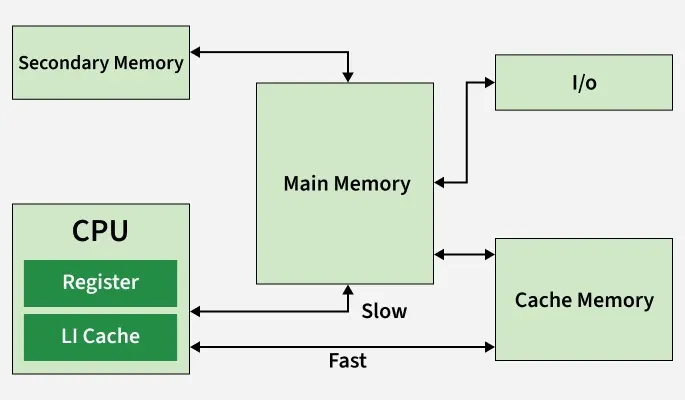
Cache Memory
Formal Definition
Locality of reference is the property of a program that describes how memory references are grouped together in time and space during execution.
Types of Locality of Reference
There are mainly two types of locality of reference:
**Temporal Locality (Locality in Time)
Temporal locality states that if a particular memory location (data or instruction) is accessed at one time, it is likely to be accessed again in the near future.
- Programs often contain loops, counters, and frequently used variables.
- Since these are used repeatedly within short intervals, storing them in cache memory ensures faster access.

Temporal Caching
**Example:
for (int i = 0; i < 100; i++) { sum = sum + a[i]; }
- The variable
i,sum, and elements of the arraya[i]are accessed repeatedly.- Storing these in the cache helps avoid multiple main memory accesses.
**Cache Operation Based on Temporal Locality:
When a CPU fetches a data item from main memory, it also keeps a copy in the cache, assuming it will be needed soon. If that assumption is correct, subsequent accesses result in a cache hit.
Spatial Locality (Locality in Space)
Spatial locality states that if a particular memory location is accessed, the nearby memory locations are also likely to be accessed soon. Instructions and data are stored in contiguous memory locations.
- When a program accesses one location, the next few instructions or data items are often located adjacent to it.
- Hence, caching nearby blocks of memory improves performance.
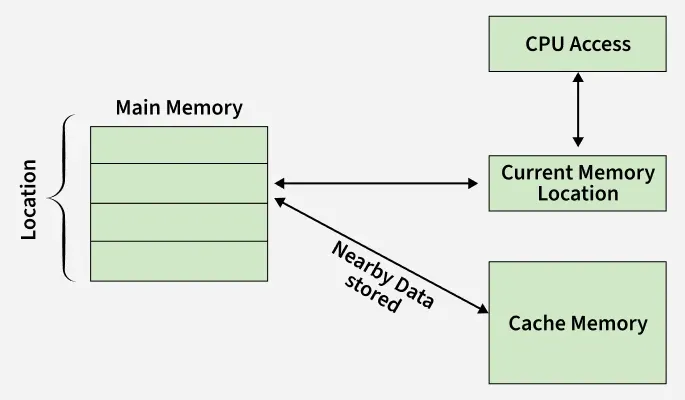
Spatial Caching
**Example:
for (int i = 0; i < 10; i++) { printf("%d", arr[i]); }
- Here, consecutive elements of the array
arr[i]are accessed.- Once
arr[0]is fetched, the CPU is likely to accessarr[1],arr[2], etc., which are stored in nearby memory locations.
**Cache Operation Based on Spatial Locality:
Cache memory utilizes block fetching. When one word of a block is accessed, the entire block (containing nearby addresses) is loaded into cache, anticipating future accesses.
Mathematical Representation of Average Memory Access Time (AMAT)
The performance of a cache memory system is often evaluated using the **Average Memory Access Time (AMAT). It represents the average time required by the CPU to access data or instructions, considering both cache hits and cache misses.
Let:
- **T c = Time to access cache memory
- **T m = Time to access main memory
- **h = Cache hit ratio (the probability that the required data is found in the cache)
Then, the average memory access time can be expressed as:
Average Memory Access Time (AMAT)= h × Tc + (1−h) × Tm
Here,
- The term (h × Tc) represents the time contribution from cache hits.
- The term (1 − h) × Tm represents the time contribution from cache misses, where data must be fetched from main memory.
A higher hit ratio (h) indicates better cache utilization and stronger locality of reference, resulting in lower AMAT and improved overall system performance.