NonRestoring Division For Unsigned Integer (original) (raw)
Non-Restoring Division For Unsigned Integer
Last Updated : 4 Apr, 2026
The non-restoring division algorithm is a faster method to divide binary numbers. Unlike traditional division, it avoids repeatedly adding back the divisor, making it more efficient for computers to perform.
- It uses repeated subtraction and addition to find the quotient bits.
- If subtraction gives a negative result, the algorithm just adds in the next step instead of fixing it.
**Flow Chart of Non-Restoring Division For Unsigned Integer
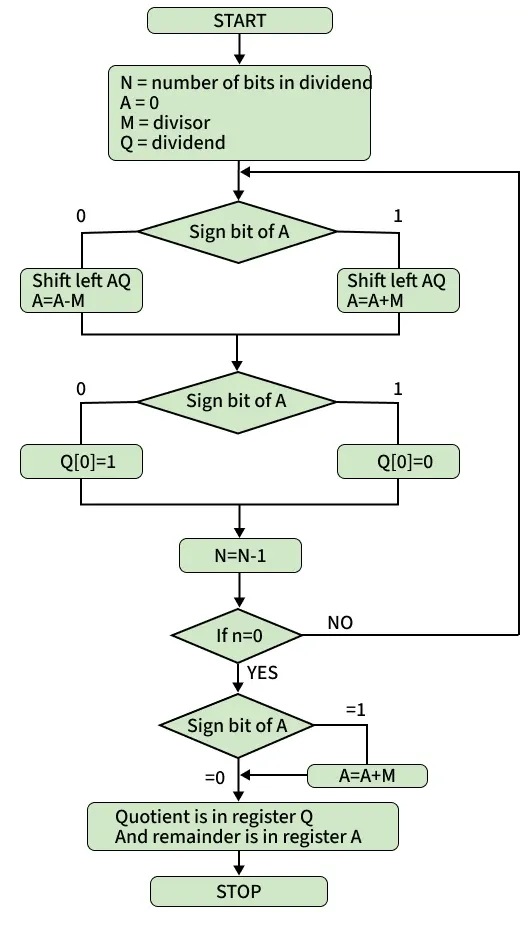
Steps Involved in the Non-Restoring Division Algorithm
Step-1: First, the registers are initialized with corresponding values (Q = Dividend, M = Divisor, A = 0, n = number of bits in dividend)
Step-2: Shift left the contents of (A, Q) as a combined register
Step-3: Check the sign bit of register A
- If the sign bit is 0, perform A = A − M
- If the sign bit is 1, perform A = A + M
Step-4: Check the sign bit of register A again
Step-5: If the sign bit is 0, set Q[0] = 1; otherwise, set Q[0] = 0 (Q[0] is the least significant bit of register Q)
Step-6: Decrement the value of n by 1
Step-7: If n is not equal to zero, go to Step-2; otherwise, proceed to the next step
Step-8: If the sign bit of A is 1, perform A = A + M
Step-9: Register Q contains the quotient and register A contains the remainder
Example
Let’s divide the binary number 1011 (which is 11 in decimal) by 0011 (which is 3 in decimal) using the Non-Restoring Division Algorithm.
**Initialization:
- Dividend (Q) = 1011
- Divisor (M) = 0011
- Accumulator (A) = 0000
- Number of bits (n) = 4
**Step-by-Step Solution
**1. Initial Setup:
- Q = 1011
- M = 0011
- A = 0000
- n = 4
**2. First Iteration:
- Shift Left AQ: A = 0000, Q = 1011 becomes A = 0000, Q = 0110
- Perform Operation: A = A - M = 0000 - 0011 = 1101 (2's complement of 0011)
- Sign Bit of A: 1
- Update Q[0]: 0
- Decrement N: N = 3
**3. Second Iteration:
- Shift Left AQ: A = 1101, Q = 0110 becomes A = 1010, Q = 1100
- Perform Operation (Since previous A < 0) : A = A + M = 1010 + 0011 = 1101
- Sign Bit of A: 1
- Update Q[0]: 0
- Decrement N: N = 2
**4. Third Iteration:
- Shift Left AQ: A = 1101, Q = 1100 becomes A = 1011, Q = 1000
- Perform Operation: A = A - M = 1011 - 0011 = 1000 (2's complement of 0011)
- Sign Bit of A: 1
- Update Q[0]: 0
- Decrement N: N = 1
**5. Fourth Iteration:
- Shift Left AQ: A = 1000, Q = 1000 becomes A = 0001, Q = 0000
- Perform Operation: A = A + M = 0001 + 0011 = 0010
- Sign Bit of A: 0
- Update Q[0]: 1
- Decrement N: N = 0
**6. Final Adjustment:
If the sign bit of A is 1 (A < 0), perform A = A + M; otherwise, no adjustment is required.
- Quotient (Q) = 0011 (3 in decimal)
- Remainder (A) = 0010 (2 in decimal)