Classification of Computers (original) (raw)
Last Updated : 16 Jul, 2025
Computers come in a wide variety of forms and serve countless purposes. They can range from tiny embedded systems to massive supercomputers, each designed to perform specific tasks. By organizing them based on factors such as size, function, and intended use, we can better understand the unique roles they play in our daily lives and industries.
The **computer systems can be classified on the following basis:
Table of Content
Here is detailed information about the Classification of computers:
1. Based on Size
Computers vary in size, from powerful supercomputers for complex tasks to embedded systems built for specific functions in everyday devices. Each type is designed to meet different performance needs and applications.
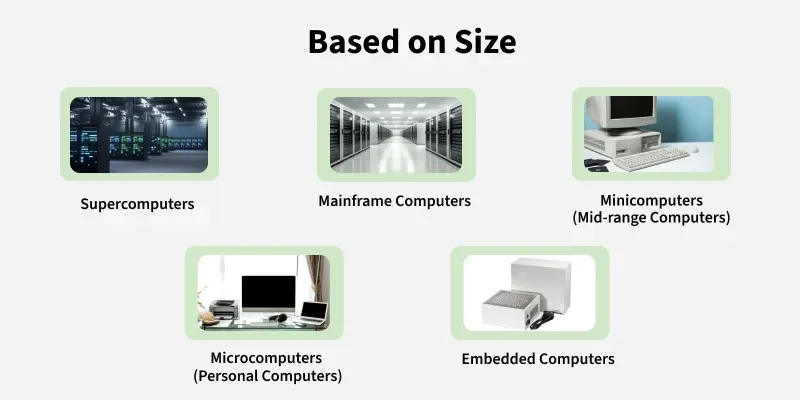
Based on Size
**a. Supercomputers
Supercomputers are the most powerful computers in terms of processing power. They are used for extremely complex computations and tasks that require massive data processing capabilities, such as scientific simulations, weather forecasting, and modelling natural phenomena.
**Characteristics:
- High-performance processors and memory systems.
- Can perform billions or even trillions of calculations per second.
- Costly and require special environments (e.g., controlled cooling systems).
**Examples:
- IBM Blue Gene
- Cray XT5
**b. Mainframe Computers
Mainframes are large and powerful computers designed to handle and process vast amounts of data quickly. They are used by large organizations like banks, insurance companies, and government institutions for tasks such as transaction processing, large-scale enterprise applications, and database management.
**Characteristics:
- Can support thousands of users simultaneously.
- Known for reliability, scalability, and processing large volumes of data.
- Operate in environments that require high security and uptime.
**Examples:
- **IBM Z Series
- **Unisys ClearPath
c****. Minicomputers (Mid-range Computers)**
Minicomputers, also known as mid-range computers, are smaller than mainframes but still capable of supporting multiple users and handling medium-scale tasks. They are typically used for smaller businesses or industrial applications that require fewer resources than mainframes.
**Characteristics:
- Less powerful than mainframes but still capable of running several programs simultaneously.
- Used in manufacturing control, research labs, and medium-sized organizations.
- Can support up to hundreds of users at once.
**Examples:
- DEC VAX
- Digital Equipment Corporation (DEC)
**d. Microcomputers (Personal Computers)
Microcomputers are the most common type of computers used by individuals. They are designed for general-purpose tasks such as browsing the internet, word processing, gaming, and other personal or office activities. Microcomputers are based on a microprocessor, which integrates the functions of a computer's central processing unit (CPU) on a single chip.
**Characteristics:
- Typically smaller, affordable, and user-friendly.
- Found in homes, schools, and offices.
- Includes desktops, laptops, tablets, and smartphones.
**Examples:
- **Desktop PCs
- **Laptops
- **Tablets
- **Smartphones
**e. Embedded Computers
Description: Embedded computers are specialized computers that are designed to perform specific tasks and are often built into other devices. These computers are not typically seen as separate units but are an integral part of everyday objects, from household appliances to industrial machines.
**Characteristics:
- Focused on specific functions, with minimal user interaction.
- Often run on low power and have limited resources.
- Commonly used in devices that require real-time processing.
**Examples:
- Smart TVs
- Washing Machines
- Car Control Systems
- Microwave Ovens
2. Based on Functionality
Computers are classified by functionality into analog, digital, and hybrid types. Analog handles continuous data, digital processes binary data, and hybrid combines both methods.
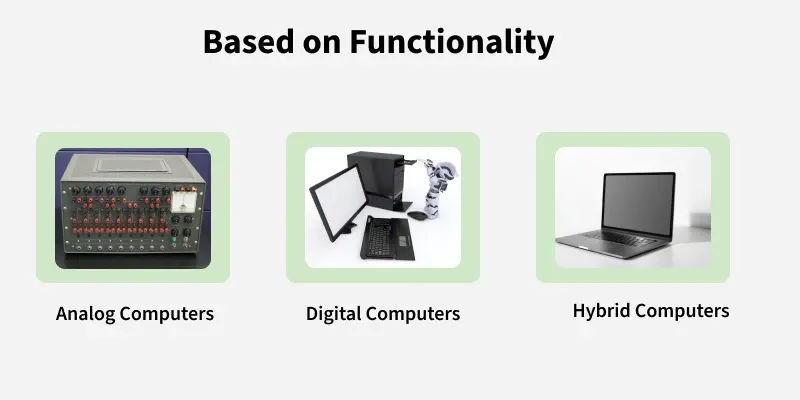
Based on Functionality
**a. Analog Computers
Analog computers are designed to process continuous data. Instead of using digital numbers (0s and 1s), these computers use physical quantities, such as voltage or current, to represent data. Analog computers are especially good at simulating real-world phenomena that vary continuously, like temperature, speed, or pressure.
**Characteristics:
- Process continuous data (e.g., temperature, pressure).
- Used for tasks that require real-time simulations.
- Often used in scientific research, engineering, and control systems.
**Examples:
- **Speedometers: Measure the speed of a vehicle using continuous data.
- **Thermometers: Measure temperature changes.
- **Radar Systems: Measure distance by sending out continuous waves and processing reflected signals.
**b. Digital Computers
Digital computers process data in binary form (0s and 1s). They are the most common type of computer and are capable of performing a wide range of tasks, from simple calculations to complex simulations. Digital computers are versatile, reliable, and can handle large volumes of data quickly.
**Characteristics:
- Process discrete data in binary format.
- Capable of performing arithmetic and logical operations.
- Used in personal computers, servers, and smartphones.
**Examples:
- **Personal Computers (PCs): Laptops, and desktops used for general tasks.
- **Smartphones: Mobile devices for communication and entertainment.
- **Servers: High-performance systems that manage data and resources for multiple users.
**c. Hybrid Computers
Hybrid computers combine features of both analog and digital computers. They can process both continuous (analog) and discrete (digital) data. Hybrid systems are designed to take advantage of the strengths of both types of computers, making them highly useful in specific applications where both types of data need to be processed simultaneously.
**Characteristics:
- Combine the real-time processing capabilities of analog systems with the precision and versatility of digital systems.
- Used in specialized applications that require both types of data.
**Examples:
- **Hospitals: Patient monitoring systems that measure heart rate (analog) and store data digitally.
- **Scientific Research: Systems that simulate complex phenomena and process both continuous data (like temperature) and discrete data (like test results).
- **Industrial Systems: Systems controlling factory machines where both analog sensors (e.g., temperature) and digital control systems are used.
3. Based on Purpose
Computers are classified by purpose into general-purpose and special-purpose types. General-purpose computers can perform a wide range of tasks, while special-purpose computers are designed for specific functions.
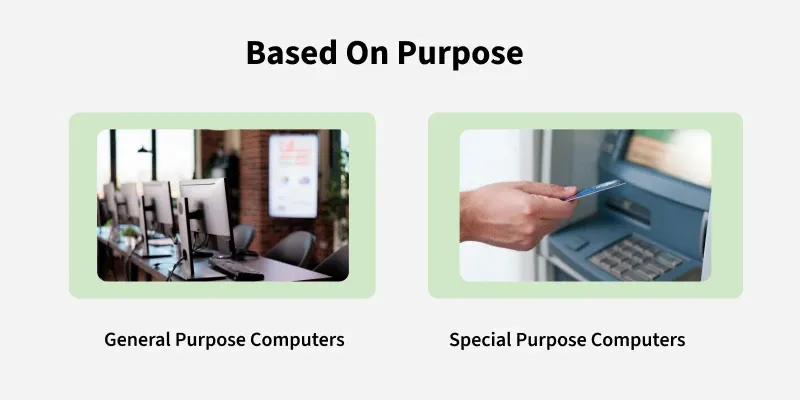
Based on Purpose
**a. General-Purpose Computers
General-purpose computers are designed to handle a wide variety of tasks. They can be programmed to perform a range of functions, from simple calculations to complex tasks. These computers are flexible and can run many different types of software, making them suitable for personal, educational, business, and entertainment use.
**Characteristics:
- Can perform multiple tasks and be used for a variety of purposes.
- Capable of running many types of software applications.
- Users can install or update software as needed.
- Typically include personal computers, laptops, and workstations.
**Examples:
- **Personal Computers (PCs): These are the most common general-purpose computers used for activities such as word processing, web browsing, and gaming.
- **Laptops: Portable computers used for general-purpose tasks.
- **Workstations: High-performance computers designed for technical and scientific work, often used for tasks like video editing, 3D design, and software development.
**b. Special-Purpose Computers
Special-purpose computers are designed and optimized to perform a specific task or set of tasks. Unlike general-purpose computers, they cannot be reprogrammed for other uses. These computers are typically more efficient than general-purpose computers for the specific function they are designed for. They are found in a wide range of devices and industries, from household appliances to industrial machinery.
**Characteristics:
- Designed to perform a specific, limited set of functions.
- Usually do not require user interaction beyond the task they are built for.
- Often optimized for speed and efficiency in their specific domain.
- Can be embedded within devices or machines for dedicated control.
**Examples:
- **Gaming Consoles: Devices like the PlayStation or Xbox, which are designed specifically for playing video games.
- **Calculators: Electronic devices designed to perform arithmetic calculations.
- **Traffic Signal Controllers: Specialized systems are used to manage the flow of traffic at intersections.
- **ATM Machines: These are computers dedicated to banking transactions and cannot be used for other tasks.
- **Microwave Ovens: Embedded systems in appliances that perform specific tasks like cooking food by controlling the temperature and time.
4. Based on Performance
Computers are classified by performance into workstations and servers. Workstations handle demanding tasks, while servers manage resources and data for multiple users.
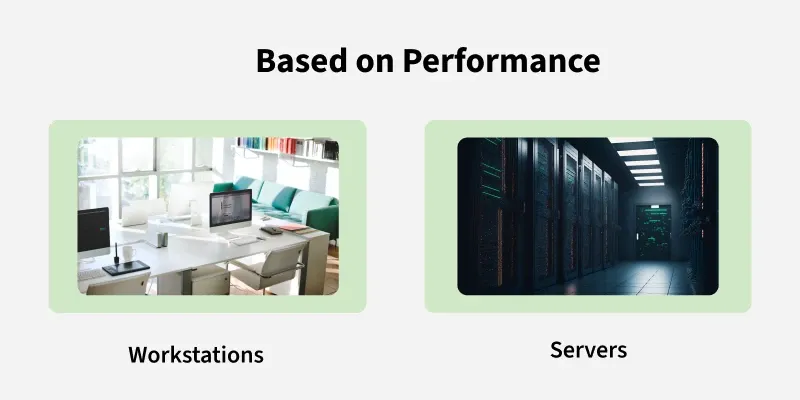
Based on Performance
**a. Workstations
Workstations are high-performance computers designed for technical, scientific, or professional applications that require greater processing power than regular personal computers (PCs). Workstations are typically used for tasks such as 3D graphics rendering, video editing, computer-aided design (CAD), and scientific simulations. They offer more powerful processors, higher RAM capacities, and advanced graphics capabilities compared to regular personal computers.
**Characteristics:
- High-performance processors (often multi-core or multi-threaded).
- Large amounts of memory (RAM), often expandable.
- Enhanced graphics processing units (GPUs) for rendering high-resolution images and video.
- Reliable and capable of running demanding software applications simultaneously.
- Often used by engineers, designers, architects, and scientists for complex tasks.
**Examples:
- **Computer-Aided Design (CAD) Workstations: Used by engineers and architects to design 2D and 3D models.
- **Video Editing Workstations: High-performance systems used by filmmakers and content creators for editing large video files.
- **Scientific Research Workstations: Used in research labs for simulations, data analysis, and modelling.
b****. Servers**
Servers are specialized computers designed to manage, store, and provide resources or services to other computers (clients) over a network. They are built to handle large amounts of data, provide access to websites, store files, and manage network communications. Servers are critical in business and enterprise environments where multiple users need to access shared data and resources simultaneously.
**Characteristics:
- High processing power to handle multiple requests and manage extensive data.
- Increased storage capacity, often with redundancies (e.g., RAID configurations) for data protection.
- Built for high availability and reliability, often operating 24/7 without interruption.
- Scalable to accommodate growing data and user needs.
- Provide services such as web hosting, file sharing, database management, and email hosting.
**Examples:
- **Web Servers: These servers host websites and deliver web pages to users' browsers. Examples include Apache HTTP Server and Nginx.
- **Database Servers: Servers dedicated to storing and managing databases, like MySQL and Microsoft SQL Server.
- **File Servers: Provide centralized storage and management of files for multiple users in an organization.
- **Mail Servers: Handle the sending, receiving, and storage of email for users across a network.
5. Based on Data Handling
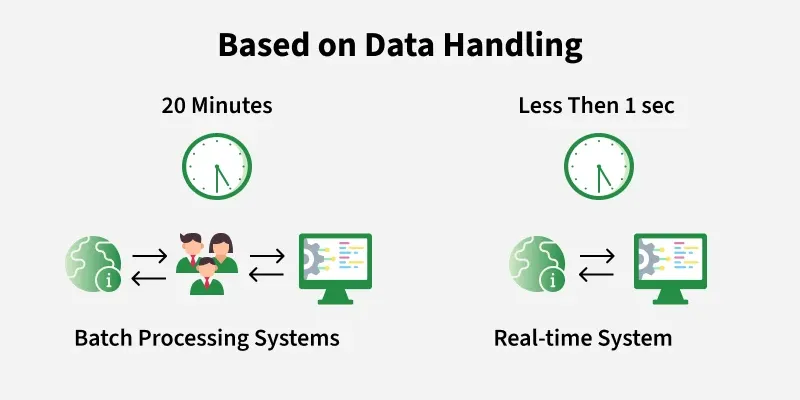
Computers are classified by data handling into batch processing and real-time systems. Batch processing handles large data sets at scheduled times, while real-time systems process data instantly as it's received.
Based on Data Handling
**a. Batch Processing Systems
In batch processing systems, data is collected, grouped, and processed all at once in large batches without any immediate interaction from users. The data is processed sequentially and typically in a pre-determined order, with no need for real-time input. Batch processing is suitable for handling large volumes of data that do not require immediate action or response.
**Characteristics:
- **No User Interaction: Once the data is input into the system, no user interaction is needed until the batch processing is complete.
- **Scheduled Processing: The data is processed in scheduled intervals (e.g., daily, weekly).
- **Efficient for Large Volumes: Ideal for applications where large volumes of data can be processed at once without immediate feedback.
- **Batch Jobs: Processing is done in a single block or series of tasks, often requiring minimal user supervision.
**Examples:
- **Payroll Systems: Employee data (e.g., hours worked, pay rates) is collected over a period (like a week or month) and processed in a batch at the end of the pay cycle.
- **Banking Systems: End-of-day processing of bank transactions (e.g., balance updates, and account reconciliations) is often done in batch mode.
- **Billing Systems: Electric, water, and gas companies often process usage data for customers in batches (e.g., monthly billing cycles).
- **Inventory Management: Large retail chains may process stock data in batches, updating inventory records at the end of each day or week.
**b. Real-Time Systems
Real-time systems process data immediately or within a very short timeframe as it is received, providing instant results or feedback. These systems are critical for applications where delays could lead to issues like safety concerns, business disruptions, or operational failure. Real-time systems are designed to provide responses within a specific time frame (known as a deadline).
**Characteristics:
- **Immediate Processing: Data is processed as it is received, with minimal delays.
- **Time-sensitive: Real-time systems must meet strict timing constraints to function correctly.
- **Continuous Monitoring: They often involve continuous monitoring of inputs and immediate decision-making.
- **Predictability: The system must guarantee that it can process data within a specific time frame (hard real-time) or with minimal delay (soft real-time).
**Examples:
- **Air Traffic Control Systems: Real-time data is crucial for tracking aircraft positions and controlling air traffic safely.
- **Industrial Automation Systems: Systems that control factory machinery or robots must operate in real time to ensure smooth, safe operations.
- **Medical Monitoring Systems: Devices such as heart rate monitors or ventilators must react instantly to changes in a patient’s condition.
- **Autonomous Vehicles: Self-driving cars must process data in real-time to make decisions about speed, direction, and obstacles.
**c. Online Processing Systems (Often part of Real-Time Systems)
Online processing refers to the processing of data in real-time over a network, where the computer is connected to a server or database, and the user interacts with the system as data is processed. This type of data handling is commonly used for systems that involve user transactions or interactions.
**Characteristics:
- **User Interaction: Online systems allow continuous interaction between the user and the computer as data is processed.
- **Real-time Data Handling: The data entered by the user is processed immediately, and the user receives instant feedback.
- **Continuous Connection: Online processing requires a stable network connection to access databases, services, or resources.
- **Used in E-commerce, Online Banking, and Ticketing: Data is processed immediately as the user enters it, allowing real-time updates to accounts, inventories, or ticket bookings.
**Examples:
- **E-commerce Websites: Online stores process customer orders in real-time, updating product availability and processing payments instantly.
- **Online Banking Systems: When a user transfers money or checks their balance, the transaction is processed in real-time.
- **Reservation Systems: Online flight or hotel booking systems process reservations and update availability in real time.