Components of a Computer (original) (raw)
Last Updated : 10 May, 2025
The **functional components of a digital computer include the **Input Unit, which takes in data; the **CPU, which processes data with its **Control Unit (CU), **Arithmetic Logic Unit (ALU), and **Registers; the **Memory Unit, which stores data temporarily (RAM) or permanently (HDD/SSD); the **Output Unit, which displays results; and the **Bus System, which connects and transfers data between components. These parts work together to execute tasks and provide results.
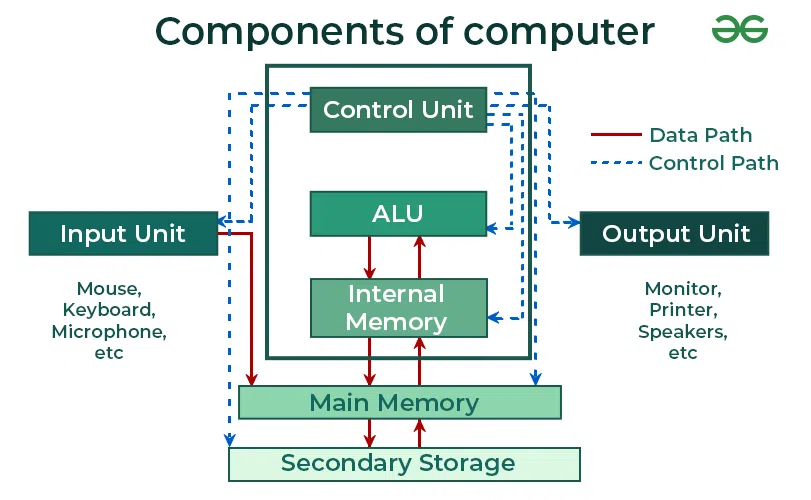
Functional Components of Computer
The **functional components of a computer are the key parts that work together to process and manage data. These include the **Input Unit for receiving data, the **CPU for processing it, the **Memory Unit for storing information, the **Output Unit for displaying results, and the **Bus System that connects all parts. These components help the computer perform tasks efficiently.
1. **Input Unit
- **Purpose: Captures data and instructions from users or external sources.
- **Function: Converts user input into binary signals that the computer can process.
- **Common Devices (2025):
- Keyboard, Mouse, Touchscreens
- Scanners, Sensors, Stylus pens
- Voice Assistants (e.g., Siri, Alexa)
- Biometric devices (face/fingerprint recognition)
- Iot-based inputs from smart devices
2. **Central Processing Unit (CPU) – The Brain of the Computer
The **CPU executes instructions and controls all internal operations. In 2025, CPUs will often have multiple **cores and **threads to handle parallel processing efficiently.
Components of CPU:
a. **Arithmetic Logic Unit (ALU)
- Performs arithmetic operations (add, subtract, multiply, divide).
- Handles logical operations (comparison, decision-making).
- Supports AI/ML tasks using built-in vector/matrix operations (in modern CPUs).
b. **Control Unit (CU)
- Directs the operations of all computer parts.
- Decodes instructions and coordinates data flow.
- Sends control signals to memory and I/O devices.
c. **Registers
- **High-speed memory locations within the CPU.
- Temporarily store instructions, addresses, and intermediate data.
- Examples: Accumulator, Instruction Register, Program Counter, Address Register.
- **Modern CPUs include 64-bit or even 128-bit registers for faster processing.
3. **Memory / Storage Unit
The **memory unit holds data and instructions before, during, and after processing.
a. **Primary Memory (Main Memory):
- **RAM (Random Access Memory): Temporarily stores data during execution.
- Types in 2025: DDR5, LPDDR5X, and emerging **MRAM.
- **ROM (Read-Only Memory): Stores boot-up instructions and firmware.
- **Cache Memory: Ultra-fast memory between CPU and RAM (L1, L2, L3 levels).
b. **Secondary Storage:
- Used for long-term data storage.
- **Examples: SSDs (NVMe drives), HDDs, flash drives, and cloud storage.
- **Modern Trend: Use of **Cloud Integration and **hybrid storage models.
4. **Output Unit
- **Purpose: Converts processed data (binary) into a form users can understand.
- **Examples:
- Visual: Monitors (LED, OLED, 4K/8K displays)
- Print: Printers (Inkjet, Laser, 3D Printers)
- Audio: Speakers, Headphones
- Haptic: Vibration feedback devices
- **Emerging Tech: AR/VR headsets, voice-based output, Braille displays for accessibility
**Interconnection between Functional Components
A computer consists of an input unit that takes input, a CPU that processes the input and an output unit that produces output. All these devices communicate with each other through a common bus. A bus is a transmission path, made of a set of conducting wires over which data or information in the form of electric signals is passed from one component to another in a computer. The bus can be of three types – **Address bus, Data bus and Control Bus.
The following figure shows the connection of various functional components:

The address bus carries the address location of the data or instruction. The data bus carries data from one component to another, and the control bus carries the control signals. The system bus is the common communication path that carries signals to/from the CPU, main memory and input/output devices. The input/output devices communicate with the system bus through the controller circuit, which helps in managing various input/output devices attached to the computer.
Conclusion
The **functional components of a computer work in unison to process data and perform tasks efficiently. Each component, from the input and output units to the CPU, memory, and bus system, has a crucial role in handling information, carrying out calculations, and delivering results. Understanding how these components interact helps us appreciate how a computer operates and how its hardware and software collaborate to perform complex functions.