Friend Class and Function in C++ (original) (raw)
Last Updated : 17 Jan, 2026
In C++, friend functions and friend classes are concepts that allow certain functions or classes to access the private and protected members of another class.
Friend Class in C++
A friend class can access private and protected members of other classes in which it is declared as a friend.
- Remember one thing, friendship is not mutual. If class A is a friend of B, then B doesn't become a friend of A automatically.
- We can declare a friend class in C++ by using the **friend keyword.
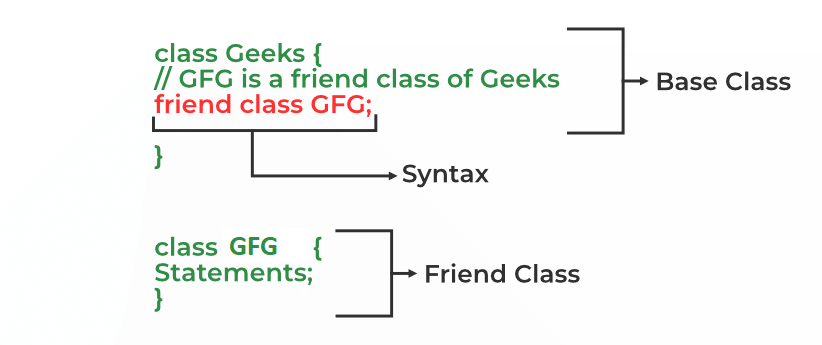
Friend class
C++ `
#include using namespace std;
class Geeks { private: int private_variable;
protected: int protected_variable;
public: Geeks() { private_variable = 10; protected_variable = 99; }
// friend class declaration
friend class GFG;
};
// class GFG is declared as a friend // inside class Geeks, therefore // Class GFG can access private members // of class Geeks. class GFG { public: void display(Geeks& t) { cout << "The value of Private Variable = " << t.private_variable << endl; cout << "The value of Protected Variable = " << t.protected_variable; } };
int main() { Geeks g; GFG fri; fri.display(g); return 0; }
`
Output
The value of Private Variable = 10 The value of Protected Variable = 99
**Note: We can declare friend class or function anywhere in the base class body whether its private, protected or public block. It works all the same.
Friend Function in C++
Like friend classes, a **friend function can be granted special access to private and protected members of a class in C++. They are not the member functions of the class but can access and manipulate the private and protected members of that class for they are declared as friends.
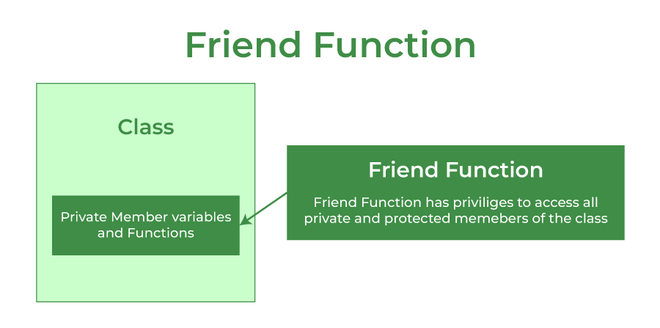
A friend function can be:
- A global function
- A member function of another class
1. Global Function as Friend Function
We can declare any global function as a friend function. The following example demonstrates how to declare a global function as a friend function in C++. The keyword "friend" is placed only in the function declaration of the friend function and **not in the **function definition or call.
**Example
C++ `
#include using namespace std;
class base { private: int private_variable;
protected: int protected_variable;
public: base() { private_variable = 10; protected_variable = 99; }
// Friend function declaration
friend void friendFunction(base& obj);
};
// friend function definition void friendFunction(base& obj) { cout << "Private Variable: " << obj.private_variable << endl; cout << "Protected Variable: " << obj.protected_variable; }
int main() { base object1; friendFunction(object1); return 0; }
`
Output
Private Variable: 10 Protected Variable: 99
In the above example, we have used a global function as a friend function. A friend function can be declared in any section of the class i.e. public or private or protected.
2. Member Function of Another Class as Friend Function
We can also declare a member function of another class as a friend function in C++. Forward declaration of the class is needed if we want to make a member function of another class a friend inside that class.
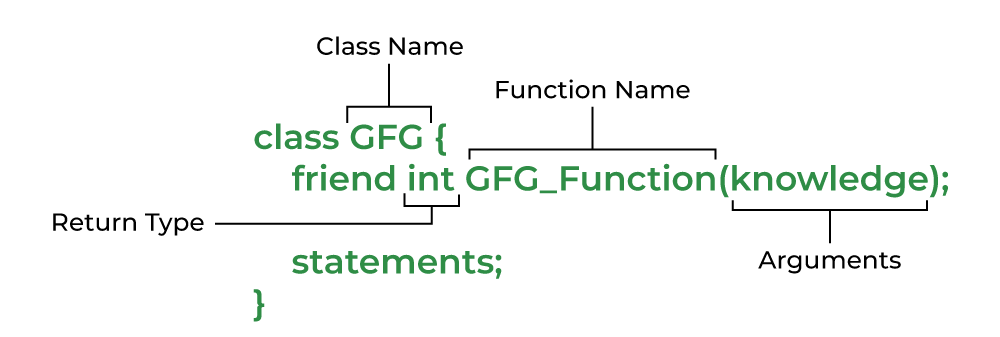
**Example
C++ `
#include using namespace std;
// Forward Declaration needed class base;
// Another class in which function is declared class GFG { public: void GFG_Function(base& obj); };
// Base class declare a frined // function of another class class base { private: int private_variable;
protected: int protected_variable;
public: base() { private_variable = 10; protected_variable = 99; }
// Friend function declaration
friend void GFG::GFG_Function(base&);
};
// Friend function definition void GFG::GFG_Function(base& obj) { cout << "Private Variable: " << obj.private_variable << endl; cout << "Protected Variable: " << obj.protected_variable; }
int main() { base object1; GFG object2; object2.GFG_Function(object1);
return 0;}
`
Output
Private Variable: 10 Protected Variable: 99
**Note: The order in which we define the friend function of another class is important and should be taken care of. We always have to define both the classes before the function definition. Thats why we have used out of class member function definition.
**Function Friendly to Multiple Classes
C++ `
#include using namespace std;
// Forward declaration class ABC;
class XYZ { int x;
public: void set_data(int a) { x = a; }
friend void max(XYZ, ABC);};
class ABC { int y;
public: void set_data(int a) { y = a; }
friend void max(XYZ, ABC);};
void max(XYZ t1, ABC t2) { if (t1.x > t2.y) cout << t1.x; else cout << t2.y; }
// Driver code int main() { ABC _abc; XYZ _xyz; _xyz.set_data(20); _abc.set_data(35);
// calling friend function
max(_xyz, _abc);
return 0;
}
`
Advantages vs Disadvantages of Friend Functions
| **Advantages | **Disadvantages |
|---|---|
| Access private and protected members without inheritance | Violates data hiding by exposing private members |
| Enable controlled data sharing between classes | Breaks encapsulation when overused |
| Useful for operator overloading flexibility | Do not support runtime polymorphism |
| Can be declared in any access section of a class | Friendship is not inherited by derived classes |