random header | Set 2 (Distributions) (original) (raw)
Last Updated : 23 Jul, 2025
Distributions
I. Uniform : 
- uniform_int_distribution: It produces random integer values i, which are uniformly distributed on the closed interval [a,b], which is described by the following probability mass function:
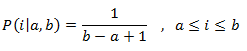
- operator(): It generates the random number that are distributed according to the probability function.
- min: It returns the greatest lower bound of the range of values returned by operator(), which is the distribution parameter 'a' for uniform_int_distribution.
- max: It returns the least upper bound of the range of values returned by operator(), which is the distribution parameter 'b' for uniform_int_distribution.
- reset: It resets the distribution, so that on the subsequent uses the result does not depends on the values already produced by it.
CPP `
// C++ program to illustrate
// the use of operator()
// in uniform_int_distribution

#include
#include
using namespace std;
// Driver program
int main()
{
// Constructing a trivial random generator engine
unsigned s = 2;

// The random number generator
default_random_engine generator (s);

uniform_int_distribution<int> distribution(1,10);
cout << "Some random numbers between 1 and 10";
for (int i = 0; i < 10; ++i)
    cout << distribution(generator) ;

cout << endl;

return 0; }Output: Some random numbers between 1 and 10: 1 3 6 10 1 5 1 4 4 9 CPP
// C++ program to illustrate
// the use of reset
// in uniform_int_distribution
#include
#include
using namespace std;
//Driver program
int main()
{
//the random number generator
default_random_engine generator;

// Initialising the uniform distribution
uniform_int_distribution<int> distribution(1, 1000);

// First random number is generated
cout << distribution(generator) << endl;

//Resets the distribution
distribution.reset();

// Second random number is
//generated independent of previous number
cout << distribution(generator) << endl;

return 0;
}
` Output:
1
132
2. uniform_real_distribution: It is the random number distribution that produces floating-point values , which is described by the following probability density function:
- operator(): It returns a new random number that follows the distribution's parameters.
- min: It returns the greatest lower bound of the range of values returned by operator(), which is the distribution parameter 'a' for uniform_real_distribution.
- max: It returns the least upper bound of the range of values returned by operator(), which is the distribution parameter 'b' for uniform_real_distribution.
- reset: It resets the distribution, so that on the subsequent uses the result does not depend on values already produced by it.
CPP `
// C++ program to illustrate
// the use of operator()
// in uniform_int_distribution
#include
#include
using namespace std;
// Driver program
int main()
{
// Constructing a trivial random generator engine
unsigned s = 2;

// The random number generator
default_random_engine generator (s);

uniform_int_distribution<int> distribution(1,10);
cout << "Random numbers between 1 and 10";
for (int i = 0; i< 10; ++i)
    cout << distribution(generator) ;

cout << endl;

return 0; }Output: some random numbers between 0.0 and 10.0: 0.150031 9.77072 3.36669 7.06447 5.11455 8.43061 1.93792 7.78965 8.31532 5.14354 CPP
// C++ program to illustrate
// the use of reset
// in uniform_real_distribution
#include
#include
using namespace std;
// Driver program
int main()
{
default_random_engine generator;
uniform_real_distribution distribution(0.0,100.0);
// It prints two independent values:
// First random number is generated
cout << distribution(generator) << endl;

//Resets the distribution
distribution.reset();

// Second random number is
//generated independent of previous number
cout << distribution(generator) << endl;

return 0;
}
` Output:
13.1538
45.865
II. Related to bernoulli trials: 
- bernoulli_distribution: It is the random number distribution that produces bool values according to a Bernoulli distribution, given by the following probability mass function:

- operator(): It returns a new random number.
- min: It returns the greatest lower bound of the range of values returned by operator(), which for bernoulli_distribution is false.
- max: It returns the least upper bound of the range of values returned by operator(), which for bernoulli_distribution is true.
CPP `
// C++ program to illustrate
// the bernoulli_distribution

#include
#include
using namespace std;
//Driver program
int main()
{
const int temp=500;
//The random number generator
default_random_engine generator;

//Initialising the bernoulli distribution
bernoulli_distribution distribution(0.7);

// count number of trues
int count=0;

for (int i = 0; i < temp; ++i)
{

    // checking for true condition
    if (distribution(generator))
    count++;
}

cout << "bernoulli_distribution (0.7) x 500:" << endl;
cout << "true: " << count << endl;
cout << "false: " << temp-count << endl;

return 0; }Output: bernoulli_distribution (0.7) x 500: true: 360 false: 140 CPP
// C++ program to
// illustrate the use of reset
#include
#include
using namespace std;
//Driver program
int main()
{
// Random number generator
default_random_engine generator;
// Initialising the bernoulli distribution
bernoulli_distribution distribution;

// print two independent values:
cout << distribution(generator) << endl;

// use of reset
// Generates second output without
// the effect of first output
distribution.reset();
cout << distribution(generator) << endl;
return 0;
}
` Output:
1
1
2. binomial_distribution: It is the random number distribution that produces integers according to a binomial discrete distribution, which is given by this probability mass function:
- operator(): It generates a new random number.
- max: It returns the least upper bound of the range given by operator(), which for binomial_distribution is the distribution parameter t.
- min: It returns the greatest lower bound of the range given by member operator(), which for binomial_distribution is always zero.
- reset: It resets the distribution, so that subsequent uses of the object do not depend on values already produced by it.
CPP `
// C++ program to illustrate
// the use of binomial_distribution
#include
#include
#include
using namespace std;
int main()
{
// construct a trivial random
//generator engine from a time-based seed:
unsigned seed = chrono::system_clock::now().time_since_epoch().count();
default_random_engine generator (seed);

// Initialising binomial distribution
binomial_distribution<int> distribution (15, 0.4);

cout << "some binomial results (t=15, p=0.4): ";
for (int i = 0; i < 15; ++i)
{

    // Use of operator()
    cout << distribution(generator) << " ";
}
cout << endl;

return 0; }Output: some binomial results (t=15, p=0.4): 7 6 7 8 4 6 7 6 9 3 5 6 4 6 7 CPP
// C++ program to illustrate
// the use of binomial_distribution
#include
#include
#include
using namespace std;
int main()
{
// construct a trivial random
//generator engine from a time-based seed:
unsigned seed = chrono::system_clock::now().time_since_epoch().count();
default_random_engine generator (seed);

// Initialising binomial distribution
binomial_distribution<int> distribution (15, 0.4);

cout << "some binomial results (t=15, p=0.4): ";
for (int i = 0; i < 15; ++i)
{

    // Use of operator()
    cout << distribution(generator) << " ";
}
cout << endl;

return 0;
}
` Output:
57
52
3. geometric_distribution: It is a random number distribution that produces integers according to a geometric discrete distribution, given by the following probability mass function:
- operator(): It returns a new random number that follows the distribution's parameters.
- max: It returns least upper bound of the range given by operator().
- min: It returns the minimum value given by operator().
- reset: It resets the distribution, so that subsequent uses of the object do not depend on values already produced by it.
CPP `
// C++ program to illustrate
//the use of geometric_distribution
#include
#include
#include
#include
using namespace std;
int main()
{
// construct a trivial random
// generator engine from a time-based seed:
int seed = chrono::system_clock::now().time_since_epoch().count();
default_random_engine generator (seed);
// Initialises the geometric distribution
geometric_distribution<int> distribution (1.0 / 5);

cout << "Plus sign is 5 spaces away from the next :" << endl;
for (int i = 0; i < 10 ; ++i)
{
    int number = distribution(generator);
    cout << string (number,' ') << "+";
}
return 0;
}Output: each plus sign is 5 spaces away from the next : ++ + + + ++ + ++ CPP
// C++ program to illustrate
// the use of reset
#include
#include
using namespace std;
// Driver program
int main()
{
// Random number generator
default_random_engine generator;

// Initialising the geometric distribution
geometric_distribution<int> distribution(0.3);

// Prints two independent values:
// Generates the first value
cout << distribution(generator) << endl;

// Use of reset
distribution.reset();

// Generates second value
cout << distribution(generator) << endl;

return 0;
}
` Output:
0
1
4. negative_binomial_distribution: It is a random number distribution that produces integers according to a negative binomial discrete distribution (also known as Pascal distribution), given by the following probability mass function:
- **operator():**It returns a new random number which follows the distribution's parameters.
- **max:**It returns least upper bound of the range given by operator().
- **min:**It returns the minimum value given by operator(),which for negative_binomial_distribution is always zero.
- reset: It resets the distribution, so that subsequent uses of the object do not depend on values already produced by it.
CPP `
// C++ program to illustrate
// the use of operator() in
// negative_binomial_distribution
#include
#include
#include
using namespace std;
// Driver program
int main()
{
// construct a trivial random
// generator engine from a time-based seed:
unsigned seed = chrono::system_clock::now().time_since_epoch().count();
default_random_engine generator (seed);
// Initialising negative binomial distribution
negative_binomial_distribution<int> distribution (6,0.7);

cout << "Negative binomial results (t=6, p=0.7): ";
for (int i = 0; i < 15; ++i)
    {
        // Use of operator
        cout << distribution(generator) << " ";
    }

cout << endl;

return 0; }Output: Negative binomial results (t=6, p=0.7): 2 6 3 1 4 1 4 1 2 0 7 3 4 4 4 CPP
// C++ program to illustrate
// the use of reset in
// negative_binomial_distribution::
#include
#include
using namespace std;
// Driver program
int main()
{
// Random number generator
default_random_engine generator;

// Initialising the negative binomial distribution
negative_binomial_distribution<int> distribution(20, 0.5);

// print two independent values:
// Generates the first value
cout << distribution(generator) << endl;

// Use of reset
distribution.reset();

// Generates the second value
cout << distribution(generator) << endl;

return 0;
}
` Output:
23
30
III.Piece wise distributions: 
- discrete_distribution: It is a random number distribution that produces integer values according to a discrete distribution.
- operator(): It returns a new random number that follows the distribution's parameters.
- max: It returns the least upper bound of the range given by operator().
- min: It returns the greatest lower bound of the range given by operator().
- reset: It resets the distribution, so that subsequent uses of the object do not depend on values already produced by it.
CPP `
// C++ program to illustrate the
// use of operator() in
// discrete_distribution
#include
#include
using namespace std;
int main()
{
// number of experiments
int n = 10000;

// maximum number of stars to distribute
int m = 100;

// Random number generator
default_random_engine generator;

//Initialising discrete distribution
discrete_distribution<int> distribution { 2, 2, 1, 1, 2, 2, 1, 1, 2, 2 };

int p[10] = {};

// use of operator()
for (int i = 0; i < n; i++)
{
    int number = distribution(generator);
    p[number]++;
}

cout << "a discrete_distribution:" << endl;
for (int i = 0; i < 10; ++i)
{
    cout << i << ": " << string(p[i]*m/n,'*') << endl;
}

return 0; }Output: a discrete_distribution: 0: ************ 1: ************* 2: ***** 3: ****** 4: ************ 5: ************ 6: ****** 7: ****** 8: ************ 9: ************ CPP
// C++ program to illustrate
//the use of reset in
//discrete_distribution
#include
#include
using namespace std;
// Driver program
int main()
{
// Random number generator
default_random_engine generator;

// Initialising the discrete distribution
discrete_distribution<int> distribution {20,20,30,40};

// print two independent values:
// Generates the first value
cout << distribution(generator) << endl;

// Use of reset
distribution.reset();

// Generates the secong value
cout << distribution(generator) << endl;

return 0;
}
` Output:
0
2
2. piecewise_constant_distribution: It is a random number distribution that produces floating-point values that are uniformly distributed over each of a sequence of contiguous subintervals, given by following probability density function:
- operator(): It returns a new random number that follows the distribution's parameters.
- max: It returns the least upper bound of the range given by operator().
- min: It returns the greatest lower bound of the range given by operator().
- reset: It resets the distribution, so that subsequent uses of the object do not depend on values already produced by it.
CPP `
// C++ program to illustrate the
// use of reset in
// piecewise_constant_distribution
#include
#include
using namespace std;
// Driver program
int main()
{
// Random number generator
default_random_engine generator;

// Initialisind piecewise_constant_distribution
piecewise_constant_distribution<double> distribution
            ( 4, 0.0, 10.0, [](double x){return x;} );

// print two independent values:
// Generates the first value
// Use of operator()
cout << distribution(generator) << endl;

// Use of reset
distribution.reset();

// Generates second value
cout << distribution(generator) << endl;

return 0;
}
` Output:
3.4205
6.6692
3. piecewise_linear_distribution: It is a random number distribution that produces floating-point values that are distributed over a sequence of contiguous subintervals.
- **operator():**It returns a new random number that follows the distribution's parameters.
- max: It returns the least upper bound of the range given by operator().
- min: It returns the greatest lower bound of the range given by operator().
- reset: It resets the distribution, so that subsequent uses of the object do not depend on values already produced by it.
CPP `
// C++ program to illustrate the
// use of reset in
// piecewise_linear_distribution
#include
#include
using namespace std;
// Driver program
int main()
{
// Random number generator
default_random_engine generator;

// Initialising piecewise_linear_distribution
piecewise_linear_distribution<double>
    distribution ( 5, 0.0, 10.0, [](double x){return x+1.0;} );

// print two independent values:
// generates first value
// use of operator()
cout << distribution(generator) << endl;

// Use of reset
distribution.reset();

// generates second value
cout << distribution(generator) << endl;

return 0;
}
`