Smart Pointers in C++ (original) (raw)
Last Updated : 28 May, 2026
A smart pointer is a class that wraps a raw pointer and automatically manages the lifetime of dynamically allocated memory.
- It ensures proper resource deallocation by automatically releasing the memory when the pointer goes out of scope, thus preventing memory leaks and dangling pointers.
- Smart pointers are defined in the header and include types such as std::unique_ptr, std::shared_ptr, and std::weak_ptr.
**Example: Problem with Raw Pointers (Memory Leak Example)
C++ `
#include using namespace std;
int main() { while (1) { int* ptr = new int; } return 0; }
`
**Explanation:
- Memory is allocated repeatedly using new.
- The allocated memory is never released using delete.
- This results in a memory leak, eventually exhausting system memory.
Types of Smart Pointers
1. auto_ptr (Deprecated)
auto_ptr was an early smart pointer that automatically deleted the managed object when it went out of scope.
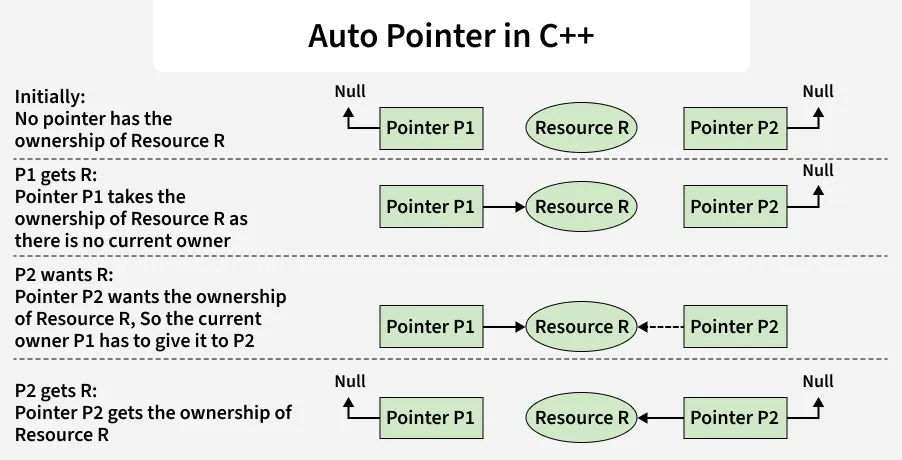
Auto Pointers in C++
C++ `
#include #include using namespace std;
int main() { auto_ptr ptr1(new int(10)); cout << *ptr1 << endl;
auto_ptr<int> ptr2 = ptr1;  // ownership transfer
cout << *ptr2;
return 0;
}
`
**Key Points:
- Ownership is transferred, leaving the original pointer null (empty).
- Copy semantics are unsafe and error-prone.
**Note: auto_ptr was deprecated in C++11 and removed in C++17.
2. unique_ptr
unique_ptr stores one pointer only at a time. We cannot copy unique_ptr, only transfer ownership of the object to another unique_ptr using the move() method.

unique_ptr
C++ `
#include #include using namespace std;
class Rectangle { int length, breadth;
public: Rectangle(int l, int b) : length(l), breadth(b) {} int area() { return length * breadth; } };
int main() { unique_ptr P1 = make_unique(10, 5); cout << P1->area() << endl;
unique_ptr<Rectangle> P2;
P2 = move(P1);  // ownership transfer

cout << P2->area();
return 0;
}
`
Key Points
- Only one unique_ptr can own an object at a time.
- Lightweight and efficient.
- Ideal for single ownership scenarios.
- make_unique() is the recommended and safer way to create a unique_ptr.
3. shared_ptr
shared_ptr allows multiple pointers to share ownership of the same object. It uses reference counting to manage memory.

shared_ptr
C++ `
#include #include using namespace std;
class Rectangle { int length, breadth;
public: Rectangle(int l, int b) : length(l), breadth(b) {} int area() { return length * breadth; } };
int main() { shared_ptr P1(new Rectangle(10, 5)); shared_ptr P2 = P1;
cout << P1->area() << endl;
cout << P2->area() << endl;
cout << P1.use_count();
return 0;
}
`
4. weak_ptr
weak_ptr is a non-owning smart pointer used with shared_ptr to prevent circular dependencies.
**Key Characteristics
- Does not increase reference count
- Prevents circular dependency
- Must be converted using lock() before use
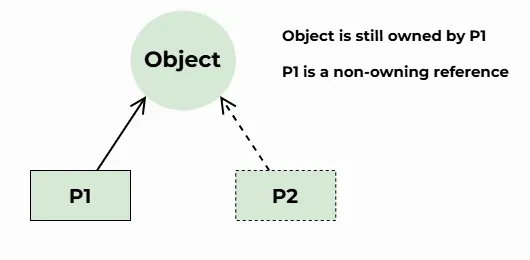
weak_ptr
Problem: Circular Dependency with shared_ptr
If two objects hold shared_ptr to each other:
- Reference count never reaches zero
- Memory leak occurs
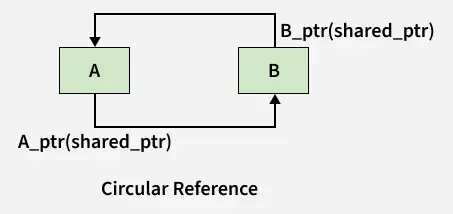
This is the reason we use **weak pointers(weak_ptr) is a non-owning reference to an object managed by shared_ptr.
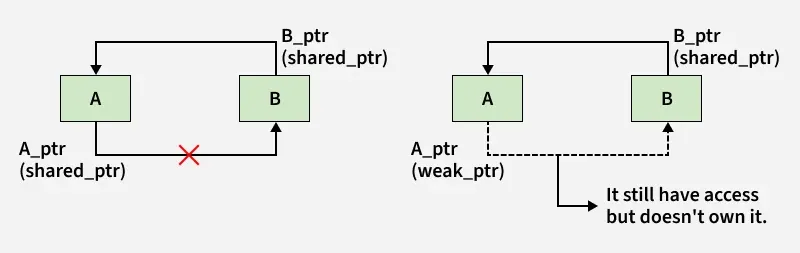
So, in the case of shared_ptr because of cyclic dependency use_count never reaches zero which is prevented by using weak_ptr, which removes this problem by declaring A_ptr as weak_ptr, thus class A does not own it, only has access to it and we also need to check the validity of object as it may go out of scope. In general, it is a design issue.
C++ `
#include #include using namespace std;
class Rectangle { int length, breadth;
public: Rectangle(int l, int b) : length(l), breadth(b) {} int area() { return length * breadth; } };
int main() { shared_ptr P1(new Rectangle(10, 5)); weak_ptr P2(P1);
cout << P1->area() << endl;
cout << P2.use_count();
return 0;
}
`
Problems with Normal Pointers
- **Memory Leaks: This occurs when memory is repeatedly allocated by a program but never freed. This leads to excessive memory consumption and eventually leads to a system crash.
- **Wild Pointers: A pointer that is not initialized with a valid object or address is called a wild pointer.
- **Dangling Pointers: Assume there is a pointer that refers to memory which was deallocated earlier in the program, that pointer is called a **dangling pointer.
Pointers Vs Smart Pointers
| Pointer | Smart Pointer |
|---|---|
| A pointer is a variable that stores the memory address of another variable. | A smart pointer is a class that manages a pointer automatically. |
| Memory must be manually managed (using new/delete). | Memory is automatically managed and released when no longer needed. |
| Does not automatically free memory when it goes out of scope. | Automatically frees memory when it goes out of scope. |
| Requires careful handling, increasing chances of errors (e.g., memory leaks). | Safer to use, as it reduces risks like memory leaks and dangling pointers. |