Types of Recursion in C++ (original) (raw)
Last Updated : 23 Jul, 2025
Recursion is a process where a function calls itself, either directly or indirectly to repeat the same task for smaller data. In C++, recursion occurs by writing a function that includes a call to itself within its body.
Based on how and where this function calls are present, recursion in C++ can be classified into the following types:
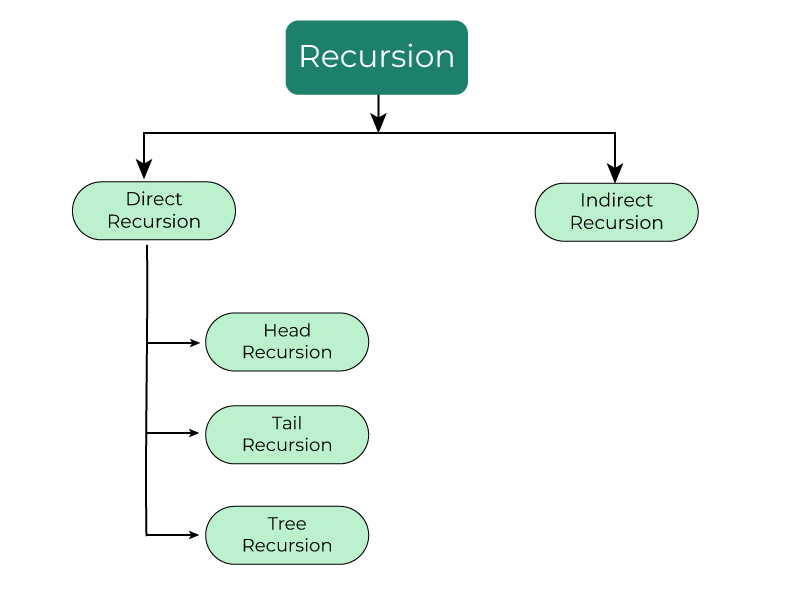
Let’s look at each type one by one.
1. Direct Recursion
Direct recursion occurs when a function calls itself directly from within its body. This is the most common and straightforward form of recursion.
**Example:
C++ `
#include using namespace std;
void show(int n) { if (n == 0) return; cout << n << " ";
// Direct recursive call
show(n - 1);
}
int main() { show(5); return 0; }
`
In this example, the show() function calls itself directly with a reduced value of n.
Direct recursion can be divided into:
**A. Head Recursion
In head recursion, the recursive call happens before any processing in the function. The function calls itself first and processes later.
C++ `
#include using namespace std;
void head(int n) { if (n != 0) { // Recursive call before processing head(n - 1); } cout << n << " "; }
int main() { head(5); return 0; }
`
Here, the function goes deep into recursion first and processes while returning.

B. Tail Recursion
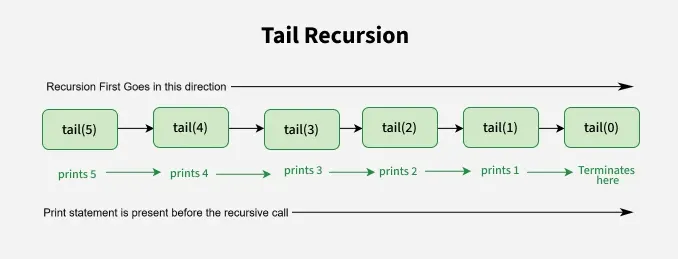
In tail recursion, the function processes first and the recursive call is the last operation.
C++ `
#include using namespace std;
void tail(int n) { if (n == 0) return; cout << n << " ";
// Recursive call after processing
tail(n - 1);
}
int main() { tail(5); return 0; }
`
Tail recursion can be more memory-efficient and may benefit from compiler optimizations.
C. Tree Recursion
Tree recursion happens when a function calls itself more than once within its body, forming a tree-like structure.
C++ `
#include using namespace std;
void tree(int n) { if (n == 0) return; cout << n << " ";
// Two recursive calls
tree(n - 1);
tree(n - 1);
}
int main() { tree(3); return 0; }
`
The function calls itself twice for each value, branching like a tree.

D. Nested Recursion
Nested recursion means the argument to a function is itself a recursive call.
C++ `
#include using namespace std;
int nested(int n) { if (n > 100) return n - 10;
// Recursive call inside another recursive call
return nested(nested(n + 11));
}
int main() { cout << nested(95); return 0; }
`
This type of recursion is complex and used only when necessary.
2. Indirect Recursion
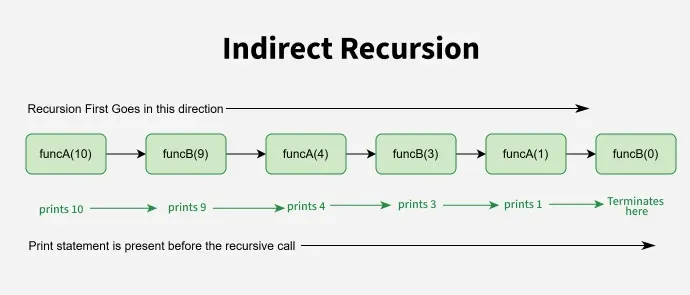
In indirect recursion, a function does not call itself directly. Instead, it calls another function that eventually calls the first one, creating a chain of calls.
C++ `
#include using namespace std;
void funcA(int); void funcB(int);
void funcA(int n) { if (n > 0) { cout << n << " "; funcB(n - 1); } }
void funcB(int n) { if (n > 0) { cout << n << " "; funcA(n / 2); } }
int main() { funcA(10); return 0; }
`
Here, funcA() calls funcB(), which calls funcA() again, forming indirect recursion.