Introduction to Tailwind CSS (original) (raw)
Last Updated : 4 May, 2026
Tailwind CSS is a modern, utility-first framework that lets developers style websites directly in HTML using utility classes. It speeds up UI development by reducing the need for writing custom CSS.
- Uses small, reusable utility classes for styling.
- Uses Tailwind utility classes directly in HTML for styling.
- Creates a clean profile card without custom CSS.
Below is a basic example that imports Tailwind CSS via CDN and applies margin to the body. The heading is styled with Tailwind's utility classes.
index.html `
<!-- Tailwind CSS CDN link -->
<link href="https://unpkg.com/tailwindcss@2.2.19/dist/tailwind.min.css" rel="stylesheet">
Geeksforgeeks
<p><strong>Tailwind CSS Tutorial</strong></p>

<p>
    You can use Tailwind CSS as a replacement
    of CSS, this is a framework that increase
    your pace to design any website.
</p>
`
Features of Tailwind CSS
Features that make Tailwind CSS a powerful and flexible framework for modern web development.
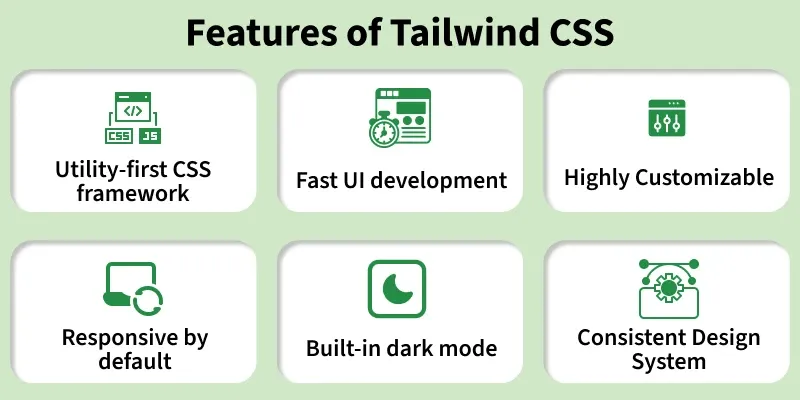
- **Utility-first CSS framework: Uses small, reusable utility classes with clear documentation and practical examples for easy learning.
- **Fast UI development: Speeds up design and prototyping by removing the need for custom CSS and integrates seamlessly with React, Vue, and Next.js.
- **Highly customizable: Enables deep customization through configuration files to match any design system.
- **Responsive by default: Follows a mobile-first approach with responsive utility prefixes for all screen sizes.
- **Built-in dark mode: Provides simple dark mode support using built-in variants.
- **Consistent design system: Maintains uniform spacing, colors, and typography, improving scalability and maintainability.
Tailwind CSS vs Traditional CSS
The table below highlights the key differences between traditional CSS and Tailwind CSS in terms of development approach and scalability.
| Traditional CSS | Tailwind CSS |
|---|---|
| Styles are written in separate CSS files, requiring frequent switching between HTML and CSS | Styles are applied directly in HTML using utility classes, reducing context switching |
| Developers must create and manage custom class names for every component | Predefined utility classes remove the need for naming custom CSS classes |
| UI development is slower due to repetitive CSS writing | Rapid UI development using ready-made utility classes |
| Maintaining consistency becomes difficult as the project grows | Consistent and reusable design system that scales easily |
Advantages of Tailwind CSS
- **No complex class names: Eliminates the need to invent and manage custom CSS class or ID naming conventions.
- **Minimal CSS output: Reduces large custom stylesheets, keeping the codebase lightweight and maintainable.
- **Easy customization: Enables flexible design changes and reusable components without extra CSS.
- **Built-in responsiveness: Makes creating mobile-friendly layouts simple using responsive utility classes.
- **Scoped styling: Applies styles locally to elements, avoiding unintended global CSS side effects.
Limitations of Tailwind CSS
- **Long class lists: HTML markup can become lengthy due to multiple utility classes.
- **Learning curve: Requires time to understand utility naming conventions.
- **Not beginner-friendly initially: Can feel overwhelming for developers new to CSS frameworks.
- **Build setup needed: Production usage requires configuration and build tools.
- **Less semantic HTML: Styling-heavy classes may reduce visual clarity of markup.