Cyber Criminals and their types (original) (raw)
Last Updated : 28 Apr, 2026
Cyber criminals are individuals or groups who use computers, networks and the internet to carry out illegal activities. Their goal is usually to steal sensitive information, make financial profit, damage systems or disrupt online services.
- Use computers, networks and online platforms to perform illegal activities.
- They often target personal data, passwords, bank details or confidential business information.
- Their actions can lead to financial loss, data breaches and disruption of services for individuals and organizations.
- Take advantage of weaknesses in software, networks or human behavior to gain unauthorized access.
- Some attackers are motivated by money, while others act for political reasons, revenge or the challenge of hacking secure systems.
- May operate alone or as part of organized cybercrime networks.
Types of Cyber Criminals
Cyber criminals can be categorized based on their motives, skills and methods. Below are the most common types.
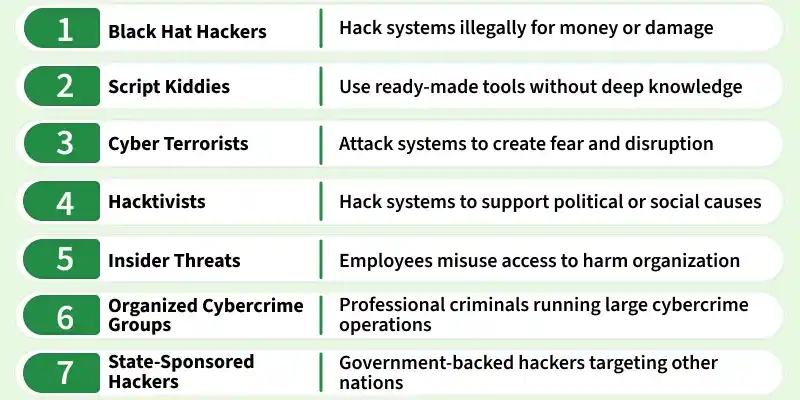
1. Black Hat Hackers
Black hat hackers are criminals who illegally break into computer systems or networks for personal gain. They exploit security vulnerabilities to steal data, spread malware or damage systems. These hackers usually operate secretly and do not have permission to access the systems they attack.
**Activities:
- **Stealing financial information: Hackers access bank accounts or payment systems to steal credit card numbers and banking details for fraud.
- **Installing malware or ransomware: Attackers infect computers with malicious software to damage systems or lock files and demand money.
- **Data theft and identity theft: Cyber criminals steal personal information and use it to impersonate victims or commit fraud.
- **Website defacement: Hackers break into websites and change the content to spread messages or damage the organization's reputation.
**Example: A hacker breaks into a bank database and steals customers’ credit card information to make unauthorized transactions.
2. Script Kiddies
Script kiddies are inexperienced hackers who use pre-written hacking tools and scripts created by skilled hackers. They usually do not understand how the attacks work but use tools downloaded from the internet. Their attacks are often random and aimed at causing disruption rather than serious financial gain.
**Activities:
- **Launching basic DDoS attacks: They use simple tools to send large amounts of traffic to a website or server, making it slow or unavailable to users.
- **Defacing websites: Attackers break into websites and change the content or appearance of the webpage without permission.
- **Using automated hacking tools: They rely on pre-built hacking tools or scripts from the internet instead of creating their own attacks.
**Example: A teenager downloads a DDoS tool from the internet and uses it to overload a gaming server, causing the server to crash temporarily.
3. Cyber Terrorists
Cyber terrorists use technology to create fear, disrupt critical infrastructure or damage national security systems. Their attacks are often politically or ideologically motivated. They target systems such as power grids, transportation networks, military systems and government websites.
**Activities:
- **Attacking government networks: Hackers try to break into government systems to steal sensitive information or disrupt important services.
- **Disrupting power or communication systems: Attackers target critical infrastructure like electricity grids or communication networks to cause widespread disruption.
- **Spreading propaganda online: Cyber attackers use websites, social media or hacked platforms to spread political messages or misinformation.
**Example: Hackers launch cyber attacks to try to shut down a country’s power grid, causing major disruption to electricity and public services.
4. Hacktivists
Hacktivists are hackers who carry out cyber attacks to promote political or social causes. Their goal is usually to spread a message, protest against organizations or expose sensitive information. Unlike cyber criminals motivated by money, hacktivists are often driven by ideology.
**Activities:
- **Website defacement: Hackers break into a website and change its content to display their own messages or protest statements.
- **Leaking confidential documents: Attackers steal and publicly release sensitive information to expose or embarrass an organization.
- **DDoS attacks against organizations: Hackers send large amounts of traffic to a company’s website or servers to make them unavailable to users.
**Example: A hacker group attacks and defaces a company's website to protest against its environmental policies.
5. Insider Threats
Insider threats are individuals who work within an organization and misuse their authorized access to harm the company. These individuals may be employees, contractors or business partners. Because insiders already have access to systems, their attacks can be very dangerous.
**Activities:
- **Stealing confidential company data: Employees misuse their access to copy or take sensitive business information such as customer data, financial records or internal documents.
- **Selling trade secrets to competitors: Insiders may share important company secrets, product designs or strategies with rival companies for personal gain.
- **Sabotaging internal systems: An employee may intentionally damage company systems, delete data or disrupt operations to harm the organization.
**Example: An employee copies sensitive company data before leaving the organization and later shares it with a competing company.
6. Organized Cybercrime Groups
These are professional criminal organizations that conduct cybercrime on a large scale. They operate like businesses with structured teams responsible for different tasks such as malware development, phishing campaigns and money laundering. These groups are responsible for many large cyber attacks worldwide.
**Activities:
- **Ransomware attacks: Cybercriminal groups infect systems with ransomware that encrypts files and demand payment to restore access.
- **Large-scale phishing campaigns: They send thousands of fake emails or messages to trick people into revealing passwords or financial information.
- **Credit card fraud: Criminals steal credit card details and use them to make unauthorized online purchases or transactions.
- **Dark web marketplaces: They use hidden online marketplaces to buy and sell stolen data, hacking tools and illegal services.
**Example: A criminal group launches ransomware attacks on multiple companies and demands payment in cryptocurrency to unlock their systems.
State-sponsored hackers are cyber criminals supported or funded by governments to carry out cyber espionage or cyber warfare. Their attacks usually target other countries, government institutions or large corporations. These attackers are highly skilled and well-resourced.
**Activities:
- **Stealing classified information: Hackers secretly access and steal sensitive government or military data that is meant to be kept confidential.
- **Attacking national infrastructure: Cyber attackers try to damage or disrupt important systems of a country, such as power grids, transportation networks or communication systems.
- **Cyber espionage against companies: Hackers spy on companies to steal trade secrets, product designs or confidential business information.
**Example: A hacker group supported by a government breaks into another country's defense systems and steals military secrets or confidential defense plans.
Understanding the Risks of Cybercrime
Cyber criminals pose a serious threat to individuals, businesses and governments because their attacks can cause financial damage, data loss and disruption of important services. As technology becomes more advanced, cyber attacks are becoming more frequent and sophisticated.
Major Risks
- **Financial Loss: Cyber criminals use methods such as online fraud, phishing and ransomware attacks to steal money from individuals and organizations.
- **Data Theft: Attackers can steal personal information, confidential business data or sensitive government records, which may lead to identity theft or misuse of information.
- **Reputational Damage: When organizations experience cyber attacks or data breaches, they may lose the trust of customers and partners, which can harm their reputation.
- **Disruption of Services: Cyber attacks can shut down important systems such as banking services, healthcare systems or company networks, interrupting normal operations.
- **Threats to National Security: In some cases, cyber attacks target government systems, military networks or critical infrastructure, which can create serious risks for a country's security.