Recovering Deleted Digital Evidence (original) (raw)
Last Updated : 11 Apr, 2026
Digital evidence refers to any data stored or transmitted in digital form that can be used in investigations or court proceedings. It is fragile in nature, as it can be easily altered, copied, or deleted, making proper handling essential. Examples include:
- Audio files and voice recordings
- Browser history, cookies, and cache
- Database files and backups
- Compressed files (ZIP, RAR), including encrypted data
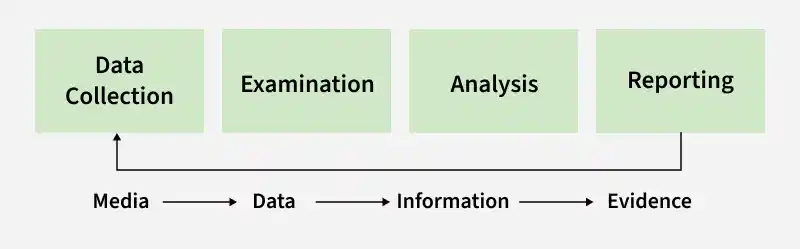
Digital forensics workflow highlighting evidence recovery stages.
Evidence Destruction Methods
Criminals attempting to destroy digital evidence employ various methods with varying success rates. The effectiveness depends on three key factors:
- The destruction method used to determine how thoroughly data is eliminated. Simple deletion differs significantly from secure wiping techniques.
- Time Available affects the completeness of destruction. Quick deletion leaves more recoverable traces than sustained wiping efforts.
- Storage Device Type impacts recovery possibilities. Traditional magnetic hard drives retain data differently than SSDs or flash memory, with each requiring specialized recovery approaches.
Recovery from Deleted Files
File deletion is one of the most common methods of evidence destruction, but it does not immediately erase the data. When a file is deleted using commands like “Delete” or “Shift+Delete,” the operating system simply marks its entry in the file system as deleted and makes the occupied space available for reuse. The actual data remains on the disk until it is overwritten by new data, which is why deleted files can often be recovered using forensic techniques.
Recovery Methods
- Recycle Bin Analysis provides the easiest recovery path. Files deleted normally are temporarily stored in the recycle bin before permanent erasure, allowing simple restoration.
- Data Recovery Tools become necessary when files bypass the recycle bin. Commercial tools like DiskInternals Partition Recovery, Autopsy, and FTK Imager can locate and restore deleted files by scanning for characteristic file signatures.
- Signature-Based Recovery identifies files by searching for known headers and footers. JPEG files begin with "JFIF" signatures, ZIP archives start with "PK," and PDF files begin with "%PDF".
Additional Recoverable Data
Beyond explicitly deleted files, investigators can recover:
- Temporary copies of Office documents including old revisions
- Application cache and temporary files
- Renamed or moved files
- Fragments from application-specific folders (like Skype's "chatsync" folder)
Specialized tools like Belkasoft Evidence Center can reconstruct user activities even when primary databases are deleted by analyzing residual application data.
Recovery from Formatted Hard Drives
Data recovery from formatted drives depends critically on the format type used.
- Quick Format: Quick formatting is rarely destructive except on SSDs. It simply reinitializes the file system without touching actual data on the disk. Files can be recovered using data carving tools that support signature-based recovery.
- Full Format: Full formatting behavior varies by operating system:
- Pre-Windows Vista systems performed full formats by scanning disk surfaces for bad sectors without zeroing data, leaving files recoverable.
- Windows Vista and Later versions write zeros across the entire disk during full formatting, making traditional recovery impossible. The system also reads sectors back to verify reliability.
SSD Drive Recovery Challenges
Solid-State Drives present unique recovery challenges due to their internal architecture and the TRIM command.
TRIM Command Impact
TRIM is a command that enables SSDs to efficiently manage deleted data. Research shows TRIM can completely wipe deleted information in under three minutes by immediately zeroing all data marked as deleted by the operating system.
**Critical implications:
- TRIM effects cannot be prevented even with write-blocking devices
- Traditional recovery methods fail on TRIM-enabled systems
- Data becomes unrecoverable almost instantly after deletion
When SSD Recovery Remains Possible
- Recovery from SSDs only works when TRIM is not issued or unsupported by system components:
- Operating System Support: Windows Vista and later support TRIM, while Windows XP and earlier versions typically don't.
- Communication Interface: SATA and eSATA connections support TRIM, but external enclosures using USB, LAN, or FireWire don't transmit TRIM commands.
- File System Compatibility: Windows supports TRIM on NTFS volumes but not on FAT-formatted disks. Linux supports TRIM on all file system types including FAT.
Data Carving Techniques
Data carving is a forensic technique used to recover files from storage devices without relying on file system metadata. It works by scanning the entire storage device and identifying file content using known patterns such as headers, footers, and internal structures, even when the file system is damaged or missing.
1. Text Data Recovery
Text information is easiest to carve because text data contains numeric values from narrow ranges representing letters, numbers, and symbols. Investigators must account for:
- Multiple languages and character sets (Turkish, Arabic, Chinese, Korean)
- Various text encodings (UTF-8, ASCII, Unicode)
- Different character set ranges for each language
Algorithms detect text blocks by counting characters belonging to specific language/encoding combinations. When threshold limits are exceeded, the algorithm identifies text block boundaries.
2. Binary Data Recovery
Binary data presents greater challenges due to randomness. However, many file types contain consistent patterns:
- Image files (JPEG, PNG, GIF) with standard headers
- Archives (ZIP, RAR) with compression signatures
- Documents (PDF, DOCX) with format-specific structures
- Database files with table headers and indexes
File carving reconstructs these files by identifying beginning signatures, following internal structures, and detecting end markers.
Data Carving Limitations
- Format Restrictions: Not all file types can be carved. Some applications use proprietary formats without permanent signatures (like certain instant messengers).
- Plain-Text Overload: The enormous volume of text files on typical computers makes targeted recovery difficult without specific search parameters.
- Cryptographic Wiping: When sensitive areas are overwritten with cryptographically strong random data, even in paranoid multi-pass modes, carving becomes impossible.
- RAM-Only Storage: Information stored exclusively in volatile memory requires live RAM analysis rather than disk carving.
- SSD Incompatibility: Data carving proves largely ineffective on SSDs due to TRIM command effects and wear-leveling algorithms.
- Fragmentation Issues: Heavily fragmented files across non-contiguous sectors complicate reassembly, often resulting in incomplete or corrupted recovered files.
Professional digital forensic investigations employ specialized tools to ensure evidence integrity.
1. **Imaging and Preservation: Disk Imaging creates bit-by-bit copies of entire storage devices, allowing analysis on duplicates while preserving originals untouched. This maintains evidence admissibility in legal proceedings.
2. **Hash Verification uses cryptographic algorithms (MD5, SHA-256) to verify data integrity. Matching hash values prove the evidence hasn't been altered during investigation.
3.**Chain of Custody documentation tracks evidence handling from seizure through analysis to court presentation, ensuring accountability and preventing tampering claims.
Popular Forensic Tools
- **Autopsy is an open-source platform providing comprehensive analysis capabilities including metadata extraction, timeline creation, keyword searches, and support for multiple file systems.
- **FTK Imager excels at creating forensic images quickly, previewing recoverable data, and providing advanced search capabilities for large datasets.
- **Belkasoft Evidence Center specializes in recovering data from application-specific locations and reconstructing user activities from fragments.
Best Practices for Evidence Recovery
To maximise recovery success while maintaining legal admissibility:
- Act Quickly: Time degrades recovery chances as operating systems may overwrite deleted space
- Document Everything: Record all actions, tools used, and findings with timestamps
- Preserve Originals: Never analyze original evidence directly; always work on forensic images
- Use Write Blockers: Prevent accidental modifications during evidence acquisition
- Maintain Proper Storage: Keep seized devices in anti-static bags away from magnets and extreme temperatures
- Follow Legal Protocols: Ensure all recovery methods comply with jurisdictional requirements
- Verify Data Integrity: Use hash values to prove evidence hasn't been altered