Web Server and its Types of Attacks (original) (raw)
Last Updated : 11 Apr, 2026
Malicious attempt to compromise the security of a web-based application or server infrastructure, targeting the application to steal sensitive data, disrupt services, or gain unauthorized control, and potentially using the compromised server as a platform for launching attacks against other users and systems.
- Exploits vulnerabilities such as SQL injection, XSS, or misconfigurations.
- Can lead to data breaches, service downtime, and system compromise.
- May be used to launch further attacks on users, networks, or other servers.
Types of Attacks
1. Denial-of-Service (DoS) and Distributed Denial-of-Service (DDoS)
Attackers overwhelm web servers with massive amounts of requests, causing them to slow down significantly or crash completely. This prevents legitimate users from accessing the service.
**Common Targets: Government services, financial institutions, large corporations, and e-commerce platforms.
**Prevention Measures:
- Rate limiting and traffic filtering control incoming requests and reduce overload risk.
- DDoS protection services and CDNs strengthen defense against large-scale traffic floods.
- Load balancers distribute traffic across multiple servers for improved stability.
- Firewalls and traffic monitoring detect and block suspicious activity or unusual spikes.
- Excess bandwidth capacity helps the system handle sudden high traffic loads effectively.
2. Web Defacement Attack
Attackers gain unauthorized access to web servers and replace legitimate website content with their own messages, images, or propaganda. This is often done to humiliate organizations, spread political messages, or demonstrate security weaknesses.
**Prevention Measures:
- Strong access controls and authentication help prevent unauthorized system entry.
- Regular updates and patches for web server software reduce security vulnerabilities.
- File integrity monitoring detects unauthorized modifications in system files.
- Secure backups ensure quick recovery during attacks or system failures.
- Web Application Firewalls (WAF) and restricted admin access from trusted IPs enhance protection.
3. SSH Brute Force Attack
Attackers systematically attempt numerous username and password combinations to gain SSH (Secure Shell) access to the server. Once successful, they can upload malicious files, steal data, or take complete control of the system.
**Prevention Measures:
- Strong authentication methods like complex passwords or SSH keys improve secure access control.
- Account lockout policies and tools like fail2ban block repeated failed login attempts.
- Changing default SSH port and restricting access to trusted IP addresses reduce attack exposure.
- Two-factor authentication (2FA) adds an extra security layer for SSH access.
- Continuous monitoring of SSH logs helps detect suspicious or unauthorized activity.
**4. CROSS SITE SCRIPTING (XSS):
This type of attack is more likely to target websites with scripting flaws. The injection of malicious code into web applications is known as Cross-Site Scripting. The script will give the hacker access to web app data such as sessions, cookies, and so on.
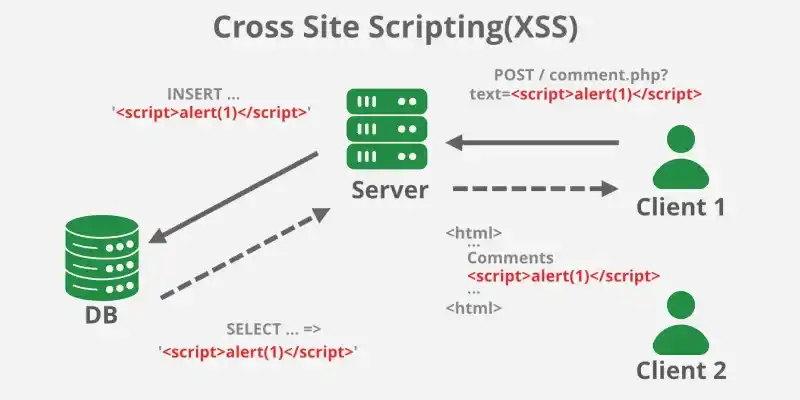
Cross Site Scripting (XSS)
**Prevention Measures:
- Input validation and sanitization prevent injection-based attacks from user input.
- Content Security Policy (CSP) and output encoding reduce risks from malicious scripts.
- Secure cookie settings using HttpOnly and Secure flags protect session data.
- Web Application Firewalls (WAF) and regular code reviews strengthen application security.
- Updated frameworks and libraries help eliminate known vulnerabilities.
5. Directory Traversal (Path Traversal)
Attackers exploit vulnerabilities to access files and directories outside the web server's root directory. This can expose sensitive configuration files, database credentials, system files, or other confidential information.
**Prevention Measures:
- Implement proper input validation and filtering.
- Use whitelisting for allowed file paths.
- Configure web servers to restrict access to directories.
- Apply principle of least privilege to file permissions.
- Disable directory listing on web servers.
6. DNS Server Hijacking (DNS Redirection)
**Description: Attackers manipulate DNS records or responses to redirect users from legitimate domains to malicious websites controlled by the attacker. Users believe they're accessing genuine sites while actually communicating with fraudulent servers.
**Prevention Measures:
- Implement DNSSEC (Domain Name System Security Extensions).
- Use reputable DNS hosting providers with strong security.
- Enable two-factor authentication for DNS management accounts.
- Monitor DNS records for unauthorized changes.
7. Man-in-the-Middle (MITM) Attack
Man-in-the-Middle (MITM) attack allows the attacker to access sensitive information by blocking and modifying the connection between the end-user and web servers. In MITM attacks or smells, the hacker captures or corrects modified messages between the user and the web server by listening or intervening in the connection.
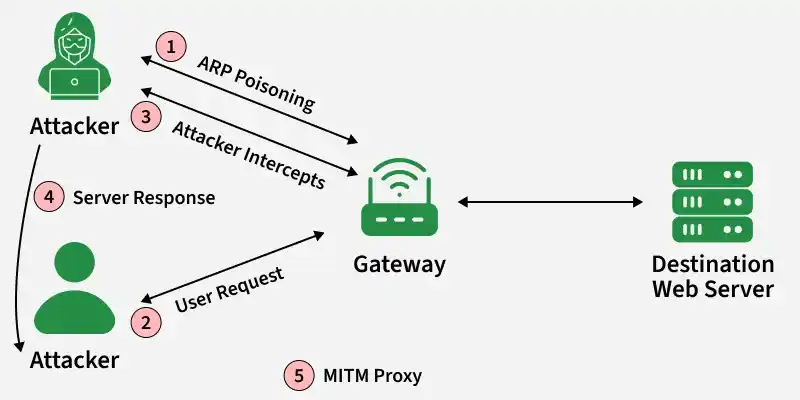
Man-in-the-Middle (MITM) attack
**Prevention Measures:
- Use HTTPS/TLS encryption for all web traffic.
- Implement certificate pinning for critical applications.
- Use VPNs for secure communications.
- Enable HTTP Strict Transport Security (HSTS).
- Avoid using public Wi-Fi for sensitive transactions.
8. HTTP Response Splitting Attack
Attackers manipulate HTTP responses by injecting malicious data into HTTP headers. This protocol manipulation can lead to cache poisoning, cross-site scripting, or other attacks. Applications that use HTTP to exchange data are vulnerable, even when using HTTPS.
**Prevention Measures:
- Validate and sanitize all user inputs that might be included in HTTP headers.
- Use modern web frameworks with built-in protections.
- Implement strict input filtering for special characters (CR, LF).
- Keep web server software and frameworks updated.
- Use security headers like X-Content-Type-Options.
Advantages
- Improves security awareness by identifying system vulnerabilities.
- Enables effective defense strategies using security mechanisms.
- Strengthens system design through secure development practices.
- Reduces risk of data breaches and protects sensitive data.
- Enhances incident response and recovery capabilities.
Disadvantages
- High cost of implementing advanced security solutions.
- Performance overhead due to security processes.
- Complex management requiring expertise and maintenance.
- Possibility of false positives affecting user experience.
- Continuous evolution of threats requires frequent updates.