Data Modeling (original) (raw)
Last Updated : 19 Jan, 2026
Data modeling is the process of creating a structured and visual representation of data, defining how data elements relate to one another within a system. It helps translate business requirements into organized data structures that support accurate analysis and effective decision-making.
- Defines data structures, relationships and business rules within an organization
- Identifies and analyzes data requirements to support business processes
- Ensures data consistency, accuracy and integrity across systems
- Helps analysts understand relationships between different data entities
- Enables efficient data storage, retrieval and performance optimization
- Supports trend analysis and data-driven decision-making
**Data Model
A data model is a visual and logical representation of an organization data elements and the relationships between them. It helps structure and organize data in alignment with business processes, enabling effective communication between business users and technical teams. Data models define how data is stored, accessed, shared and maintained across information systems.
Types of Data Models
There are three main types of data models:
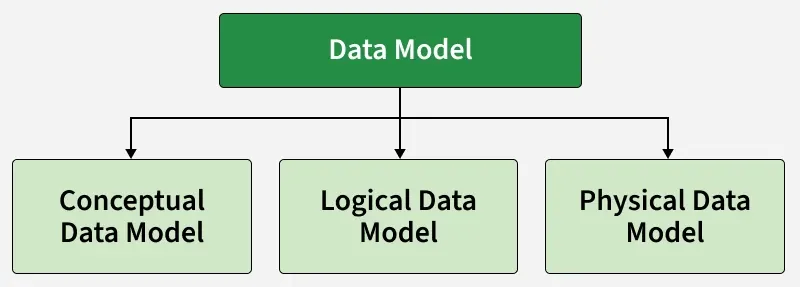
Type of Data Model
**1. Conceptual Data Model: The conceptual data model represents high-level, abstract business concepts and structures. It is primarily used in the early stages of a project to define and examine business requirements and relationships.
- **Purpose: Organize and define business problems, rules and concepts.
- **Focus: High-level overview of data such as customer data, market data and purchase data.
- **Audience: Business stakeholders and analysts.
- **Example Use: Understanding the relationship between customers and their orders before designing the database structure.
**2. Logical Data Model: The logical data model builds upon the conceptual model and provides a detailed representation of the data at a logical level.
- **Purpose: Define tables, columns, relationships and constraints that form the data structure.
- **Focus: Structure of the data without depending on any specific database management system (DBMS).
- **Audience: Data architects and analysts.
- **Example Use: Outlining the schema, relationships and rules for customer and order data, which later guides the physical database design.
**3. Physical Data Model: The physical data model represents the implementation of the data model in a specific database system.
- **Purpose: Define every element needed to construct a database, including tables, columns, keys and constraints (primary key, foreign key, NOT NULL, etc.).
- **Focus: Actual implementation of the database using queries and the chosen DBMS features.
- **Audience: Developers and database administrators (DBAs).
- **Example Use: Creating the database schema and ensuring that all constraints and relationships are enforced in the physical database.
Data Modeling Process
Data modelers work closely with stakeholders such as developers, database administrators and business users at each stage to define entities and attributes, establish relationships and create models that accurately represent data in a format usable by applications.
**1. Identifying data sources
The first step is to identify and examine data sources, both internal and external to the organization.
- **Purpose: Understand where data originates and how different sources contribute to the overall information landscape.
- **Significance: Ensures a comprehensive framework for data modeling by gathering all relevant data, laying the foundation for an accurate and complete representation of the data ecosystem.
**2. Defining Entities and Attributes
At this stage, data modelers identify entities (objects or concepts) and their attributes (characteristics).
- **Entities: Represent the main subjects of the data (e.g., Customer, Product).
- **Attributes: Describe the properties of each entity (e.g., Customer Name, Product Price).
- **Significance: Establishes an organized and clear structure for understanding data characteristics and creating a functional model.
**3. Mapping Relationships
Relationships define the associations between entities.
- **Purpose: Identify and describe the links, including nature and cardinality (one-to-one, one-to-many, many-to-many).
- **Significance: Captures the interdependencies within data, improving the accuracy of the model by reflecting real-world relationships.
**4. Choosing a model Type
Selecting the appropriate data model type is crucial and depends on project requirements and data characteristics.
- **Options: Conceptual, logical, physical models or specific approaches like relational or object-oriented models.
- **Significance: Determines the level of abstraction and detail in the representation, ensures alignment with project objectives and facilitates creating a model suited for the type of data being handled.
**5. Implementing and Maintaining
Implementation involves converting a logical or physical data model into a database schema.
- **Implementation Tasks: Creating tables, defining constraints, adding database-specific details.
- **Maintenance: Updating the model to reflect changes in business requirements or technology.
- **Significance: Turns the theoretical model into a practical, usable database and ongoing maintenance ensures the model remains accurate, relevant and aligned with evolving organizational needs.
Types of Data Modeling
**1. Hierarchical Model: The structure of the hierarchical model resembles a tree. The remaining child nodes are arranged in a certain sequence and there is only one root node or alternatively one parent node. However the hierarchical approach is no longer widely applied. approach connections in the actual world may be modelled using this approach.
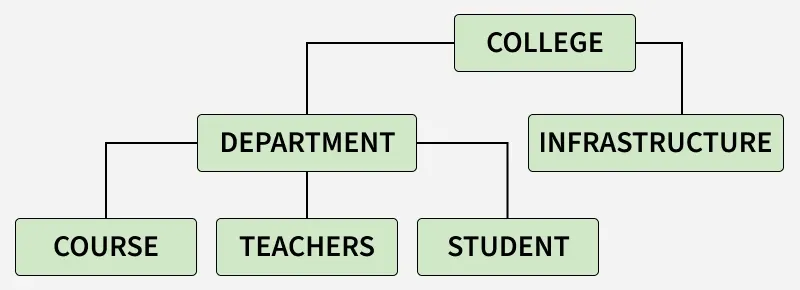
Hierarchical Model
For example in a college there are many courses, many professors and students. So college became a parent and professors and students became its children.
**2. Relational Model: Relational Mode represent the links between tables by representing data as rows and columns in tables. It is frequently utilised in database design and is strongly related to relational database management systems (RDBMS).
**3. Object-Oriented Data Model: In this model data is represented as objects similar to those used in object-oriented programming, creating objects with stored values is the object-oriented method. In addition to allowing data abstraction, inheritance and encapsulation the object-oriented architecture facilitates communication.
**4. Network Model: We have to represent objects and the relationships using the network model. One of its features is a schema, which is a graph representation of the data. An item is stored within a node and the relationship between them is represented as an edge. This allows them to generalise the maintenance of many parent and child records.
**5. ER-Model: A high-level relational model called the entity-relationship model (ER model) is used to specify the data pieces and relationships between the entities in a system. This conceptual design gives us an easier-to-understand perspective on the facts. An entity-relationship diagram, which is made up of entities, attributes and relationships, is used in this model to depict the whole database.
A relationship between entities is called an association. Mapping cardinality many associations like:
- One to One
- One to Many
- Many to One
- Many to Many
Benefits of Data Modeling
In order to organise and structure data and provide database design clarity, data modelling is essential. It acts as a common language, promoting efficient stakeholder communication. It directs the best database architecture for effective data storage and retrieval through visual representation.
- Visualizes complex data structures, providing a clear roadmap for understanding relationships.
- Acts as a universal language, fostering effective communication between business and technical stakeholders.
- Creates organized databases by defining entities, properties and relationships.
- Enhances data quality and integrity by reducing anomalies and redundancy through normalization.
- Minimizes errors in database and application development.