Data Collection Methods Primary and Secondary Data (original) (raw)
Last Updated : 14 Feb, 2026
Data Collection is the systematic process of gathering, measuring and analyzing information from various sources to gain an accurate understanding of a specific topic or problem. It is the first and most fundamental step in research, statistics and data-driven decision-making, as it provides the relevant information needed to answer research questions or solve statistical problems. Accurate data collection ensures reliable results, meaningful insights and informed decisions, while poor or incomplete data can lead to misleading analysis and incorrect conclusions.
The main objectives of data collection are:
- To support decision-making.
- To identify trends and patterns.
- To measure performance and progress.
- To provide evidence for conclusions.
In simple terms, it is the process of gathering facts and figures to discover the truth using statistical methods.
- **Data: Data is a tool that helps an investigator in understanding the problem by providing him with the information required. Data can be classified into two types; viz., Primary Data and Secondary Data.
- **Investigator: An investigator is a person who conducts the statistical enquiry.
- **Enumerators: In order to collect information for statistical enquiry, an investigator needs the help of some people. These people are known as enumerators.
- **Respondents: A respondent is a person from whom the statistical information required for the enquiry is collected.
- **Survey: A survey is a method of collecting information from a group of individuals to study characteristics such as quality, price, usefulness, satisfaction, etc.
Methods of Collecting Data
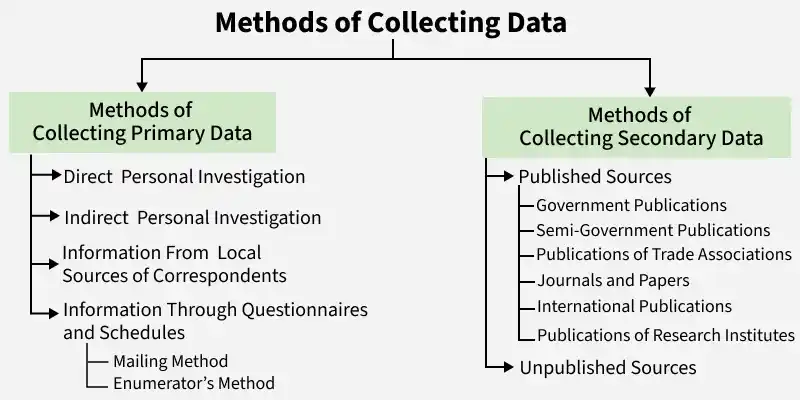
Methods of Collecting Data
Primary Data
Primary data is information collected directly from original sources for a specific research purpose. It is fresh, relevant and tailored to the study. Advantages of primary data is
- High accuracy
- More control over data quality
- Specific to research objectives
Methods of Collecting Primary Data
There are a number of methods of collecting primary data, Some of the common methods are as follows:
**1. Interviews: Interviews involve direct communication between the investigator and respondents.
- **Direct Personal Investigation****:** The investigator personally collects information from the source.
- **Indirect Oral Investigation****:** Information is collected from third parties who possess relevant knowledge.
- **Advantage: Provides real-time, natural data; no reliance on self-reported information.
- **Disadvantage: Observer bias; limited to what can be seen; may influence subjects' behavior.
- **Suitable Use Case: Behavioral studies, user experience research.
**2. Questionnaires: A questionnaire is a structured set of questions prepared to collect information. The investigator can collect data through the questionnaire in two ways:
- **Mailing Method: Questionnaires are sent by mail or online.
- **Enumerator’s Method: The enumerator personally visits respondents and fills the questionnaire.
- **Advantage: Can reach a large audience quickly and cost-effectively.
- **Disadvantage: Responses may be biased or inaccurate; low response rates.
- **Suitable Use Case: Customer satisfaction surveys, market research.
**3. Observations: The observation method involves collecting data by watching and recording behaviors or events as they naturally occur.
- **Advantage: Provides real-time, authentic data without reliance on self-reported information.
- **Disadvantage: Risk of observer bias and behavior changes.
- **Suitable Use Case: User behavior studies, classroom analysis, field research.
**4. Experiments: The experiment method involves manipulating variables in a controlled environment to study cause-and-effect relationships.
- **Advantage: Allows for the establishment of cause-and-effect relationships with high precision.
- **Disadvantage: Can be expensive and less realistic.
- **Suitable Use Case: Drug testing, teaching method evaluation, marketing impact analysis.
**5. Focus Group: A focus group gathers 6–12 participants to discuss a topic under a moderator’s guidance.
- **Advantage: Provides diverse and detailed insights.
- **Disadvantage: Results may not represent the larger population.
- **Suitable Use Case: Product feedback, brand perception studies, public opinion research.
**6. Local Correspondents: In Local Correspondent method, for the collection of data, the investigator appoints correspondents or local persons at various places, which are then furnished by them to the investigator. With the help of correspondents and local persons, the investigators can cover a wide area.
Secondary Data
Secondary data is collected from information that has already been gathered, processed and published by others. It is broadly classified into Published Sources and Unpublished Sources.
Methods of Collecting Secondary Data
Secondary data can be collected through different published and unpublished sources. Some of them are as follows:
1. Published Sources
Published sources are officially available reports and documents that provide reliable and structured data for research and analysis.
- **Government Publications: Central and State Governments publish statistical reports such as census data, economic surveys and industrial statistics. **Examples of Government publications on Statistics are the Annual Survey of Industries, Statistical Abstract of India, etc.
- **Semi-Government Publications: Different Semi-Government bodies also publish data related to health, education, deaths and births. These kinds of data are also reliable and used by different informants. Some **examples of semi-government bodies are Metropolitan Councils, Municipalities, etc.
- **Publications of Trade Associations: Various big trade associations collect and publish data from their research and statistical divisions of different trading activities and their aspects. **For example, data published by Sugar Mills Association regarding different sugar mills in India.
- **Journals and Papers: Different newspapers and magazines provide a variety of statistical data in their writings, which are used by different investigators for their studies.
- **International Publications: Different international organizations like IMF, UNO, ILO, World Bank, etc., publish a variety of statistical information which are used as secondary data.
- **Publications of Research Institutions: Research institutions and universities also publish their research activities and their findings, which are used by different investigators as secondary data. For example National Council of Applied Economics, the Indian Statistical Institute, etc.
2. Unpublished Sources
Unpublished sources are another source of collecting secondary data. The data in unpublished sources is collected by different government organizations and other organizations. These organizations usually collect data for their self-use and are not published anywhere. For example, research work done by professors, professionals, teachers and records maintained by business and private enterprises.
Example: Understanding Variables in Secondary Data
The table below shows the production of rice in India.
| Year (X) | Production of Rice (Y) |
|---|---|
| 1950–1951 | 20.58 |
| 1966–1967 | 30.34 |
| 1975–1976 | 48.74 |
| 1998–1999 | 86.03 |
| 2002–2003 | 77.70 |
| 2020–2021 | 120.00 |
| 2023–2024 (Estimated) | 136.76 |
From the data, we can observe that rice production has increased significantly over time, though there are slight fluctuations in some years. For example:
- In 1950–1951, production was 20.58 million tonnes.
- By 2020–2021, it increased to 120 million tonnes.
- The estimated production for 2023–2024 is 136.76 million tonnes.
**Understanding Variables
- Year (X) is one variable.
- Production of Rice (Y) is another variable.
Since production changes from year to year, it is called a variable. A variable is a quantity whose value varies across observations. By analyzing such data, investigators can identify long-term growth trends, production patterns and agricultural development over time.