Data Mart (original) (raw)
Last Updated : 6 Nov, 2025
A data mart is a specialized subset of a data warehouse focused on a specific functional area or department within an organization. It provides a simplified and targeted view of data, addressing specific reporting and analytical needs. Data marts are smaller in scale and scope, typically holding relevant data for a specific group of users, such as sales, marketing or finance.
**Note: They are organized around specific subjects, such as sales, customer data or product information and are structured, transformed and optimized for efficient querying and analysis within the domain.
Types of Data Mart
There are three common types of data marts:
- Independent Data Mart
- Dependent Data Mart
- Hybrid Data Mart
1. Independent Data Mart
- An independent data mart is created and maintained separately from the data warehouse.
- It is created to satisfy the particular needs of a specific business unit or department.
- Independent data marts are typically smaller in size and more rapidly and readily set up.
- They offer flexibility and agility since they are not constrained by the challenges of the centralized data warehouse.
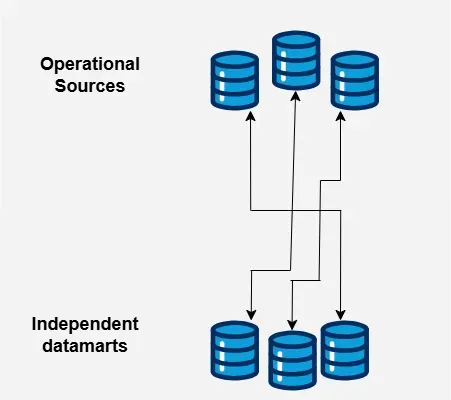
Independent Data Mart
**Note: Nevertheless, data redundancy and inconsistency may result if it is replicated over several different data marts.
2. Dependent Data Mart
- A dependent data mart is generated right out of a data warehouse. It takes some of the data from the data warehouse and arranges it to meet the needs of a specific industry.
- Dependent data marts, which profit from the data integration, data quality and consistency provided by the data warehouse, allow for the centralization and preservation of all data in a single source of truth.
- They are often developed to serve particular reporting and analytical needs and they are frequently updated from the data warehouse.
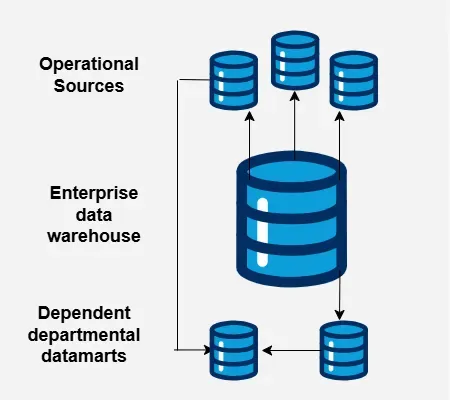
Dependent Data Mart
**Note: Dependent data marts offer data consistency and prevent data duplication because they rely on the data warehouse as their main source of data.
3. Hybrid Data Mart
- Both independent and dependent data mart components can be found in a hybrid data mart.
- As well as combining additional data sources particular to a given business unit or department, it makes use of the centralized data warehouse for the integration and consistency of the core data.
- By offering flexibility and agility for department-specific needs while keeping the integrity and consistency of shared data from the data warehouse, hybrid data marts offer the benefits of both strategies.
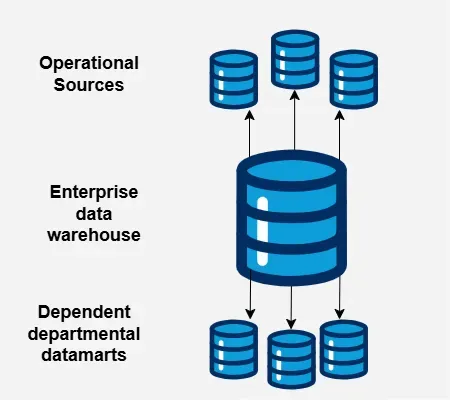
Hybrid Data Mart
**Note: This strategy creates a balance between localized data management and centralized data management.
Structures of Data Mart
These typical structures are used by data marts to represent and store information:
1. Star
A common data mart structure is the dimensional model, commonly referred to as a star architecture. It comprises numerous dimension tables surrounding a core fact table. The fact table includes quantifiable information or metrics about a certain business procedure or topic matter, such as sales or inventory.
- Dimension tables offer contextual or descriptive details about the data in the fact table.
- Typically, each dimension table depicts a certain feature or perspective of the data, such as time, region, products or consumers.
- Through primary-key and foreign-key associations, the fact table and dimension tables are connected, creating a star-like structure.
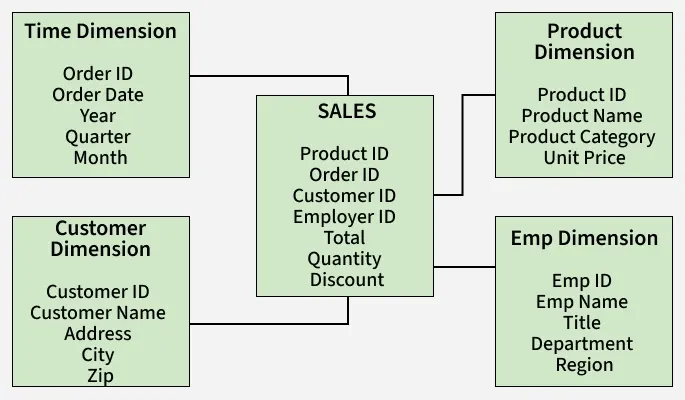
Star Schema
**Note: This format makes it simple for users to quickly slice and dice data along many dimensions, which supports effective querying and analysis.
2. Snowflake
A dimensional model extension that offers more normalized data structures is the snowflake model. By dividing them into several linked tables, this structure further normalizes dimension tables. When working with complex hierarchies or when a dimension has a lot of properties, this normalization can help decrease data redundancy.
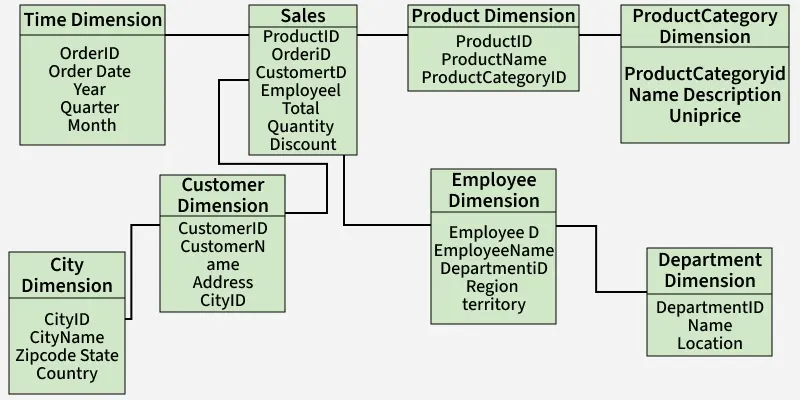
Snowflake Schema
**Note: The snowflake model , however, can make searches and data integration procedures more difficult.
Advantages of Data Mart
- Data marts are built to serve the specific reporting and analytical requirements of a particular business unit or department.
- Data marts are designed to provide optimized performance for specific business areas or departments.
- By storing a subset of relevant data and tailoring the structure to meet specific analytical needs, data marts can deliver faster query response times and improved data retrieval performance.
- Data marts empower business users by providing them with direct access to relevant data and analytical tools .
- Users can access and analyze data more efficiently, leading to enhanced productivity and decision-making.