Introduction to Data Sampling (original) (raw)
Last Updated : 28 Apr, 2026
Data sampling is a statistical method that selects a representative subset (sample) from a large dataset. Analysts then study this sample to make inferences and draw conclusions about the entire dataset.
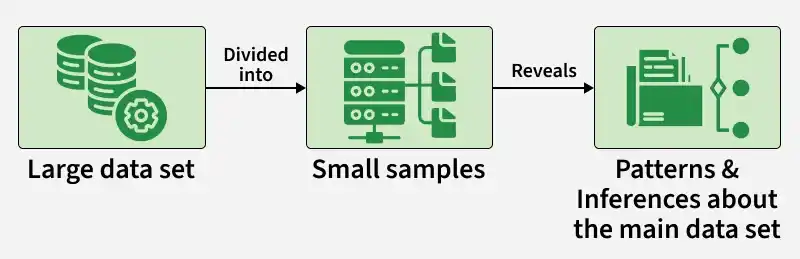
Data Sampling
Data sampling is essential for efficiently analyzing large datasets. It is important for the following reasons:
- **Cost and Time Efficient: Sampling reduces the time and resources needed by analyzing just a portion of the data instead of the entire dataset.
- **Feasible for Large Populations: When it is too costly or impractical to study the whole population, sampling offers a manageable and effective solution.
- **Reduces Risk of Error: By using proper sampling methods, researchers can avoid biases and minimize the influence of outliers.
- **Maintains Accuracy: A well-chosen sample can accurately reflect the larger population ideal when testing or analyzing everything isn’t possible.
Data Sampling Process
The process of data sampling involves the following steps:
- **Identify the Target Dataset: Choose the large dataset you want to study it represents the whole population.
- **Determine Sample Size: Decide how many data points to include in your sample. This subset will be used for analysis.
- **Choose a Sampling Method: Select a suitable technique like Random, Systematic, Cluster, Stratified or Snowball sampling, based on your goals and data type.
- **Collect the Sample: Apply the chosen method to extract the sample from the dataset systematically.
- **Analyze the Sample: Study the sample to understand patterns and characteristics using statistical tools.
- **Generalize to the Population: Use insights from the sample to make predictions or conclusions about the entire dataset.
Types of Data Sampling Techniques
There are mainly two types of Data Sampling techniques which are further divided into 4 sub-categories each. They are as follows:
1. Probability Data Sampling Technique
Probability Sampling ensures every data point has a known, non-zero chance of being selected. This helps create a representative sample, allowing reliable generalization to the whole population.
- **Simple Random Sampling: Each data point has an equal chance of selection. For example Tossing a coin head or tail has equal probability.
- S**ystematic Sampling: Data is selected at regular intervals from an ordered list. For example From 10 entries, selecting every 2nd one (2nd, 4th, 6th...).
- **Stratified Sampling: Data is divided into groups (strata) based on shared traits and samples are drawn from each group. For example Dividing employees by gender, then sampling from each group.
- **Cluster Sampling: Random groups (clusters) are selected and then all or some members within them are sampled. For example Choosing random user groups from different mobile networks.
2. Non-Probability Data Sampling
Non-probability data sampling means that the selection happens on a non-random basis and it depends on the individual as to which data does it want to pick. There is no random selection and every selection is made by a thought and an idea behind it.
- **Convenience Sampling: Data is selected based on ease of access and minimal effort. For example Choosing the most recent or easily available IT recruitment data.
- **Voluntary Response Sampling: Participants choose to take part in the study on their own. For example A blood group survey where only willing participants respond.
- **Purposive Sampling: Data is selected for a specific purpose or characteristic. For example Surveying rural areas to study educational needs.
- **Snowball Sampling: Participants recruit others, growing the sample like a snowball. For example One slum resident leads to another in a housing conditions survey.
Steps to Determine Sample Size
Sample size refers to the number of observations selected from the population for analysis. It determines how accurately the sample represents the overall dataset.
- Firstly calculate the population size, as in the total sample space size on which the sampling has to be performed.
- Find the values of confidence levels that represent the accuracy of the data.
- Find the value of error margins if any with respect to the sample space dataset.
- Calculate the deviation from the mean or average value from that of standard deviation value calculated.
Effective Data Sampling
Before performing data sampling, consider the following to ensure accuracy and reliability:
- **Statistical Regularity: Larger datasets improve sampling accuracy by giving each data point an equal chance of selection, ensuring balanced representation.
- **Data Accuracy: Ensure the dataset is correct and verified from reliable sources before sampling.
- **Stratification Clarity: When using stratified sampling, clearly define the strata or groups to be created to represent the population accurately.
- **Sufficient Sample Size: A large enough parent dataset is essential for obtaining clear and stable results.
Advantages
- Enables faster analysis and decision-making.
- Reduces time and computational effort.
- Lowers data collection and processing costs.
- Maintains reliable and accurate results when appropriate sampling techniques are applied.
Limitations
- Differences between the sample and the full population can reduce accuracy if the sample is not well chosen.
- Some sampling methods, such as cluster sampling, can be complex to design and implement.
- Poor sampling can reduce accuracy.
- Small or biased samples can lead to incorrect conclusions.