What is ETL (Extract Transform Load) (original) (raw)
Last Updated : 10 Jun, 2026
ETL (Extract, Transform, Load) is a data integration process used to collect data from multiple sources, transform it into a consistent format and load it into a target system such as a data warehouse or data lake. It helps organizations organize and prepare data for analysis, reporting and decision making.
- Extracts data from different sources and systems.
- Transforms data by cleaning, validating and organizing it.
- Loads the processed data into a database, data warehouse or data lake.
- Ensures data is accurate, consistent and ready for business use.
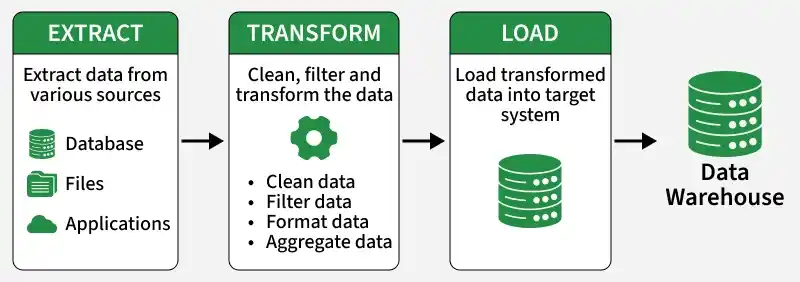
ETL
Working of ETL
ETL works in three main stages: Extract, Transform and Load. These stages help collect data from different sources, prepare it for analysis and store it in a target system.
The extraction stage involves collecting raw data from various sources and moving it to a temporary storage area called the staging area. The data may come in different formats and structures. Common Data Sources:
- SQL and NoSQL databases
- CRM and ERP systems
- JSON and XML files
- Flat files (CSV, TXT, etc.)
- Emails
- Web pages
2. Transform
In the transformation stage, the raw data is cleaned and processed to make it suitable for analysis and storage. Common Transformation Tasks:
- Filtering and cleaning data
- Combining data from multiple sources
- Removing duplicate records
- Performing calculations and aggregations
- Validating data quality and compliance
- Encrypting or securing sensitive information
- Formatting data to match the target system structure
3. Load
In the loading stage, the transformed data is transferred to a target system such as a data warehouse, data lake or database. Data can be loaded all at once, incrementally or through periodic refreshes.
- Stores processed data in the target system.
- Supports full, incremental or refresh based loading.
- Makes data available for reporting, analytics and machine learning.
- Often scheduled during low activity periods to reduce system impact.
ETL tools
ETL tools are software applications that automate the process of extracting, transforming and loading data from multiple sources into a target system. They help organizations efficiently prepare data for analytics, reporting and machine learning.
- Provide user-friendly interfaces for designing and managing data pipelines.
- Support data cleaning, transformation and validation tasks.
- Handle complex operations such as calculations, aggregations and data merging.
- Ensure data security through encryption and compliance with industry standards.
- Many modern ETL tools also support ELT, real-time processing and streaming data for AI and analytics applications.
- Common examples include Informatica Power Center, AWS Glue, Apache NiFi, Microsoft SSIS and IBM DataStage.
Alternative Data Integration Methods
While ETL and ELT are widely used for data integration, several other methods help organizations collect, process and access data efficiently.
1. Change Data Capture (CDC)
Change Data Capture (CDC) identifies and captures only the data that has changed since the last update. This reduces processing time and resource usage by avoiding the movement of unchanged data.
- Captures only modified data.
- Reduces data transfer and processing costs.
- Supports near real time data updates.
2. Data Virtualization
Data Virtualization provides a unified view of data from multiple sources without physically moving or copying it.
- Creates a single view of distributed data.
- Eliminates the need for data duplication.
- Enables faster access to information from different systems.
3. Stream Data Integration (SDI)
Stream Data Integration (SDI) continuously collects, processes and transfers data in real time for immediate analysis.
- Processes data as it is generated.
- Supports real time analytics and monitoring.
- Commonly used in applications such as fraud detection and IoT systems.
Advantages
- Improves data quality by removing errors, inconsistencies and duplicate records.
- Automates data integration processes, reducing manual effort and saving time.
- Organizes and prepares data for reporting, analytics and business intelligence.
- Converts raw data into a structured format suitable for analysis.
- Efficiently handles large volumes of data from multiple sources.
Limitations
- Can become complex when dealing with multiple data sources and formats.
- Requires regular maintenance as data sources and business requirements evolve.
- May lead to data loss or inconsistencies if transformations are not handled properly.
- Large datasets and complex transformations can introduce processing delays.
- Performance and scalability may become challenging as data volume grows.