Data Warehousing Security (original) (raw)
Last Updated : 4 Jun, 2026
Data warehousing is the process of collecting and storing large amounts of data from different sources in one central place. It helps organizations analyze data, generate insights and make better business decisions using accurate and organized information.
- Stores data from multiple sources in one place
- Helps in better decision-making
- Supports data analysis and reporting
- Protects data from unauthorized access
- Helps organizations meet compliance requirements
Data Warehouse Security Threats
Data warehousing systems store large amounts of important organizational data, so they can face several security threats that may affect data confidentiality, integrity and availability.
- **Unauthorized Access: Unauthorized users may enter the data warehouse due to weak passwords or insecure systems, leading to data modification or deletion.
- **Data Theft: Sensitive data may be stolen physically or through hacking and cyberattacks.
- **Hacking: Attackers may gain illegal access to the data warehouse to steal, damage or manipulate data.
- **Malware Attacks: Malware such as viruses, ransomware or phishing attacks can corrupt or steal data.
- **Insider Threats: Employees or authorized users may misuse their access privileges for harmful purposes.
Security Mechanisms in Data Warehousing
Data warehouses store large amounts of sensitive data, so security mechanisms are needed to protect the data from threats like hacking, unauthorized access and data theft.
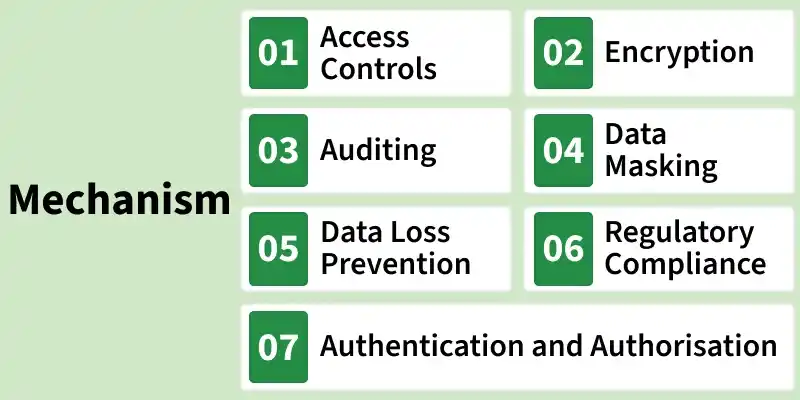
Security Mechanisms
- **Access Control: Restricts data warehouse access only to authorized users using user accounts and permissions.
- **Authentication and Authorization: Verifies user identity using methods like passwords, two-factor authentication or biometrics, and ensures users access only the data they need.
- **Encryption: Protects data by converting it into encrypted form during storage and transmission.
- **Auditing: Monitors and records user activities to detect suspicious behavior or security breaches.
- **Data Masking: Hides sensitive information by replacing real data with masked or fake data.
- **Data Loss Prevention: Uses backups, firewalls and recovery systems to prevent data loss or destruction.
- **Regulatory Compliance: Ensures the organization follows security and privacy standards such as GDPR, HIPAA and PCI-DSS.
Database vs. Data Warehouse
| Basis | Database | Data Warehouse |
|---|---|---|
| Purpose | Used for storing and managing current data. | Used for analyzing historical data. |
| Data | Stores current and updated data. | Stores historical data from multiple sources. |
| Usage | Supports daily operations and transactions. | Supports reporting and decision-making. |
| Processing | OLTP (transaction processing). | OLAP (analytical processing). |
| Examples | MySQL, Oracle | Snowflake, Amazon Redshift |
Advantages
- Improves customer trust by protecting the confidentiality and integrity of data.
- Helps maintain data quality and accuracy through access controls and audit trails.
- Reduces financial losses caused by security breaches, legal issues and reputation damage.
Disadvantages
- Implementing security measures can make data warehousing systems more complex to manage and maintain.
- Security controls such as access restrictions may slow down decision-making and business operations.
- Strong security mechanisms may reduce flexibility and quick access to data for users.