What is Big Data? (original) (raw)
Last Updated : 1 Aug, 2025
Big Data refers to vast and rapidly growing volumes of data that are too large and complex for traditional data processing tools to manage. This data comes in many forms structured (e.g., tables), semi-structured (e.g., JSON, XML), and unstructured (e.g., text, images, video).
With the explosion of devices, sensors, online services, and digital platforms, data is now generated at an unprecedented rate. This growth makes it essential for organizations to adopt advanced tools and technologies to capture, store, analyze, and utilize this data effectively.
Practical Uses of Big Data
Organizations use Big Data to:
- Make smarter decisions by identifying trends and patterns
- Predict customer behavio**r and personalize user experiences
- Improve operational efficiency by finding process inefficiencies
- Innovate faster by identifying new business opportunities
- Enhance risk management by detecting fraud or security threats
Big Data transforms raw information into actionable insights that help companies gain a competitive edge.
The 5 V’s of Big Data
- **Volume: Refers to the huge amount of data generated every second-ranging from terabytes to petabytes. Example: YouTube uploads 500+ hours of video every minute.
- **Velocity: The speed at which data is created, shared, and processed. Data streams in from sensors, social media, and transactions in real-time.
- **Variety: Data comes in multiple formats-text, audio, images, videos, logs, sensor data, etc. Handling all these types together is complex
- **Veracity: Refers to the trustworthiness and accuracy of the data. Inconsistent, duplicated, or noisy data can lead to wrong insights.
- **Value: Not all data is useful. The key is extracting relevant data and turning it into business value through analytics.
Additional V’s:
- **Variability: Data meaning may change over time or context.
- **Visualization: Making complex data understandable through visual tools (charts, graphs, dashboards).
How Big Data Works
To make Big Data useful, organizations follow a **3-step process:
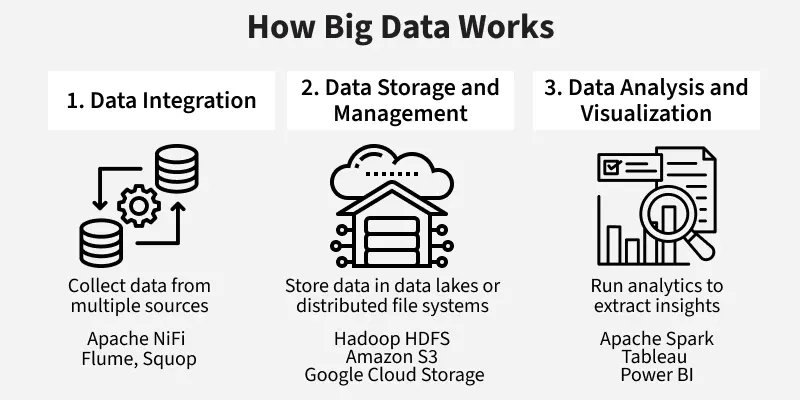
Big Data workflow
1. **Data Integration
- Collect data from multiple sources: apps, sensors, websites, logs, etc.
- Tools used: Apache NiFi, Flume, Sqoop
2. **Data Storage and Management
- Store data in data lakes or distributed file systems like HDFS
- Choose between cloud-based storage or on-premises infrastructure
- Tools used: Hadoop HDFS, Amazon S3, Google Cloud Storage
3. **Data Analysis and Visualization
- Run analytics to extract insights using tools like Spark or Python
- Create dashboards and reports for decision-making
- Tools used: Apache Spark, Tableau, Power BI, Python (Pandas, NumPy)
Core Big Data Technologies
| **Tool | **Purpose |
|---|---|
| **Hadoop | Distributed storage and batch processing |
| **Apache Spark | In-memory fast data processing |
| **Kafka | Real-time data streaming |
| **Hive & Pig | Querying and analyzing big datasets |
| **NoSQL Databases | Scalable databases (e.g., MongoDB, Cassandra) |
| **Data Lakes | Store raw data in any format for future use |
**Real-World Applications of Big Data
Big Data is changing how industries operate. Here are some examples:
- **Retail: Amazon and Flipkart use purchase history and browsing patterns to suggest products.
- **Finance: Banks detect fraudulent transactions in real-time using Big Data models.
- **Healthcare: Hospitals analyze patient records and medical data to improve diagnoses and treatment.
- **Transportation: Uber uses GPS and traffic data to reduce wait times and improve driver routes.
**Benefits of Big Data
- **Better Decision-Making: Identify trends, customer needs, and risks for smarter strategies.
- **Faster Innovation: Speed up product development by quickly analyzing market feedback.
- **Enhanced Customer Experience: Personalize offerings based on behavior and preferences.
- **Operational Efficiency: Detect inefficiencies and automate repetitive tasks.
- **Risk & Threat Detection: Monitor suspicious activity and prevent financial fraud or cyberattacks.