Introduction to Branched RAG (original) (raw)
Last Updated : 6 Feb, 2026
Branched RAG is an extension of Retrieval-Augmented Generation (RAG) where the system explores multiple retrieval or reasoning paths instead of a single linear process. By considering different sources or perspectives before generating a response, it helps produce more accurate, structured and context-aware answers compared to traditional RAG which typically follows only one retrieval path.
- Enables parallel retrieval and reasoning paths
- Improves performance on multi‑facet or ambiguous queries
- Useful for complex QA, analysis and decision‑support systems
- Aggregating results from several branches helps generate balanced and well-informed outputs.
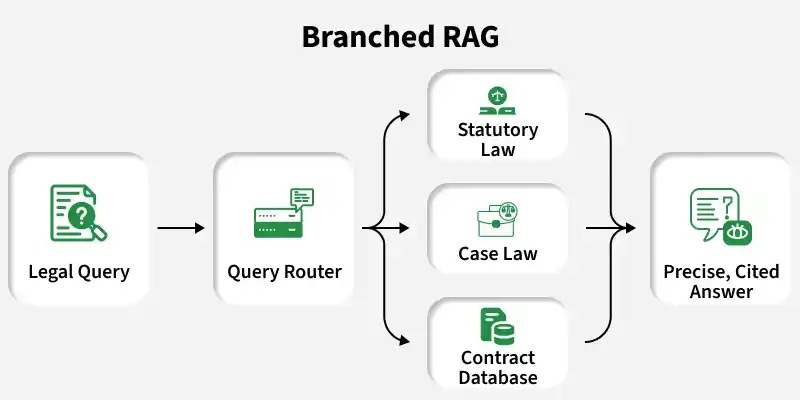
Branched RAG
Branched RAG is an advanced technique where a user query is divided into multiple paths or branches instead of following a single retrieval flow. In this approach:
- A single query is split into multiple reasoning or retrieval branches.
- Each branch retrieves different but relevant information from various sources.
- The model processes these branches independently to explore multiple perspectives.
- The outputs from all branches are then combined to produce a more accurate and well-informed final response.
Components of Branched RAG
The main components of Branched RAG are:
- **External Knowledge Source: Stores domain specific or general information such as documents, databases, APIs or knowledge bases used for retrieval.
- **Branch Generator: Breaks the user query into multiple reasoning paths or sub-queries to explore different perspectives.
- **Embedding Model: Converts text into numerical vector representations that capture semantic meaning.
- **Vector Database: Stores embeddings and enables fast similarity search for retrieving relevant information.
- **Branch Retrievers: Each branch independently retrieves relevant documents based on its specific context or interpretation.
- **Branch Processing Module: Processes and analyses retrieved information separately for each branch.
- **Aggregation Layer: Combines outputs from multiple branches to create a unified understanding.
- **LLM (Generator): Generates the final response using combined information from all branches.
Working of Branched RAG
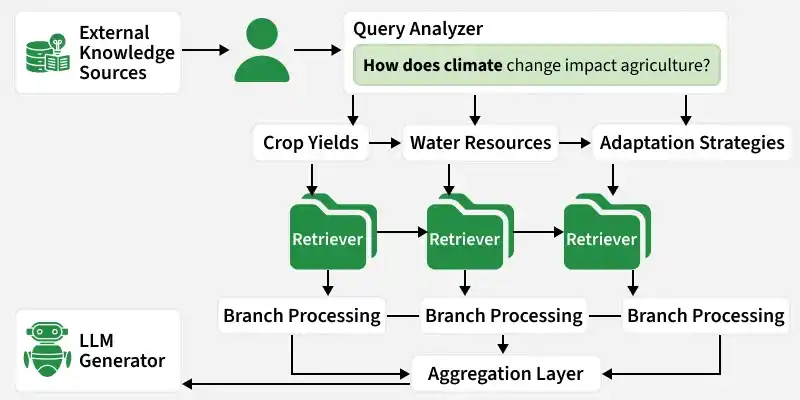
Working of Branched RAG
1. Query Understanding
The system receives a user query and analyses its intent, scope and keywords to determine whether the query contains multiple aspects, sub-questions or reasoning paths.
2. How the Query Is Split (Branch Creation)
After understanding the query, it is divided into multiple logical branches:
1. The query is decomposed into independent sub-queries based on intent, entities or reasoning requirements
2. Each branch targets a specific sub-topic or interpretation
3. Branching can be based on:
- Different concepts in the query
- Multiple entities or timeframes
- Alternative reasoning paths like facts, comparisons, causes, examples, etc
This allows the system to explore multiple directions instead of following a single retrieval path.
3. Parallel Retrieval
Each branch retrieves relevant information independently from external sources such as:
- Vector databases
- Knowledge graphs
- Documents or APIs
This happens in parallel, reducing latency and increasing information.
4. Independent Processing
The retrieved information from each branch is processed separately:
- Each branch performs focused reasoning
- Noise is reduced by keeping contexts isolated
- The model can apply deeper analysis specific to that sub-topic
5. How Outputs Are Aggregated (Aggregation and Fusion)
Once all branches finish processing, their outputs are combined using aggregation logic:
- Relevant results are ranked or scored based on relevance
- Redundant or conflicting information is filtered
- Key insights from each branch are merged into a single coherent context
This step ensures completeness without duplication.
6. Final Response Generation
The LLM generates the final answer using the aggregated context:
- Combines insights from all branches
- Maintains logical flow and consistency
- Produces a context-aware and well-rounded response
Simple RAG vs Branched RAG
Lets see a quick difference between simple Retrieval-Augmented Generation (RAG) and Branched RAG:
| Feature | Simple RAG | Branched RAG |
|---|---|---|
| Approach | Uses a single retrieval pipeline. | Splits query into multiple branches for retrieval. |
| Query Processing | Processes query as one unit. | Breaks query into sub-parts and analyses separately. |
| Information Coverage | Limited to one retrieval context. | Broader coverage from multiple sources. |
| Complexity | Simple and easy to implement. | More complex due to branching logic. |
| Performance on Complex Tasks | Best for straightforward queries. | Better for multi-step or complex problems. |
| Use Cases | Basic chatbots, document search. | Research assistants, advanced reasoning tasks. |
What Problems does Branched RAG Solve?
- **Single Perspective Limitation: Traditional RAG follows one retrieval path, which may miss alternative viewpoints. Branched RAG explores multiple reasoning paths to capture broader context.
- **Incomplete Information Retrieval: A single retrieval step may overlook important data. Multiple branches increase the chances of finding relevant information.
- **Complex Query Handling: Multi-topic or multi-step questions benefit from branching, where different aspects of a query are handled separately.
- **Improved Reasoning Quality: Parallel processing of branches allows deeper analysis and more structured responses.
- **Reduced Bias and Errors: Combining results from multiple branches helps reduce reliance on a single source, improving reliability.
- **Better Context Awareness: Multiple retrieval paths help maintain richer context, especially for complicated or analytical tasks.
Challenges
Despite its advantages, Branched RAG introduces several challenges:
- **System Complexity: Managing multiple branches and combining results increases architectural complexity.
- **Higher Computational Cost: Running parallel retrieval and reasoning processes may require more resources.
- **Latency Issues: Additional processing steps can increase response time compared to traditional RAG.
- **Aggregation Difficulty: Effectively merging outputs from different branches requires careful design.
Applications
Some practical applications of Branched RAG :
- **Advanced Question Answering Systems: Enables AI assistants to analyse multiple perspectives before generating answers.
- **Research and Knowledge Exploration: Useful for analysing large amounts of information from different sources simultaneously.
- **Decision Support Systems: Evaluates multiple reasoning paths to help generate balanced conclusions.
- **Enterprise Knowledge Management: Retrieves information across multiple departments or datasets for comprehensive responses.
- **Content Generation and Analysis: Produces richer and more structured outputs by combining insights from different branches.