Quartile Deviation in Discrete Series | Formula, Calculation and Examples (original) (raw)
Last Updated : 23 Jul, 2025
What is Quartile Deviation?
**Quartile Deviation (_absolute measure) divides the distribution into multiple quarters. Quartile Deviation is calculated as the average of the difference of the upper quartile (Q3) and the lower quartile (Q1).
Quartile~Deviation=\frac{Q_3-Q_1}{2}
Where,
Q3 = Upper Quartile (Size of 3[\frac{N+1}{4}]^{th} item)
Q1 = Lower Quartile (Size of [\frac{N+1}{4}]^{th} item)
What is Interquartile Range?
Interquartile Range refers to the difference between two quartiles.
Interquartile Range = Q3 - Q1
What is Coefficient of Quartile Deviation?
For comparative studies of the variability of two or more series with different units, the Coefficient of Quartile Deviation (relative measure) is used.
Coefficient~of~Quartile~Deviation=\frac{Q_3-Q_1}{Q_3+Q_1}
Where,
Q3 = Upper Quartile (Size of 3[\frac{N+1}{4}]^{th} item)
Q1 = Lower Quartile (Size of [\frac{N+1}{4}]^{th} item)
Examples of Quartile Deviation in Discrete Series
Example 1:
From the following table, calculate the interquartile range, quartile deviation, and coefficient of quartile deviation.

Solution:
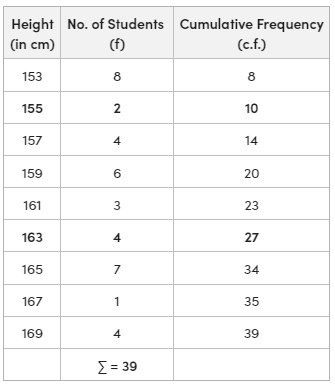
Q_1=Size~of~\frac{N+1}{4}^{th}~item=Size~of~\frac{39+1}{4}^{th}~item=Size~of~10^{th}~item
**Q 1 = 155 centimeters
Q_3=Size~of~3[\frac{N+1}{4}]^{th}~item=Size~of~3[\frac{39+1}{4}]^{th}~item=Size~of~30^{th}~item
**Q 3 = 163 centimeters
**Interquartile Range = Q3 - Q1 = 163 - 155 = 8
**Quartile Deviation = \frac{Q_3-Q_1}{2}=\frac{163-155}{2}=4
**Coefficient of Quartile Deviation = \frac{Q_3-Q_1}{Q_3+Q_1}=\frac{163-155}{163+155}=0.025
Example 2:
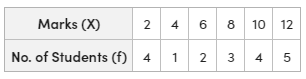
Calculate the interquartile range, quartile deviation, and coefficient of quartile deviation from the following data.
Solution:

Q_1=Size~of~\frac{N+1}{4}^{th}~item=Size~of~\frac{19+1}{4}^{th}~item=Size~of~5^{th}~item
**Q 1 = 4
Q_3=Size~of~3[\frac{N+1}{4}]^{th}~item=Size~of~3[\frac{19+1}{4}]^{th}~item=Size~of~15^{th}~item
**Q 3 = 12
**Interquartile Range = Q3 - Q1 = 12 - 4 = 8
**Quartile Deviation = \frac{Q_3-Q_1}{2}=\frac{12-4}{2}=4
**Coefficient of Quartile Deviation = \frac{Q_3-Q_1}{Q_3+Q_1}=\frac{12-8}{12+8}=0.2
Example 3:
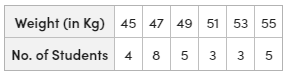
Calculate the interquartile range, quartile deviation, and coefficient of quartile deviation from the following data.
Solution:
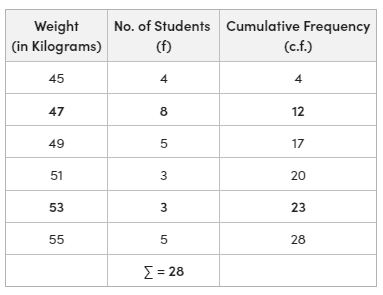
Q_1=Size~of~\frac{N+1}{4}^{th}~item=Size~of~\frac{28+1}{4}^{th}~item=Size~of~7.25^{th}~item
**Q 1 = 47 Kilograms
Q_3=Size~of~3[\frac{N+1}{4}]^{th}~item=Size~of~3[\frac{28+1}{4}]^{th}~item=Size~of~21.75^{th}~item
**Q 3 = 53 Kilograms
**Interquartile Range = Q3 - Q1 = 53 - 47 = 6
**Quartile Deviation = \frac{Q_3-Q_1}{2}=\frac{53-47}{2}=3
**Coefficient of Quartile Deviation = \frac{Q_3-Q_1}{Q_3+Q_1}=\frac{53-47}{53+47}=0.06
Example 4:
Calculate the interquartile range, quartile deviation, and coefficient of quartile deviation from the following data.

Solution:

Q_1=Size~of~\frac{N+1}{4}^{th}~item=Size~of~\frac{199+1}{4}^{th}~item=Size~of~50^{th}~item
**Q 1 = 40 Years
Q_3=Size~of~3[\frac{N+1}{4}]^{th}~item=Size~of~3[\frac{199+1}{4}]^{th}~item=Size~of~150^{th}~item
**Q 3 = 60 Years
**Interquartile Range = Q3 - Q1 = 60 - 40 = 20
**Quartile Deviation = \frac{Q_3-Q_1}{2}=\frac{60-40}{2}=10
**Coefficient of Quartile Deviation = \frac{Q_3-Q_1}{Q_3+Q_1}=\frac{60-40}{60+40}=0.2