Difference Between OneTailed and TwoTailed Tests (original) (raw)
Difference Between One-Tailed and Two-Tailed Tests
Last Updated : 19 Dec, 2023
**One and Two-Tailed Tests are ways to identify the relationship between the statistical variables. For checking the relationship between variables in a **single direction (Left or Right direction), we use a one-tailed test. A two-tailed test is used to check whether the relations between variables are in any direction or not.
**One-Tailed Test
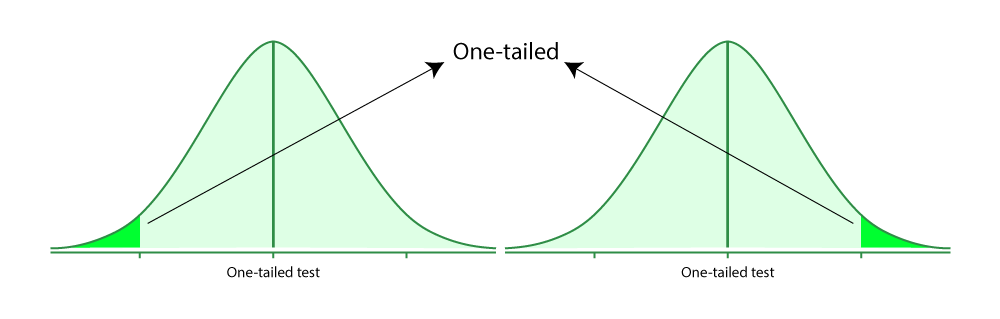
A one-tailed test is based on a uni-directional hypothesis where the area of rejection is on only one side of the sampling distribution. It determines whether a particular population parameter is larger or smaller than the predefined parameter. It uses one single critical value to test the data.
Difference Between One-Tailed and Two-Tailed Tests
**Null Hypothesis ( H**0): where \theta represents a parameter (e.g., population mean) and __θ_0 is a specific value.
**Alternative Hypothesis ( H**1):
- For a right-tailed test: H_1: \theta > \theta_0
- For a left-tailed test: H_1: \theta < \theta_0
**Test Statistic: Depending on the type of test and the distribution, the test statistic is computed (__Z_-score for normal distribution).
**Decision Rule: If the test statistic falls in the critical region, reject the null hypothesis in favor of the alternative hypothesis.
**Example: Effect of participants of students in coding competition on their fear level.
- H0: There is no important effect of students in coding competition on their fear level.
The main intention is to check the **decreased fear level when students participate in a coding competition.
**Two-Tailed Test
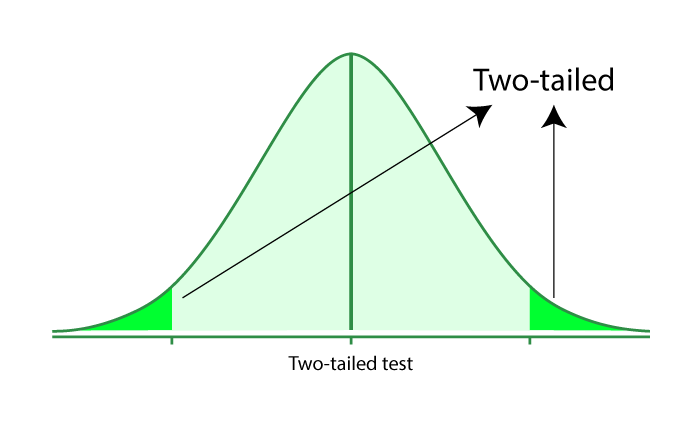
A two-tailed test is also called a nondirectional hypothesis. For checking whether the sample is greater or less than a range of values, we use the two-tailed. It is used for null hypothesis testing.
Difference Between One-Tailed and Two-Tailed Tests
**Null Hypothesis ( H**0): where \theta represents a parameter (e.g., population mean) and __θ_0 is a specific value.
**Alternative Hypothesis ( H**1): \text{Alternative Hypothesis } (H_1): \theta \neq \theta_0 \text{ (not equal to)}
**Test Statistic: Compute the test statistic as appropriate for the distribution (__Z_-score for normal distribution).
**Decision Rule: If the test statistic falls in either tail of the distribution's critical region, reject the null hypothesis in favor of the alternative hypothesis.
**Example: Effect of new bill pass on the loan of farmers.
- H0: There is no significant effect of the new bill passed on loans of farmers.
New bill passes can affect in both ways either **increase or decrease the loan of farmers.
**Difference Between One and Two-Tailed Test:
| **One-Tailed Test | **Two-Tailed Test |
|---|---|
| A test of any statistical hypothesis, where the alternative hypothesis is **one-tailed either right-tailed or left-tailed. | A test of a statistical hypothesis, where the alternative hypothesis is **two-tailed. |
| For one-tailed, we use either **> or ****<** sign for the alternative hypothesis. | For two-tailed, we use ≠ sign for the alternative hypothesis. |
| When the alternative hypothesis specifies a direction then we use a one-tailed test. | If no direction is given then we will use a two-tailed test. |
| Critical region lies entirely on either the right side or left side of the sampling distribution. | Critical region is given by the portion of the area lying in both the tails of the probability curve of the test statistic. |
| Here, the Entire level of significance (α) i.e. 5% has either in the left tail or right tail. | It splits the **level of significance (α) into half. |
| Rejection region is either from the left side or right side of the sampling distribution. | Rejection region is from both sides i.e. left and right of the sampling distribution. |
| It checks the relation between the variable in a singles direction. | It checks the relation between the variables in any direction. |
| It is used to check whether the one mean is different from another mean or not. | It is used to check whether the two mean different from one another or not. |