Python Bokeh Plotting a Line Graph (original) (raw)
Last Updated : 3 Jul, 2020
Bokeh is a Python interactive data visualization. It renders its plots using HTML and JavaScript. It targets modern web browsers for presentation providing elegant, concise construction of novel graphics with high-performance interactivity. Bokeh can be used to plot a line graph. Plotting a line graph can be done using the line() method of the plotting module.
plotting.figure.line()
Syntax : line(parameters)Parameters :
- x : x-coordinates of the points to be plotted
- y : y-coordinates of the points to be plotted
- line_alpha : percentage value of line alpha, default is 1
- line_cap : value of line cap for the line, default is butt
- line_color : color of the line, default is black
- line_dash : value of line dash such as :
- solid
- dashed
- dotted
- dotdash
- dashdot
default is solid- line_dash_offset : value of line dash offset, default is 0
- line_join : value of line join, default in bevel
- line_width : value of the width of the line, default is 1
- name : user-supplied name for the model
- tags : user-supplied values for this model Other Parameters :
- alpha : sets all alpha keyword arguments at once
- color : sets all color keyword arguments at once
- legend_field : name of a column in the data source that should be used
- legend_group : name of a column in the data source that should be used
- legend_label : labels the legend entry
- muted : determines whether the glyph should be rendered as muted or not, default is False
- name : optional user-supplied name to attach to the renderer
- source : user-supplied data source
- view : view for filtering the data source
- visible : determines whether the glyph should be rendered or not, default is True
- x_range_name : name of an extra range to use for mapping x-coordinates
- y_range_name : name of an extra range to use for mapping y-coordinates
- level : specifies the render level order for this glyph Returns : an object of class
GlyphRenderer
**Example 1 :**In this example we will be using the default values for plotting the graph.
Python3 1== `
importing the modules
from bokeh.plotting import figure, output_file, show
file to save the model
output_file("gfg.html")
instantiating the figure object
graph = figure(title = "Bokeh Line Graph")
the points to be plotted
x = [1, 2, 3, 4, 5] y = [1, 6, 8, 2, 3]
plotting the line graph
graph.line(x, y)
displaying the model
show(graph)
`
Output : 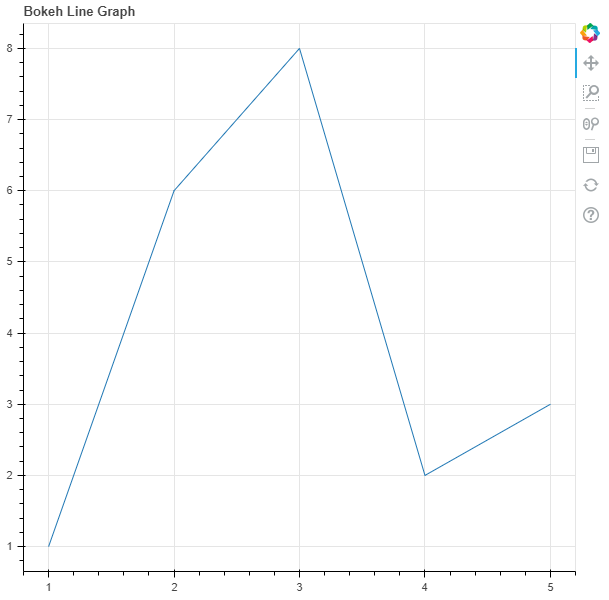 **Example 2 :**In this example we will be plotting a line graph with dotted lines alongside other parameters.
Python3 1== `
importing the modules
from bokeh.plotting import figure, output_file, show
file to save the model
output_file("gfg.html")
instantiating the figure object
graph = figure(title = "Bokeh Line Graph")
name of the x-axis
graph.xaxis.axis_label = "x-axis"
name of the y-axis
graph.yaxis.axis_label = "y-axis"
the points to be plotted
x = [1, 2, 3, 4, 5] y = [5, 2, 1, 7, 1]
color of the line
line_color = "red"
type of line
line_dash = "dotted"
offset of line dash
line_dash_offset = 1
name of the legend
legend_label = "Sample Line"
plotting the line graph for AAPL
graph.line(x, y, line_color = line_color, line_dash = line_dash, line_dash_offset = line_dash_offset, legend_label = legend_label)
displaying the model
show(graph)
`
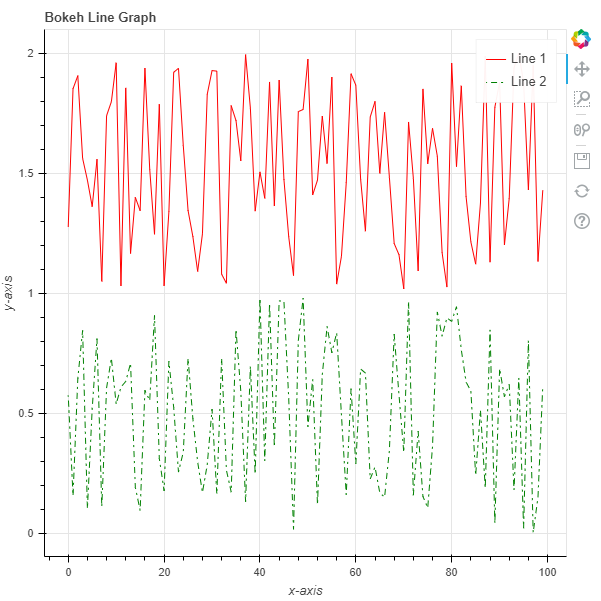
Output : 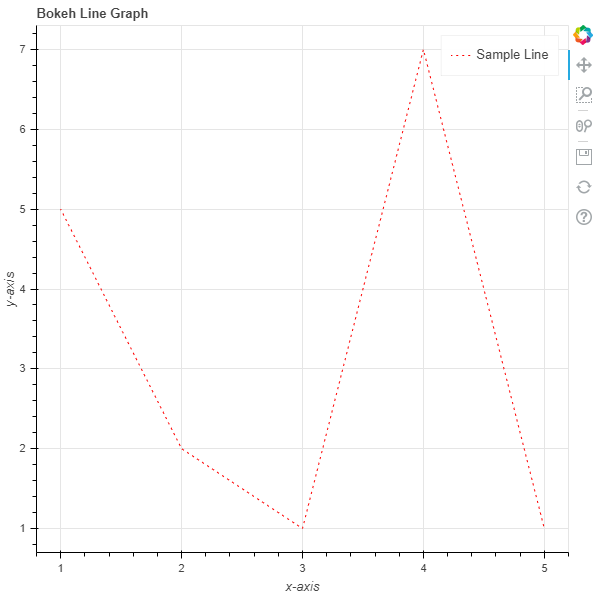 **Example 3 :**Now we will see how to plot multiple lines in the same graph. We will generate the points using the
 random() function.
Python3 1== `
importing the modules
from bokeh.plotting import figure, output_file, show import random
file to save the model
output_file("gfg.html")
instantiating the figure object
graph = figure(title = "Bokeh Line Graph")
name of the x-axis
graph.xaxis.axis_label = "x-axis"
name of the y-axis
graph.yaxis.axis_label = "y-axis"
plotting line 1
generating the points to be plotted
x = [] y = [] for i in range(100): x.append(i) for i in range(100): y.append(1 + random.random())
parameters of line 1
line_color = "red" line_dash = "solid" legend_label = "Line 1"
plotting the line
graph.line(x, y, line_color = line_color, line_dash = line_dash, legend_label = legend_label)
plotting line 2
generating the points to be plotted
x = [] y = [] for i in range(100): x.append(i) for i in range(100): y.append(random.random())
parameters of line 2
line_color = "green" line_dash = "dotdash" line_dash_offset = 1 legend_label = "Line 2"
plotting the line
graph.line(x, y, line_color = line_color, line_dash = line_dash, line_dash_offset = line_dash_offset, legend_label = legend_label)
displaying the model
show(graph)
`
Output :