Concurrency Control in DBMS (original) (raw)
Last Updated : 27 Oct, 2025
In a Database Management System (DBMS), Concurrency control is a mechanism in DBMS that allows simultaneous execution of transactions while maintaining ACID properties - Atomicity, Consistency, Isolation and Durability. It maintains the integrity, accuracy and reliability of data when multiple users or processes perform read/write operations concurrently. It helps manage issues like:
- Conflicting operations on shared data
- Inconsistent database states
- Lost or incorrect updates
**Note: By implementing concurrency control techniques such as locking or timestamp ordering, DBMS ensures that transactions are executed safely and independently, even when they overlap in time.
Need of Concurrency Control
Concurrency control is essential to:
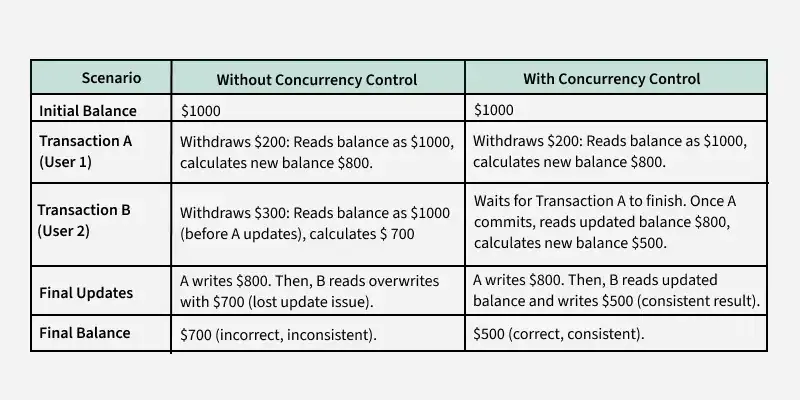
Concurrency Control
- Prevent conflicts between simultaneous transactions.
- Maintain data consistency and accuracy in multi-user environments.
- Avoid problems such as dirty reads, lost updates and inconsistent reads.
Example:
- **Without concurrency control: Two users update the same record simultaneously and one update overwrites the other.
- **With concurrency control: The DBMS uses locks or timestamps to ensure updates occur sequentially and data remains correct.
Concurrency Problems in DBMS
When multiple transactions execute concurrently, several problems may occur:
- **Dirty Read: A transaction reads uncommitted data from another transaction that may later roll back.
- **Lost Update: Two transactions update the same data and one update overwrites the other.
- **Inconsistent Read: A transaction reads the same data multiple times and the data changes in between reads.
Concurrency Control Protocols
Concurrency control protocols define rules to ensure correct and consistent execution of transactions. The main protocols are:
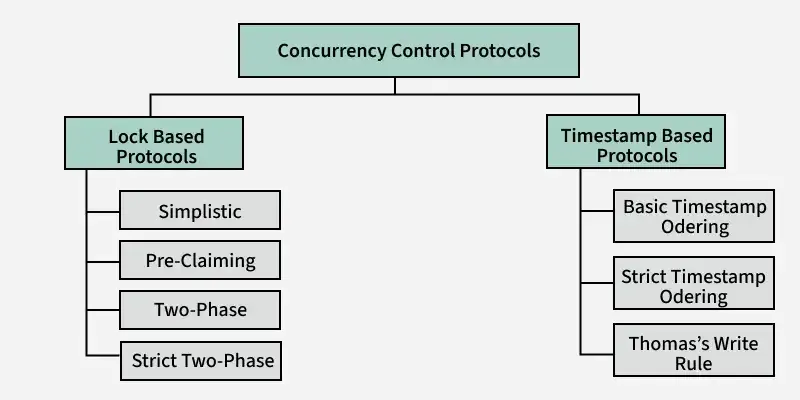
Concurrency Control Protocols
1. Lock-Based Concurrency Control:
- Uses locks to restrict access to data items during a transaction. Common types include shared locks (read) and exclusive locks (write).
- Ensures serializability and prevents conflicts.
- **Example: Two-Phase Locking (2PL) guarantees that once a transaction releases a lock, it cannot obtain any new locks.
2. Timestamp-Based Concurrency Control:
- Each transaction is assigned a timestamp.
- The DBMS uses these timestamps to order transactions and prevent conflicts based on their start time.
Read more about Locked based concurrency control protocol & Timestamp based concurrency control protocol
Recoverable and Cascadeless Schedules
Concurrency control also ensures proper scheduling of transactions:
Recoverable Schedules:
- A transaction commits only if all transactions it depends on have committed.
- Prevents inconsistencies caused by dependent transactions.
- **Example: Strict 2PL ensures recoverability by delaying commits until all dependent transactions commit.
Cascadeless Schedules:
- Avoids cascading rollbacks, where one failed transaction causes others to fail.
- Achieved by allowing transactions to read data only after the previous transaction commits.
Advantages of Concurrency Control
- **Reduced Waiting Time: Multiple transactions can proceed simultaneously, reducing idle time.
- **Improved Response Time: Faster access and interaction with the database.
- **Better Resource Utilization: Hardware and database resources are efficiently shared.
- **Increased System Efficiency: Higher throughput and better overall performance.
Disadvantages of Concurrency Control
- **Overhead: Managing locks and timestamps adds system overhead.
- **Deadlocks: Circular waits between transactions can halt progress.
- **Reduced Concurrency: Locking can limit the number of simultaneous transactions.
- **Complexity: Implementation in distributed or large systems can be difficult.
- **Inconsistencies: Rollbacks or long waits may cause temporary data inaccuracy or staleness.