Data Warehouse Design Approaches (original) (raw)
Last Updated : 24 Apr, 2026
Designing a data warehouse requires choosing the right approach for how the system will be structured, developed, and scaled. The chosen design impacts data consistency, performance, integration effort, and how quickly insights can be delivered to different teams. There are two common approaches to constructing a data warehouse:
- **Top-Down Approach: This method starts with designing the overall data warehouse architecture first and then creating individual data marts.
- **Bottom-Up Approach: In this method, data marts are built first to meet specific business needs and later integrated into a central data warehouse.
Components of Data Warehouse Architecture
A data warehouse architecture consists of several key components that work together to store, manage and analyze data.
- **External Sources: Where data originates. Includes: Structured (databases, spreadsheets), Semi-structured (XML, JSON) & Unstructured (emails, images)
- **Staging Area: A temporary space where raw data is cleaned and validated before moving to the warehouse. ETL tools manage this process: Extract (E) - Pulls raw data from sources, Transform (T) - Standardizes and formats the data & Load (L) - Moves the data into the data warehouse
- **Data Warehouse: A central storage for organized, cleansed data, including both raw data and metadata. Supports analysis, reporting and decision-making.
- **Data Marts: Smaller, focused sections of the data warehouse for specific teams (e.g., sales, marketing), enabling quick access to relevant data.
- **Data Mining: Analyzing large datasets in the warehouse to find patterns, trends and insights that support decisions and improve operations.
Top-Down Approach
The Top-Down Approach, introduced by Bill Inmon, is a method for designing data warehouses that starts by building a centralized, company-wide data warehouse. This central repository acts as the single source of truth for managing and analyzing data across the organization. It ensures data consistency and provides a strong foundation for decision-making.
Working of Top-Down Approach
- **Central Data Warehouse: The process begins with creating a comprehensive data warehouse where data from various sources is collected, integrated and stored. This involves the ETL (Extract, Transform, Load) process to clean and transform the data.
- **Specialized Data Marts: Once the central warehouse is established, smaller, department-specific data marts (e.g., for finance or marketing) are built. These data marts pull information from the main data warehouse, ensuring consistency across departments.
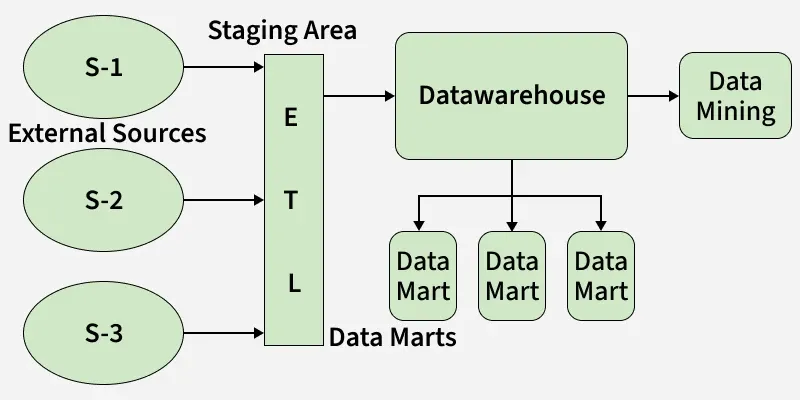
Top-Down Approach
Advantages of Top-Down Approach
- **Consistent View: Data marts built from a central warehouse ensure uniform data across departments, reducing reporting discrepancies.
- **High Data Consistency: Standardizing data through one source minimizes errors and improves the reliability of insights.
- **Simplified Maintenance: Updates in the central warehouse automatically reflect in all data marts, saving time and effort.
- **Scalable Architecture: New data marts can be added easily as business needs grow or change.
- **Stronger Governance: Centralized control improves data security, access management and compliance.
- **Less Data Duplication: Data is stored once in the warehouse, saving space and avoiding redundant or conflicting records.
- **Better Reporting: A unified data source enables faster, more accurate reporting and decision-making.
- **Improved Integration: Central sourcing makes it easier to combine data from multiple systems for deeper analysis.
Disadvantages of Top-Down Approach
- **High Cost & Time: Building a central data warehouse and data marts requires major investment and long implementation time, making it hard for smaller organizations.
- **Complex Setup: Designing and managing a centralized system is technically complex and requires skilled resources and careful planning.
- **Low Flexibility: Predefined structures make it hard to adapt quickly to changing business needs or reporting requirements.
- **Limited User Input: IT-led development can exclude business users, resulting in solutions that may not meet their actual needs.
- **Data Delays: Pulling data from various systems can cause processing delays, affecting real-time reporting and insights.
- **Unclear Data Ownership: Centralization can blur responsibility, making it unclear who manages or maintains specific data.
Bottom-Up Approach
The Bottom-Up Approach, popularized by Ralph Kimball, takes a more flexible and incremental path to designing data warehouses. Instead of starting with a central data warehouse, it begins by building small, department-specific data marts that cater to the immediate needs of individual teams, such as sales or finance. These data marts are later integrated to form a larger, unified data warehouse.
Working of Bottom-Up Approach
- **Department-Specific Data Marts: The process starts with creating data marts for individual departments or specific business functions. These data marts are designed to meet immediate data analysis and reporting needs, allowing departments to gain quick insights.
- **Integration into a Data Warehouse: Over time, these data marts are connected and consolidated to create a unified data warehouse. The integration ensures consistency and provides a comprehensive view of the organization’s data.
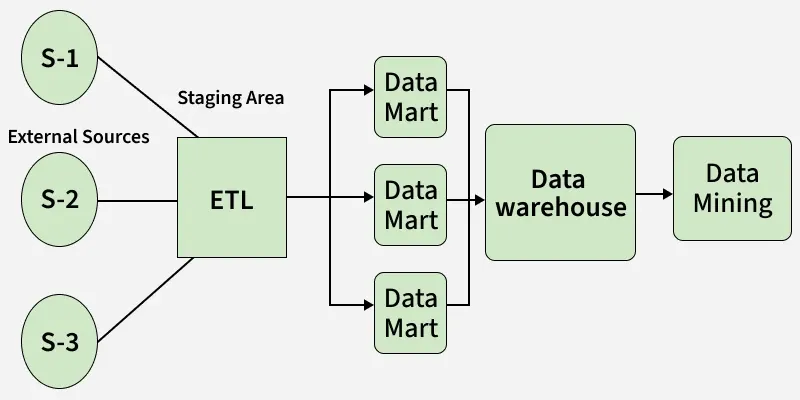
Bottom-Up Approach
Advantages of Bottom-Up Approach
- **Faster Reporting: Data marts allow quick insights and report generation.
- **Step-by-Step Development: Enables gradual rollout with quick wins.
- **User-Centric: Involves business users to meet actual needs.
- **Highly Flexible: Easily customized for departments or evolving needs.
- **Quick Results: Early setup gives immediate value.
Disadvantages of Bottom-Up Approach
- **Inconsistent Views: Different structures can lead to inconsistent reporting.
- **Data Silos: Independent marts may cause duplication and isolation.
- **Integration Difficulty: Combining varied marts into one warehouse is hard.
- **Redundant Efforts: Similar marts may be built by different teams.
- **Harder to Manage: Multiple marts increase maintenance overhead.