Denormalization in Databases (original) (raw)
Last Updated : 17 Apr, 2026
Denormalization is a database optimization technique where redundant data is intentionally added to one or more tables to reduce the need for complex joins and improve query performance. It is not the opposite of normalization, but rather an optimization applied after normalization.
- In a normalized database, data is stored in separate tables to minimize redundancy.
- for example, storing teacher details in a Teachers table and course details in a Courses table, linked by teacherID.
- While this maintains data integrity, frequent joins between large tables can slow performance.
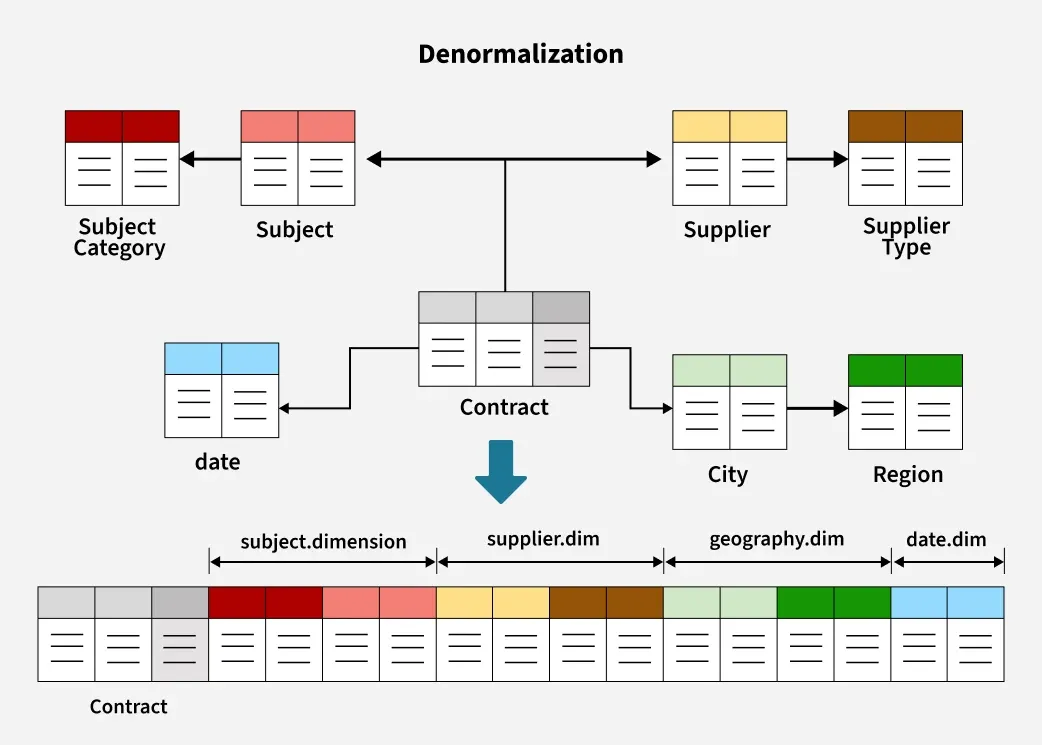
Denormalization
**Note: Denormalization strikes a balance by allowing some redundancy to achieve faster data retrieval and better performance, at the cost of slightly more maintenance effort when updating data.
Step 1: Unnormalized Table
This is the starting point where all the data is stored in a single table.
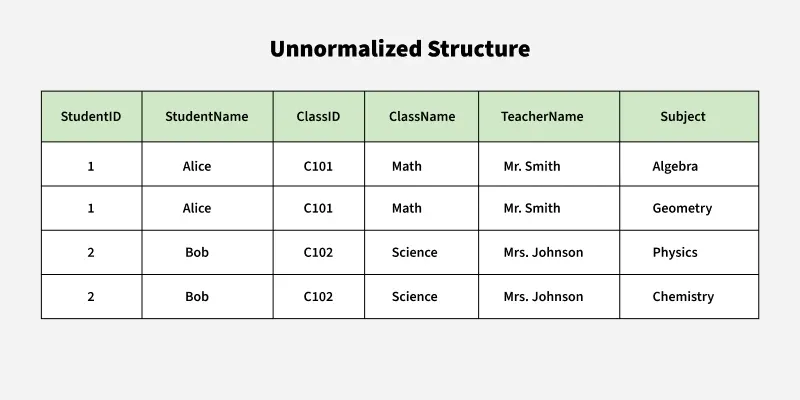
Unnormalized Structure
- **Redundancy: For example, "Alice" and "Math" are repeated multiple times. Similarly, "Mr. Smith" is stored twice for the same class.
- **Update Anomalies: If "Mr. Smith" changes to "Mr. Brown," we have to update multiple rows. Missing one row could lead to inconsistencies.
- **Inefficient Storage: Repeated information takes up unnecessary space.
Step 2: Normalized Structure
To eliminate redundancy and avoid anomalies, we split the data into smaller, related tables. This process is called normalization. Each table now focuses on a specific aspect, such as students, classes or subjects.
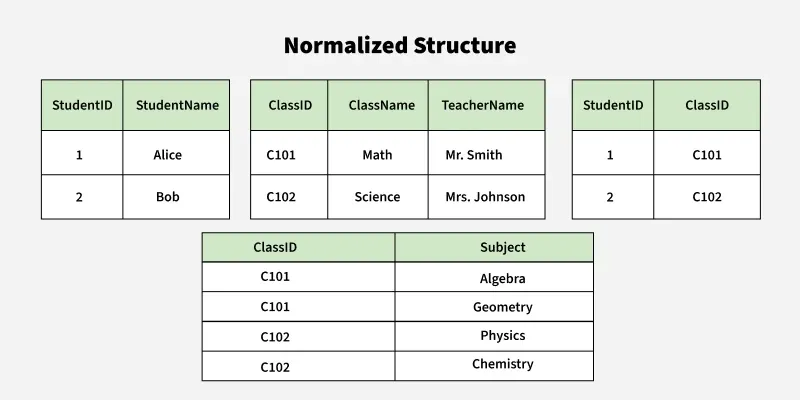
Normalized Structure
- **No Redundancy: "Mr. Smith" appears only once in the Classes Table, even if multiple subjects are associated with the class.
- **Easier Updates: If "Mr. Smith" changes to "Mr. Brown," you only update the Classes Table and it automatically reflects everywhere.
- **Efficient Storage: Repeated data is eliminated, saving space.
Step 3: Denormalized Table
In some cases, normalization can make querying complex and slow because you need to join multiple tables to get the required information. To optimize performance, we can denormalize the data by combining related tables into a single table.
- All related information (student name, class name, teacher and subject) is stored in a single table.
- This simplifies querying because you don’t need to join multiple tables.

Denormalized Structure
Denormalization v/s Normalization
Normalization and Denormalization both are the method which use in database but it works opposite to each other. One side normalization is used for reduce or removing the redundancy which means there will be no duplicate data or entries in the same table and also optimizes for data integrity and efficient storage
Denormalization is used for add the redundancy into normalized table so that enhance the functionality and minimize the running time of database queries (like joins operation ) and optimizes for performance and query simplicity. In a system that demands scalability, like that of any major tech company, we almost always use elements of both normalized and denormalized databases.
Advantages
This section highlights the benefits of denormalization in improving performance and simplifying data access.
- **Improved Query Performance: Denormalization can improve query performance by reducing the number of joins required to retrieve data.
- **Reduced Complexity: By combining related data into fewer tables, denormalization can simplify the database schema and make it easier to manage.
- **Easier Maintenance and Updates: Denormalization can make it easier to update and maintain the database by reducing the number of tables.
- **Improved Read Performance: Denormalization can improve read performance by making it easier to access data.
- **Better Scalability: Denormalization can improve the scalability of a database system by reducing the number of tables and improving the overall performance.
Disadvantages
This section outlines the limitations of denormalization, particularly related to data redundancy and maintenance challenges.
- **Reduced Data Integrity: By adding redundant data, denormalization can reduce data integrity and increase the risk of inconsistencies.
- **Increased Complexity: While denormalization can simplify the database schema in some cases, it can also increase complexity by introducing redundant data.
- **Increased Storage Requirements: By adding redundant data, denormalization can increase storage requirements and increase the cost of maintaining the database.
- **Increased Update and Maintenance Complexity: Denormalization can increase the complexity of updating and maintaining the database by introducing redundant data.
- **Limited Flexibility: Denormalization can reduce the flexibility of a database system by introducing redundant data and making it harder to modify the schema.