Difference Between OLAP and OLTP in Databases (original) (raw)
Last Updated : 31 Oct, 2025
OLAP (Online Analytical Processing) and OLTP (Online Transaction Processing) are both integral parts of data management, but they have different functionalities.
- OLTP focuses on handling large numbers of transactional operations in real time, ensuring data consistency and reliability for daily business operations.
- OLAP is designed for complex queries and data analysis, enabling businesses to derive insights from vast datasets through multidimensional analysis.
Online Analytical Processing (OLAP)
Online Analytical Processing (OLAP) refers to software tools used for the analysis of data in business decision-making processes. OLAP systems generally allow users to extract and view data from various perspectives, many times they do this in a multidimensional format which is necessary for understanding complex interrelations in the data.
**Note: These systems are part of data warehousing and business intelligence, enabling users to do things like trend analysis, financial forecasting and any other form of in-depth data analysis.
OLAP Examples
Any type of Data Warehouse System is an OLAP system. The uses of the OLAP System are described below.
- Spotify personalizes homepages with custom songs and playlists based on user preferences.
- Netflix movie recommendation system.
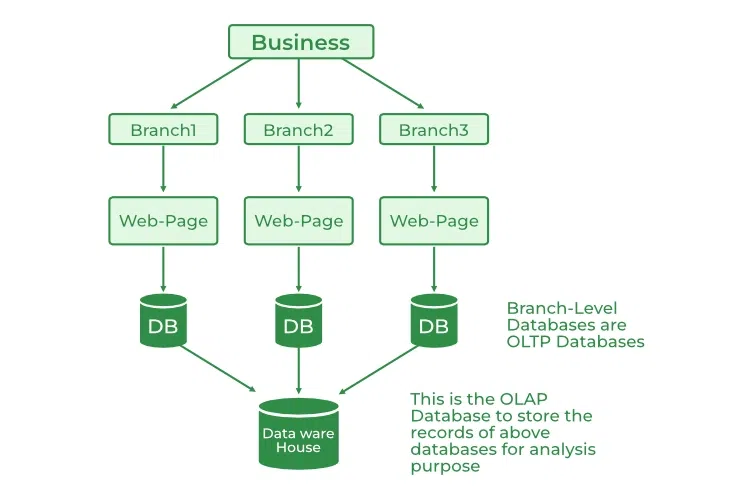
Benefits of OLAP Services
- Helps in keeping consistency and performing calculation on data.
- Can store planning, analysis and budgeting for business analytics within one platform.
- Efficiently handle large volumes of data, making them suitable for enterprise-level business applications.
- Assist in applying security restrictions for data protection.
- Provide a multidimensional view of data, which helps in applying operations on data in various ways.
Drawbacks of OLAP Services
- Requires professionals to handle the data because of its complex modeling procedure.
- Expensive to implement and maintain in cases when datasets are large.
- Data analysis occurs only after extraction and transformation, leading to system delays.
- Not efficient for decision-making, as it is updated on a periodic basis.
Online Transaction Processing (OLTP)
Online Transaction Processing, commonly known as OLTP, is a data processing approach emphasizing real-time execution of transactions. The majority of OLTP systems are meant to manage numerous short atomic operations that keep databases in line.
- To maintain transaction integrity and reliability, these systems support ACID (Atomicity, Consistency, Isolation, Durability) properties.
- It is through this that numerous unavoidable applications run their critical courses like online banking, reservation systems etc.
OLTP Examples
An example considered for OLTP System is ATM Center a person who authenticates first will receive the amount first and the condition is that the amount to be withdrawn must be present in the ATM. The uses of the OLTP System are described below.
- ATM center is an OLTP application.
- OLTP handles the ACID properties during data transactions via the application.
- It's also used for Online banking, Online airline ticket booking, sending a text message, add a book to the shopping cart.
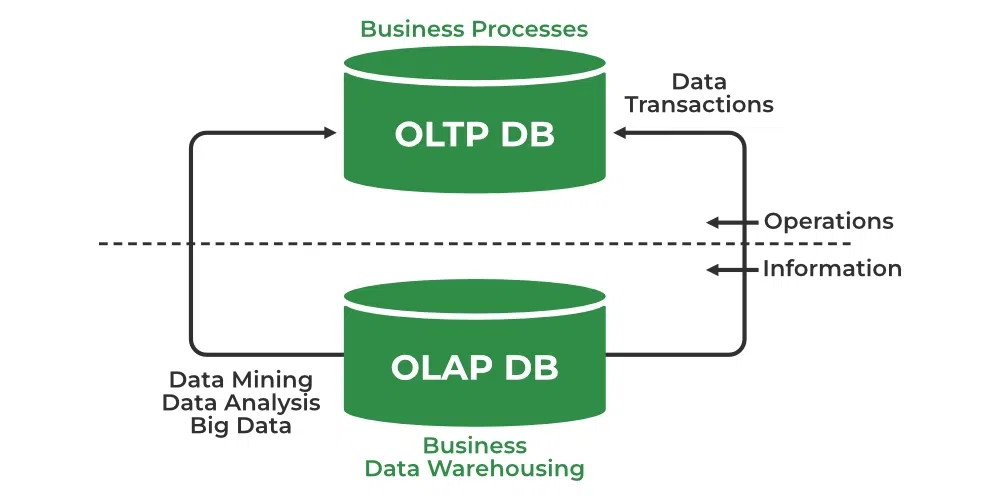
Benefits of OLTP Services
- Allow users to quickly read, write and delete data operations.
- Support an increase in users and transactions for real-time data access.
- Provide better data protection through multiple security features.
- Aid in decision-making with accurate, up-to-date data.
- Ensure data integrity, consistency and high availability.
Drawbacks of OLTP Services
- Limited analysis capability, not suited for complex analysis or reporting.
- High maintenance costs due to frequent updates, backups and recovery.
- Susceptible to disruption during hardware failures, impacting online transactions.
- Prone to issues like duplicate or inconsistent data.
Difference Between OLAP and OLTP
| Category | OLAP (Online Analytical Processing) | OLTP (Online Transaction Processing) |
|---|---|---|
| Data Source | Historical data from multiple databases. | Current operational data. |
| Purpose | Used for analysis and decision-making. | Used for day-to-day transactions. |
| Method Used | Uses a data warehouse. | Uses a standard DBMS. |
| Normalization | Tables are not normalized. | Tables are normalized (3NF). |
| Query Type | Complex, read-heavy queries (slow). | Simple, read/write queries (fast). |
| Data Volume | Large (TB–PB). | Small (MB–GB). |
| Update Frequency | Updated periodically in batches. | Updated frequently by users. |
| Backup & Recovery | Periodic backup. | Continuous and rigorous backup. |
| Users | Used by analysts, managers and executives. | Used by clerks and operational staff. |
| Focus | Subject-oriented (analysis-focused). | Application-oriented (operation-focused). |