Difference between Relational database and NoSQL (original) (raw)
Last Updated : 19 Jan, 2026
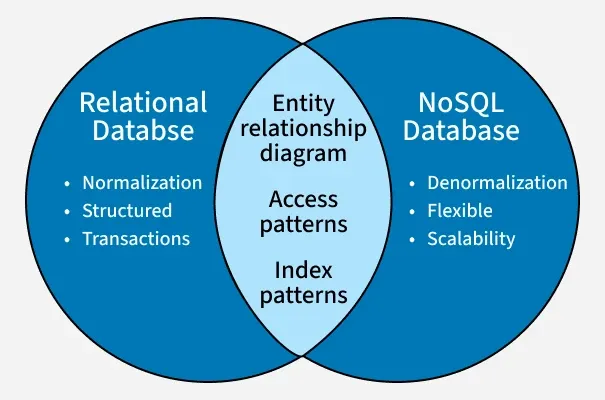
In modern data storage systems, choosing between an RDBMS and a NoSQL database is a crucial architectural decision. This choice directly impacts application scalability, performance, and development flexibility.
- RDBMS emphasizes structured data, fixed schemas, and strong consistency
- NoSQL focuses on scalability, flexible schemas, and high performance for large datasets
- The right choice depends on application requirements, data complexity, and growth needs
1. Relational Databases (RDBMS)
Relational databases have been the industry standard since the 1970s. They are built on the **Relational Model, which organizes data into rows and columns (tables) that are linked by keys.
- **Structure: Highly structured. You must define a schema (tables, columns, data types) _before you can insert data.
- **Language: Uses **SQL (Structured Query Language) for defining and manipulating data.
- **Scaling: Typically scales **Vertically (Scaling Up). To handle more load, you add more CPU, RAM, or SSD to a single server.
- **Core Principle (ACID): RDBMS prioritizes data integrity above all else using ACID properties:
- **Atomicity: Transactions are "all or nothing." If one part fails, the whole transaction fails.
- **Consistency: Data must meet all validation rules (constraints) at all times.
- **Isolation: Concurrent transactions do not interfere with each other.
- **Durability: Once data is saved, it is saved forever, even if the power goes out.
**Examples: MySQL, PostgreSQL, Oracle Database, Microsoft SQL Server, AWS Aurora.
2. NoSQL Databases (Non-Relational)
NoSQL ("Not Only SQL") databases emerged in the late 2000s to handle the scale and speed required by modern web applications (Big Data, real-time analytics, social networks).
- **Structure: Flexible and schema-less. You can store data without pre-defining the structure, and different items can have different fields.
- **Language: Varies by database (proprietary APIs, JSON-based queries, etc.).
- **Scaling: Scales **Horizontally (Scaling Out). To handle more load, you simply add more servers (nodes) to the cluster.
- **Core Principle (BASE): NoSQL often prioritizes speed and availability over strict consistency (though many modern NoSQL DBs offer options for strong consistency).
- **Basically Available: The system guarantees availability.
- **Soft State: The state of the system may change over time, even without input.
- **Eventual Consistency: The system will _eventually become consistent once it stops receiving inputs.
**Examples: MongoDB, Redis, Cassandra, DynamoDB, Neo4j.
3. The Four Types of NoSQL Databases
Unlike RDBMS, which are all fairly similar, NoSQL is a broad category containing four distinct types:
A. Document Databases
- **How it works: Stores data in JSON-like documents (BSON, XML). Each document contains pairs of fields and values.
- **Best For: Content management systems (CMS), catalogs, user profiles.
- **Example: MongoDB, AWS DocumentDB.
B. Key-Value Stores
- **How it works: The simplest model. Every item is stored as an attribute name (Key) and its value. It acts like a massive hash table. It is incredibly fast.
- **Best For: Caching, session management, real-time leaderboards, shopping carts.
- **Example: Redis, Memcached, Amazon DynamoDB.
C. Column-Oriented Databases
- **How it works: Stores data in columns rather than rows. This allows for reading a single column across millions of rows very efficiently.
- **Best For: Big data analytics, time-series data, data warehousing.
- **Example: Apache Cassandra, HBase, Amazon Keyspaces.
D. Graph Databases
- **How it works: Stores data in "Nodes" (entities) and "Edges" (relationships). It excels at traversing complex relationships.
- **Best For: Social networks (friend of a friend), fraud detection, recommendation engines.
- **Example: Neo4j, Amazon Neptune.
Relational Databases Vs NoSQL
Here is a detailed comparison based on various features:
| **Feature | **Relational (SQL) | **NoSQL (Non-Relational) |
|---|---|---|
| **Data Structure | Structured (Table-based) | Unstructured (Document, Key-Value, Graph) |
| **Schema | Rigid (Defined upfront) | Flexible (Dynamic) |
| **Query Language | SQL (Standardized) | Varies (UnQL, JSON, API-based) |
| **Scaling | Vertical (Add power to server) | Horizontal (Add more servers) |
| **Relationships | Supported via JOINS | Not heavily supported (often denormalized) |
| **Transactions | ACID (Strong consistency) | BASE (Eventual consistency) |
| **Best for | Complex queries, financial systems | High throughput, massive data, agility |
Choosing the Right Database for Your Use Case
Choose RDBMS (SQL) If:
- **Data Integrity is Critical: Financial transactions, inventory management, and accounting systems where "eventual" consistency is unacceptable.
- **Structure is Unlikely to Change: You have a clear, stable schema.
- **Complex Relationships: You need to perform complex JOINs across multiple tables to generate reports.
Choose NoSQL If:
- **Speed & Scale are Critical: You need single-digit millisecond latency and potentially unlimited throughput (e.g., gaming, IoT).
- **Unstructured Data: You are storing data streams, logs, or social media feeds where the format changes constantly.
- **Rapid Prototyping: You are building a startup app and the data model is evolving daily.
Mapping to AWS Services
Here is how these concepts map to the AWS cloud ecosystem:
| **Database Type | **AWS Service | **Use Case |
|---|---|---|
| **Relational (SQL) | **Amazon RDS / Aurora | Traditional web apps, ERP, CRM, Commerce. |
| **Key-Value (NoSQL) | **Amazon DynamoDB | Serverless apps, gaming, high-traffic web scale. |
| **Document (NoSQL) | **Amazon DocumentDB | Content management, catalogs (MongoDB compatible). |
| **In-Memory (Key-Value) | **Amazon ElastiCache | Caching, session store (Redis/Memcached). |
| **Graph (NoSQL) | **Amazon Neptune | Fraud detection, knowledge graphs. |
| **Column (NoSQL) | **Amazon Keyspaces | High-scale industrial data (Cassandra compatible). |