File Organization in DBMS (original) (raw)
Last Updated : 9 Sep, 2025
File organization in DBMS refers to the method of storing data records in a file so they can be accessed efficiently. It determines how data is arranged, stored, and retrieved from physical storage.
The Objective of File Organization
- It helps in the faster selection of records i.e. it makes the process faster.
- Different Operations like inserting, deleting, and updating different records are faster and easier.
- It prevents us from inserting duplicate records via various operations.
- It helps in storing the records or the data very efficiently at a minimal cost.
Types of File Organizations
Various methods have been introduced to Organize files. These particular methods have advantages and disadvantages on the basis of access or selection. Thus it is all upon the programmer to decide the best-suited file Organization method according to his requirements.
Some types of File Organizations are:
- Sequential File Organization
- Heap File Organization
- Clustered File Organization
- ISAM (Indexed Sequential Access Method)
- Hash File Organization
- B+ Tree File Organization
we will be discussing each of the file Organizations in further sets of this article along with the differences and advantages/ disadvantages of each file Organization method.
Sequential File Organization
The easiest method for file Organization is the Sequential method. In this method, the file is stored one after another in a sequential manner. There are two ways to implement this method:
**1. Pile File Method
This method is quite simple, in which we store the records in a sequence i.e. one after the other in the order in which they are inserted into the tables.
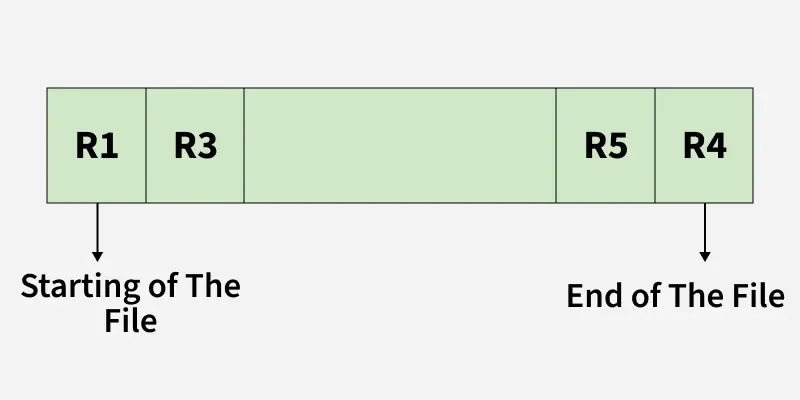
Pile File Method
**Insertion of the new record: Let the R1, R3, and so on up to R5 and R4 be four records in the sequence. Here, records are nothing but a row in any table. Suppose a new record R2 has to be inserted in the sequence, then it is simply placed at the end of the file.

New Record Insertion
**2. Sorted File Method
In this method, As the name itself suggests whenever a new record has to be inserted, it is always inserted in a sorted (ascending or descending) manner. The sorting of records may be based on any primary key or any other key.

Sorted File Method
**Insertion of the new record: Let us assume that there is a preexisting sorted sequence of four records R1, R3, and so on up to R7 and R8. Suppose a new record R2 has to be inserted in the sequence, then it will be inserted at the end of the file and then it will sort the sequence.

new Record Insertion
Advantages of Sequential File Organization
- Fast and efficient method for huge amounts of data.
- Simple design.
- Files can be easily stored inmagnetic tapes i.e. cheaper storage mechanism.
Disadvantages of Sequential File Organization
- Time wastage as we cannot jump on a particular record that is required, but we have to move in a sequential manner which takes our time.
- The sorted file method is inefficient as it takes time and space for sorting records.
Heap File Organization
**Heap File Organization works with data blocks. In this method, records are inserted at the end of the file, into the data blocks. No Sorting or Ordering is required in this method. If a data block is full, the new record is stored in some other block, Here the other data block need not be the very next data block, but it can be any block in the memory. It is the responsibility of DBMS to store and manage the new records.

Heap File Organization
**Insertion of the new record: Suppose we have four records in the heap R1, R5, R6, R4, and R3, and suppose a new record R2 has to be inserted in the heap then, since the last data block i.e data block 3 is full it will be inserted in any of the data blocks selected by the DBMS, let's say data block 1.

New Record Insertion
If we want to search, delete or update data in the heap file Organization we will traverse the data from the beginning of the file till we get the requested record. Thus if the database is very huge, searching, deleting, or updating the record will take a lot of time.
Other types file organistions are discussed into later articles.
Advantages of Heap File Organization
- Fetching and retrieving records is faster than sequential records but only in the case of small databases.
- When there is a huge number of data that needs to be loaded into the database at a time, then this method of file Organization is best suited.
Disadvantages of Heap File Organization
- The problem of unused memory blocks.
- Inefficient for larger databases.
Read related articles: