Sequential File Organization in DBMS (original) (raw)
Last Updated : 30 Jul, 2025
File organization refers to how data is stored in blocks or files to allow easy access and maintain order. It defines the logical relationship among records and affects operations like insertion, deletion, and updating. In sequential file organization, records are stored in a specific order, such as alphabetically. New records are added at the end, and the file can grow dynamically. It's efficient for small datasets due to its simple, linear structure, allowing easy traversal.
Types of Sequential File Organization
Sequential file organization is further classified as:
- Pile File Method
- Sorted File Method

Types of Sequential File Organization
Pile File Method
One method of sequential file organization is the pile file, where records are stored in the order they arrive, similar to how customers' orders are taken as per their arrival.The pile file method operates on a ****"first-come, first-served"** basis, where the record comes first would be stored first in sequence.
How Insertion Works in Pile File Method?

Inserting a new record
- Whenever a new record is added then it will automatically append itself to the end of the existing file in a sequential manner.
- In this, the files are not stored in a sorted manner.
- Suppose in this the record R5 will be added to the end of the file, i.e., after record R10.
Sorted File Method
Another method of sequential file organization is sorted file, where files are stored in sorted format either ascending or descending. In a sorted file, records are arranged based on a **primary key or attribute, which dictates their sequential order. Adding new records in a sorted file according to the sorting criteria does not affect the overall sequence. It takes less time to search for the previous record.
Imagine a database file as a classroom register, where student records are arranged in ascending order by their unique roll numbers. This "sorted file" method allows for efficient retrieval of specific records, similar to quickly finding a student's information based on their roll number.
How Insertion Works in Sorted File Method?
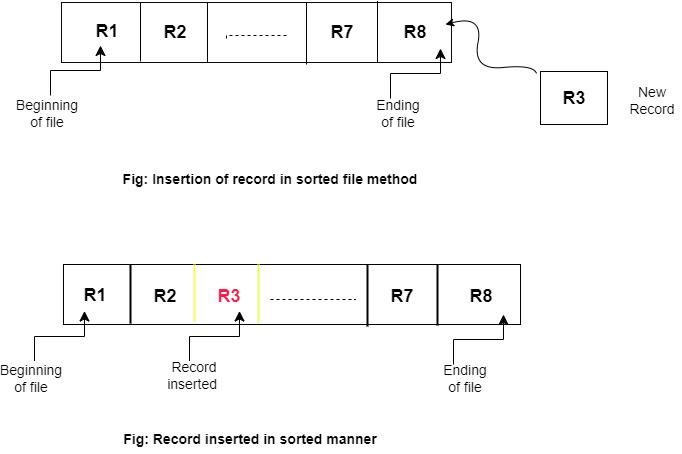
Inserting a new record in a sorted file
- In a sorted file, when a new record arrives, it's not simply added to the end and then moved later. Instead, it's inserted directly into its correct position based on a specific key or attribute. This ensures the final sequence remains sorted, enabling fast and efficient searching.
- Let R1, R2, R7, and R8 be four previous records stored in the file based on primary key references, and a new record R3 comes and then it will move forward to its correct position, i.e., after R2.
- A primary key is the unique key or attribute that determines the order of the records within the file. No two records can have the same primary key.
Advantages of Sequential File Organization
- **Design: Compared to other file organization methods, sequential file organization boasts a simple design and minimal complexity, making it easy to develop and implement.
- **Small Datasets: Sequential processing, can be efficient for small amounts of data. But for large datasets, other methods might be more efficient such as hash file and heap file.
- **Accuracy: Sequential file organization is inherently accurate as it maintains a simple order, and there's no manipulation involved that could introduce errors.
- **Processing: For generating reports or calculations that require processing every record, sequential file organization is straightforward and accurate.
Disadvantages of Sequential File Organization
- **Time-Consuming: Random record access within a pile file presents a time-consuming challenge. Unlike indexed methods, each record must be sequentially traversed from left to right.
- **Memory Wastage: When a record is deleted the space it occupied usually remains unused. This can lead to memory waste, especially for large datasets with frequent deletions, and act as an inefficient memory method.
- **System Processing: While using sorted files the record must always be sorted and adding or changing records often requires re-sorting the entire set, which can slow down your system, especially for larger files.
Therefore, sequential file organization is the easiest way to organize files and a straightforward approach to data storage and processing where records are stored in sequential order. This makes it ideal for traversing over small datasets. Also, the drawback is that there is time wastage in traversing the whole file to find a single record.