Super Key in DBMS (original) (raw)
Last Updated : 23 Jul, 2025
Keys in DBMS play an important role in maintaining the integrity and uniqueness of data. Among these, the **super key isone of thefundamental concept. It helps in designing database and keeping it well-structured.
A **Super Key in DBMS is a group of one or more attributes in a table that can uniquely identify every row in that table. It ensures no two rows have the same combination of values for those attributes.
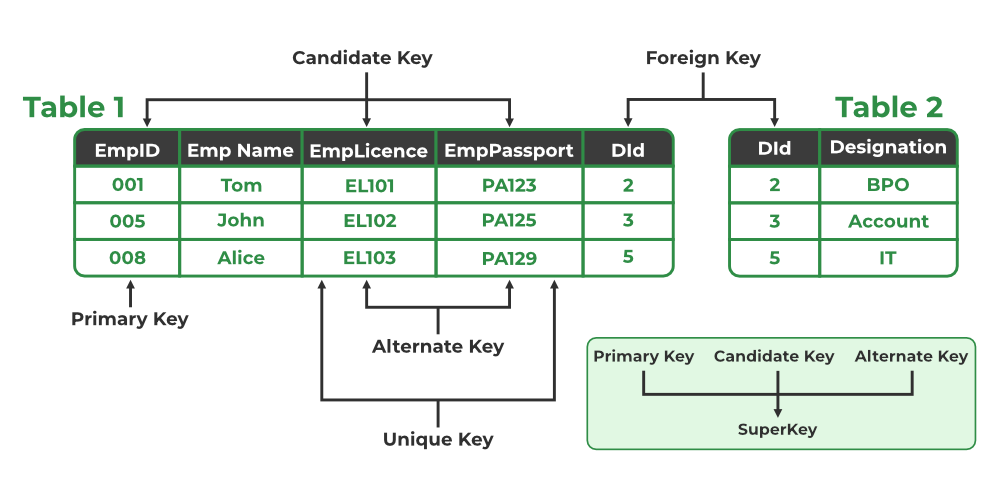
Super Key
Key Features of Super Key in DBMS
- **Uniqueness:
A super key ensures that every row in a table is uniquely identified and prevents duplicate records. - **One or More Attributes:
It can consist of a single column or a combination of multiple columns. - **Not Necessarily Minimal:
A super key may include extra attributes that are not required for uniqueness, unlike a candidate key. - **Includes Primary Key and Candidate Keys:
Every primary key and candidate key is a super key, but not all super keys are primary keys or candidate key.

Super key as superset of primary and candidate keys
- **Foundation for Database Design:
Super keys are essential for determining candidate keys and ensuring data integrity in a database.
Examples of Super Key in DBMS with Tables
Let’s consider a table called **Employees:
| Employee_ID | Name | Department | |
|---|---|---|---|
| 101 | Alice | HR | alice@company.com |
| 102 | Bob | IT | bob@company.com |
| 103 | Charlie | IT | charlie@company.com |
In this example:
- **Employee_ID uniquely identifies each row in the table.
- Any combination of attributes that includes **Employee_ID will also be a super key because **Employee_ID alone is sufficient for uniqueness.
So, from the above table, we can conclude the following set of the super keys:
{Employee_ID}{Employee_ID, Name}{Employee_ID, Department}{Employee_ID, Email}{Employee_ID, Name, Department}{Employee_ID, Name, Email}{Employee_ID, Department, Email}{Employee_ID, Name, Department, Email}
Difference Between Super Key and Candidate Key
| **Super Key | **Candidate Key |
|---|---|
| A set of one or more attributes that uniquely identifies a row in a table. | A minimal super key that uniquely identifies a row without any unnecessary attributes. |
| It may include extra attributes that are not required for uniqueness. | It is always minimal(contains only the necessary attributes for uniqueness). |
| Ensures rows are unique in the table. | It also ensures rows are unique but in the most efficient way. |
| A table can have many super keys. | A table may have one or more candidate keys. |
| Every candidate key is a super key. | Not every super key is a candidate key. |
| Example: {Employee_ID}, {Employee_ID, Name}in Employees table where Employee_ID is candidate key. | Example: {Employee_ID} in Employees table. |
Read more about Difference between Super Key and Candidate Key
How to Identify a Super Key in a Database Table
Identifying a super key in a database table is straightforward if you follow these simple steps:
**1. Understand the Table
- Look at all the columns (attributes) in the table and understand what kind of data they hold.
- Think about which column or combination of columns can uniquely identify each row in the table.
**2. Start with Single Columns
- Check if any single column can uniquely identify every row. (Example: Columns like
Student_IDorEmployee_IDare often unique.) - If one column is enough, it is a super key.
**3. Combine Columns if Needed
- If no single column is unique, combine two or more columns until they uniquely identify each row.
**4. Check for Uniqueness
- Make sure no two rows in the table have the same values for the chosen column(s).
- If they do, the combination cannot be a super key.
**5. Include Extra Columns
- Remember, a super key can include extra columns that are not necessary for uniqueness.
- Example:
{Employee_ID, Name}is a super key because it includesEmployee_ID, which is already unique.
**Example
**Table: Employees
- **Step 1: Check single columns:
Employee_IDis unique → Super Key.
- **Step 2: Combine columns if needed:
{Employee_ID, Name}→ Still unique → Super Key.{Employee_ID, Department}→ Also a Super Key.
- **Step 3: Include extra columns:
{Employee_ID, Name, Department, Email}→ Also a valid Super Key.
Importance of Super Key in DBMS
**1. Ensures Unique Records
- Super keys help uniquely identify each row in a table.
- This avoids duplicate entries and keeps the database clean and reliable.
**2. Helps Define Primary and Candidate Keys
- Super keys are used to find candidate keys, which are smaller sets of attributes that can also uniquely identify rows.
- From these candidate keys, the primary key is selected, making super keys the base of database design.
**Role of Super Keys in Database Design and Normalization
**1. Basis for Table Relationships
- Super keys allow tables to have unique identifiers, which are crucial for establishing links between different tables in the database.
- They also assist in defining foreign keys to maintain referential integrity.
**2. Supporting Normalization
- Super keys help identify dependencies between columns.
- During normalization, this ensures data is organized to eliminate redundancy and anomalies, resulting in efficient storage and easy maintenance.
**3. Simplifying Database Design
- Super keys guide database designers to structure tables in a way that ensures every row is easily distinguishable.
- This simplifies the process of linking and querying data.
**How Super Keys Ensure Data Integrity in DBMS?
**1. Preventing Duplicate Data
- Super keys make sure every record in the database is unique and eliminate any chance of duplication.
**2. Ensuring Accurate Data Retrieval
- Since super keys guarantee uniqueness, retrieving or updating specific rows becomes straightforward and error-free.
**3. Maintaining Consistency
- Super keys ensure that the database operates consistently across all tables and operations.This avoids confusion during searches, updates, or deletions.
Conclusion
Understanding of super keys is important for creating well-structured databases. They help keep data unique, reduce duplicate information, and are the basis for primary and candidate keys. By learning how super keys work, you can design reliable databases and confidently handle related questions in DBMS.