Dense Layer (tf.keras.layers.Dense) in TensorFlow (original) (raw)
Last Updated : 23 Jul, 2025
In TensorFlow, the **tf.keras.layers.Dense layer represents a fully connected (or dense) layer, where every neuron in the layer is connected to every neuron in the previous layer. This layer is essential for building deep learning models, as it is used to learn complex patterns and relationships in data.
The Dense layer applies the following mathematical operation:
\text{output} = \text{activation} (\text{dot}(\text{input}, \text{kernel}) + \text{bias})
where:
- **activation: An element-wise activation function (if specified).
- **dot(input, kernel): A matrix multiplication between the input data and the weight matrix (kernel).
- **bias: A bias vector added to the computation (if use_bias=True).
This means every neuron receives a weighted sum of all the inputs, applies an activation function, and then passes the result to the next layer.
**Syntax of tf.keras.layers.Dense:
tf.keras.layers.Dense(
units,
activation=None,
use_bias=True,
kernel_initializer="glorot_uniform",
bias_initializer="zeros",
kernel_regularizer=None,
bias_regularizer=None,
activity_regularizer=None,
kernel_constraint=None,
bias_constraint=None
)
**Parameters Explained:
- **units: (Required) Number of neurons in the layer.
- **activation: (Optional) Activation function (e.g., relu, sigmoid, softmax).
- **use_bias: (Default: True) Whether the layer includes a bias term.
- **kernel_initializer: bias_initializer: (Default: zeros) Initialization method for bias.
- **kernel_regularizer: Regularization method for weights (e.g., l2 regularization).
- **bias_regularizer: Regularization method for bias.
- **activity_regularizer: Applies regularization to the output.
- **kernel_constraint & bias_constraint: Constraints applied to weights or bias (e.g., max-norm).
How to Use tf.keras.layers.Dense?
The tf.keras.layers.Dense layer is typically used in sequential or functional API models in TensorFlow. Below are examples of how to use it:
Example 1: Using Dense Layer in a Sequential Model
Python `
from tensorflow import keras
Define a simple neural network model
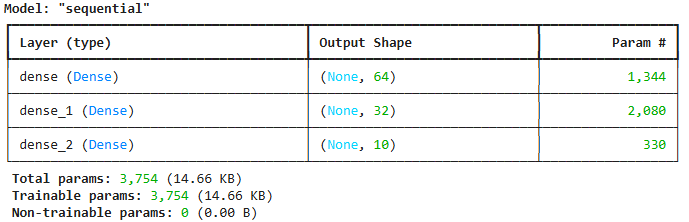
model = keras.Sequential([ keras.layers.Dense(64, activation='relu', input_shape=(20,)), # First hidden layer keras.layers.Dense(32, activation='relu'), # Second hidden layer keras.layers.Dense(10, activation='softmax') # Output layer with 10 classes ])
Compile the model
model.compile(optimizer='adam', loss='categorical_crossentropy', metrics=['accuracy'])
Model Summary
model.summary()
`
**Output:
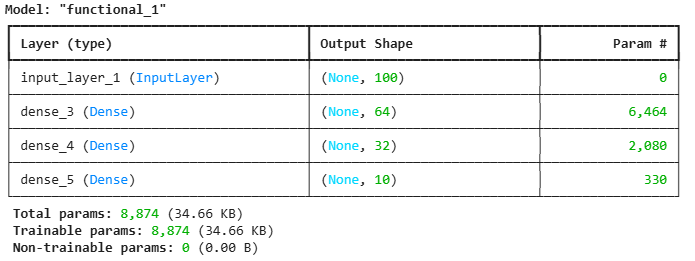
Example 2: Using Dense Layer in the Functional API
Python `
import tensorflow as tf from tensorflow.keras import Input, Model from tensorflow.keras.layers import Dense
Define input
inputs = Input(shape=(100,))
Define layers
x = Dense(64, activation='relu')(inputs) x = Dense(32, activation='relu')(x) outputs = Dense(10, activation='softmax')(x)
Create model
model = Model(inputs, outputs)
Summary of the model
model.summary()
`
**Output: