Heart Disease Prediction using ANN (original) (raw)
Last Updated : 2 Jul, 2025
Deep Learning is a technology of which mimics a human brain in the sense that it consists of multiple neurons with multiple layers like a human brain. The network so formed consists of an input layer, an output layer, and one or more hidden layers. The network tries to learn from the data that is fed into it and then performs predictions accordingly. The most basic type of neural network is the ANN (Artificial Neural Network). The ANN does not have any special structure, it just comprises of multiple neural layers to be used for prediction. Let's build a model that predicts whether a person has heart disease or not by using ANN.
**About the data:
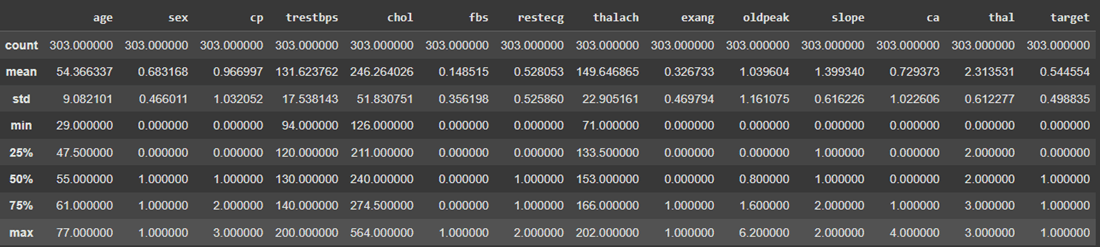
In the dataset, we have _13 columns in which we are given different attributes such as sex, age, cholesterol level, etc. and we are given a target column which tells us whether that person has heart disease or not. We will keep all the columns as independent variables other than the target column because it will be our dependent variable. We will build an ANN which will predict whether a person has heart disease or not given other attributes of the person.
**Code: Importing Libraries
Python `
import tensorflow as tf import pandas as pd import numpy as np import matplotlib.pyplot as plt import keras from keras.models import Sequential from keras.layers import Dense from sklearn.metrics import confusion_matrix from sklearn.model_selection import train_test_split
`
**Code: Importing Dataset
Python `
data = pd.read_csv('/content/Dataset--Heart-Disease-Prediction-using-ANN.csv')
`
**Data Description:
Python `
data.describe()
`
**Code: Check for null values
Python `
data.isnull().any()
`
**Output:
0
age False
sex False
cp False
trestbps False
chol False
fbs False
restecg False
thalach False
exang False
oldpeak False
slope False
ca False
thal False
target Falsedtype: bool
**Assign Dependent and Independent variable
Python `
X = data.iloc[:,:13].values y = data["target"].values
`
**Code : Split data into Train and Test dataset
Python `
X_train,X_test,y_train, y_test = train_test_split(X,y,test_size = 0.3 , random_state = 0 )
`
**Code: Scale the data.
Python `
from sklearn.preprocessing import StandardScaler sc = StandardScaler() X_train = sc.fit_transform(X_train) X_test = sc.transform(X_test)
`
**Code: Building the Model
Python `
classifier = Sequential() classifier.add(Dense(activation = "relu", input_dim = 13, units = 8, kernel_initializer = "uniform")) classifier.add(Dense(activation = "relu", units = 14, kernel_initializer = "uniform")) classifier.add(Dense(activation = "sigmoid", units = 1, kernel_initializer = "uniform")) classifier.compile(optimizer = 'adam' , loss = 'binary_crossentropy', metrics = ['accuracy'] )
`
**Code : Fitting the Model
Python `
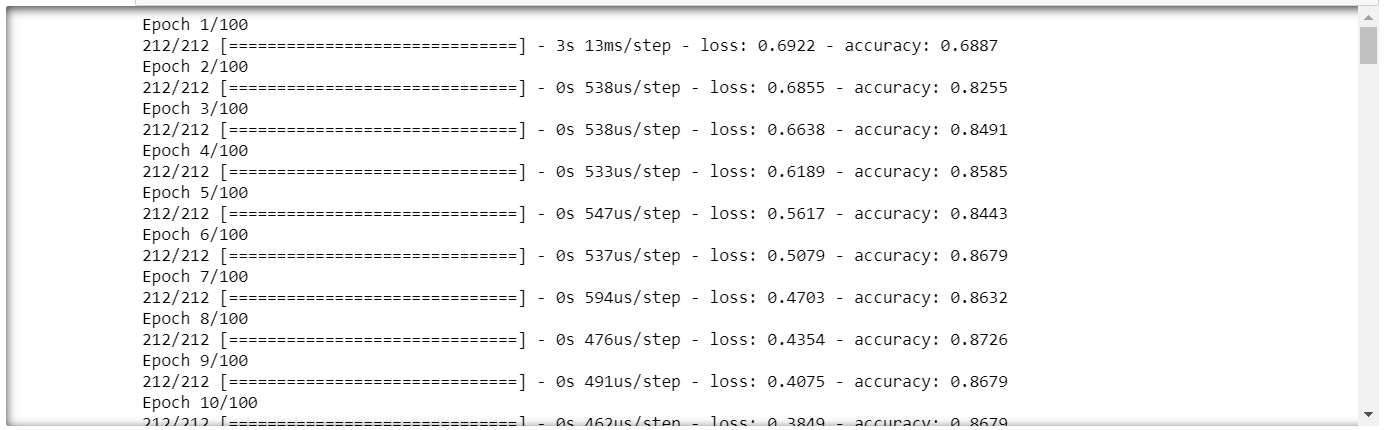
classifier.fit(X_train , y_train , batch_size = 8 ,epochs = 100 )
`
**Code : Performing prediction and rescaling
Python `
y_pred = classifier.predict(X_test) y_pred = (y_pred > 0.5)
`
**Code: Confusion Matrix
Python `
cm = confusion_matrix(y_test,y_pred) cm
`
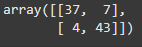
Confusion Matrix
**Code: Accuracy
Python `
accuracy = (cm[0][0]+cm[1][1])/(cm[0][1] + cm[1][0] +cm[0][0] +cm[1][1]) print(accuracy*100)
`
**Output:
**87.91208791208791
We will get accuracy approximately around 88%.
**Get complete notebook link :
- Notebook: click here.
- Dataset: click here.