Amazon Web Services Introduction to Simple Workflow Service (original) (raw)
Last Updated : 15 Jun, 2026
Amazon Simple Workflow Service (SWF) is a fully managed workflow orchestration service provided by AWS that helps developers coordinate distributed applications and background tasks. It enables reliable execution of long-running workflows by managing task scheduling, state tracking, retries, and inter-task dependencies automatically.
- **Decoupled Control Flow: Separates execution rules from the code running individual tasks.
- **State Tracking: Automatically records execution history without database overhead.
- **Long-Running Execution: Supports execution workflows running for up to one year.
- **Distributed Architecture: Coordinates tasks across local, cloud, and on-premises environments.
- **Reliable State Engine: Replaces complex custom state machines with a managed platform.
Core Workflow Functions
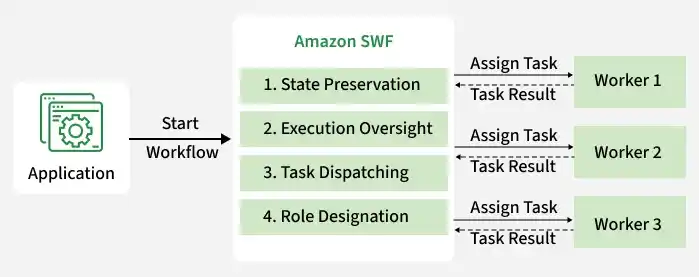
Amazon SWF maintains the execution flow of distributed systems through several automated operations:
- **State Preservation: Persistently records the current execution progress of active workflows.
- **Execution Oversight: Monitors task success and triggers recoveries if workers fail.
- **Task Dispatching: Holds tasks in centralized queues and assigns them to ready workers.
- **Role Designation: Determines which workers are permitted to execute specific activities.
Core Concepts
The primary architectural building blocks of Amazon SWF include:
- **Workflow: A set of activities and coordination logic designed to achieve a business goal.
- **Domain: An isolated resource container that limits the scope of workflows within an account.
- **Activity: A single task or unit of work that must be registered before execution.
- **Activity Execution: Repeated runs of an activity, such as reprocessing an item order.
Amazon SWF Actors
Actors represent programs written in any language that interact with the SWF API to drive execution:
- **Workflow Starters: Applications like web portals or mobile apps that trigger a workflow run.
- **Deciders: Coordination logic programs that schedule next steps based on historical workflow data.
- **Activity Workers: Background processes that poll SWF, receive tasks, execute the business logic, and report results.
Execution History
SWF maintains a complete and consistent audit log of all events inside a workflow:
- **Comprehensive Records: Maintains a complete event history of workflow executions, including task scheduling, completion, failures, and retries.
- **Decider Input: Provides deciders with the source history needed to determine subsequent actions.
- **No Local State: Saves developers from managing database states within their custom code.
Executing a Workflow
Follow these steps to deploy and run an Amazon SWF workflow:
- Register a domain in Amazon SWF.
- Register workflow and activity types.
- Develop activity workers to execute business tasks.
- Create a decider program to control workflow execution.
- Deploy workers and deciders on EC2 instances, containers, or on-premises systems.
- Start workflow executions using applications or APIs.
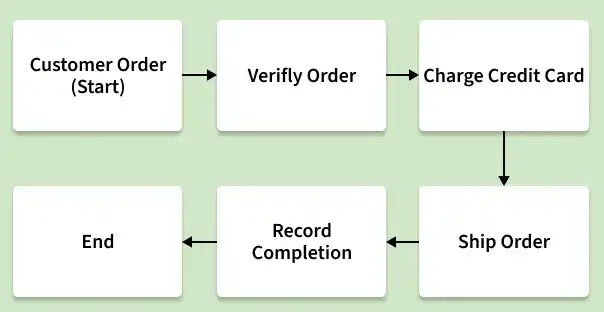
An e-commerce order-processing pipeline serves as a common workflow example consisting of four consecutive tasks:
- Validate the incoming order.
- Charge the customer's credit card.
- Ship the purchased merchandise.
- Record order completion logs.
Use Cases
- Order processing systems
- Media transcoding pipelines
- Financial transaction processing
- ETL and data-processing workflows
- Human approval workflows
- Machine learning task orchestration
Benefits
- **Workflow Reliability: Ensures durable execution using AWS-managed fault-tolerant infrastructure.
- **Scalable Architecture: Supports large-scale distributed applications efficiently.
- **Flexible Development: Works with applications written in different programming languages.
- **Reduced Operational Overhead: Eliminates the need to manage custom state machines and task queues.
- **Long-Running Workflow Support: Handles workflows running for months or even up to one year.