History and Origin of the Kanban Methodology (original) (raw)
Last Updated : 23 Jul, 2025
Agile methodology has evolved as a modern approach to managing and delivering projects. It provides us with various methodologies like Scrum and Kanban. Although kanban is not more than a century old, it has had a significant impact in that period. Everything from software development to manufacturing has benefited from the history of kanban. The kanban tool is becoming widely used in project management, and its applications are only growing.
In this article, we will go through the history and evolution of Kanban, one of the most popular Agile Methods for Modern Software Development.
Table of Content
- What is Kanban?
- Purpose and Significance of Kanban Methodology
- The Roots of Kanban: 1600s
- Origin of Kanban and Early Beginnings: 1940s
- Evolution of Kanban: 1940-1950s
- Transition to Software Development: 2003-2008
- Some Notable Contributions in Kanban: 2007-2009
- Key Principles of Kanban were Defined: Past 2010
- Scrum vs Kanban
- Conclusion
- FAQs on History of Kanban
What is Kanban?
Kanban is a modern Agile Methodology that focuses on continuous improvement and efficient workflow using the visual approach of listing out the project activities.
- It has a fundamental approach of breaking down the Project into small manageable tasks that can be separately managed.
- It pinpoints the key activities according to the requirement to prevent unnecessary activities within the project lifecycle.
- It includes visual signals to depict both the status of the tasks and their transit to different states.
Purpose and Significance of Kanban Methodology
Since Kanban has come into existence for efficient management of projects and ensuring their delivery, it has its core purpose in improving the overall productivity of the Project Execution and making it seamless across all its phases.
- It aims to identify the bottlenecks and helps project managers to make data-driven decisions.
- the main significance of the Kanban is that it provides the visual-based tracking of tasks and activities. This enables all the members of the team to collaborate using a user-friendly interface.
- Moreover, it breakdowns the large projects into smaller subtasks which makes management easy, and adds a lot to its importance.
The Roots of Kanban: 1600s
- The roots of the Kanban date back to the 1600s during which there was a lot of social upheaval and military conflicts in Japan. This caused the downfall of the local businesses and thus they needed to enhance their customer satisfaction to survive in the market.
- Due to this, business owners felt the need to follow the standard principles to manage their business activities. Also, they need to follow a structured approach to enhance their consumer satisfaction within the budget but without compromising the quality.
- This is the reason why the term ‘Kanban’ was born. This term was used to visually denote the various business activities for managing the business activities.
Origin of Kanban and Early Beginnings: 1940s
Why is it called Kanban?
- The word ‘Kanban’ is made of two Japanese words namely ‘Kan’ which means sign and ‘Ban*’ which means ‘*Board.’ Thus, it refers to the ‘*Visual Card’ or ‘***Visual Signal.**’
- Taiichi Ohno, an industrial engineer, started Kanban in the 1940s, as a simple planning system for automotive manufacturing in Toyota Automotive, one of the leading automobile manufacturers. At that time, Kanban was primarily used as a simple plan to control and manage the inventory of the production system.
Origin of Kanban
- The main purpose of developing the Kanban was the lower throughput of the manufacturing facilities of Toyota. Thus, to stand ahead in the market competition, Kanban helped the company manage all types of inventory of finished, semi-finished, and raw materials.
- This helped the organization to achieve its goals along with adaptive planning and flexibility. In this way, Toyota was able to manage all the production systems from the supplier to the end users with optimum efficiency.
Evolution of Kanban: 1940-1950s
- One of the most popular principles that Toyota Automotive used to implement in its production was ‘Lean Manufacturing.’ It is a production system that aims to reduce the wastage of the resources as well as the response time from the supplier to consumers. Kanban was originally used in Toyota’s Lean Manufacturing Systems to attain production efficiency.
- After becoming the Director in the year 1959, Taiichi Ōno identified that overproduction was the cause of waste as customer demands may vary over time. He started experimenting with the different principles to improve production efficiency and started using paper cards for signaling production within his factory.
- He named this new method ‘Kanban’ in which a Kanban card was attached to each product on the shop floor in each of its sales. Once the number of Kanban cards reached a certain threshold, the production of that product was started. Hence, the main focus was to produce only what was needed.
This is how the simple Kanban Cards evolved as a management technique for the Production Systems.
Transition to Software Development: 2003-2008
- Originating as a part of Manufacturing innovations, Kanban extended its popularity to other sectors like software development and the healthcare sector.
- The main reason for this was the popularity of Toyota’s Production System which was based on the ‘Kanban’ method. The application of Kanban made Toyota a global competitor in the market.
- Due to this, various other industries tried to implement the core logic of Toyota’s Kanban principles into their system. And, during the same time, Software Industry also witnessed a shift in the requirements due to which Agile Manifesto was published in the year 2001. It highlighted various principles such as Scrum and Lean Software Development.
- Therefore, during the years 2003 to 2008, software professionals started using visual boards which were called ‘Kanban Boards’ to manage their Projects related to Software Development. This is how the ‘Kanban’ which came out of Japan’s automotive sector transitioned into the Software Industry.
Following this, many industry experts contributed to Kanban. Let's look at them as well.
Some Notable Contributions in Kanban: 2007-2009
- Many pioneers and organizations made significant contributions to spreading awareness about the Kanban Methodology and making it a globally adopted methodology of Agile Software Development.
- Marry and Tom Poppendieck were the first people to spread knowledge about Kanban in software development. They made their contributions through conferences and publishing books on topics such as Value Stream Mapping, Queuing Theory, and Visual Workspace which formed the foundation of the Kanban for Software Development.
- After this, Microsoft started using the Kanban principles in software development-based projects. It started using the elements of the Scrum and Kanban methods in the existing methods through which the first Scrumban project became successful in the year 2004.
- Apart from this, David Anderson, who was working at Microsoft started making his contributions to the Agile principles. In 2007, he left Microsoft and collaborated with Dominica DeGrandis, who is one of the top Kanban experts now.
- They introduced the ‘**Kanban system for change request processing’ that helped the teams remove the time-boxed iterations in the project.
- This was followed by some more contributions and in September 2007, Karl Scotland, Engineering Program Manager at Yahoo, introduced Kanban to this team. Due to these contributions, Kanban became popular and gained momentum in the year 2009.
Key Principles of Kanban were Defined: Past 2010
After Kanban became significantly popular by the year 2009, many other contributions were made through journals, books, conferences, etc. Finally, in the year 2016, a book named ‘Essential Kanban Condensed’ by David J Anderson and Andy Carmichael was published. It highlighted the key practices of the Kanban Methodology in software project management.
These principles are discussed as shown below:
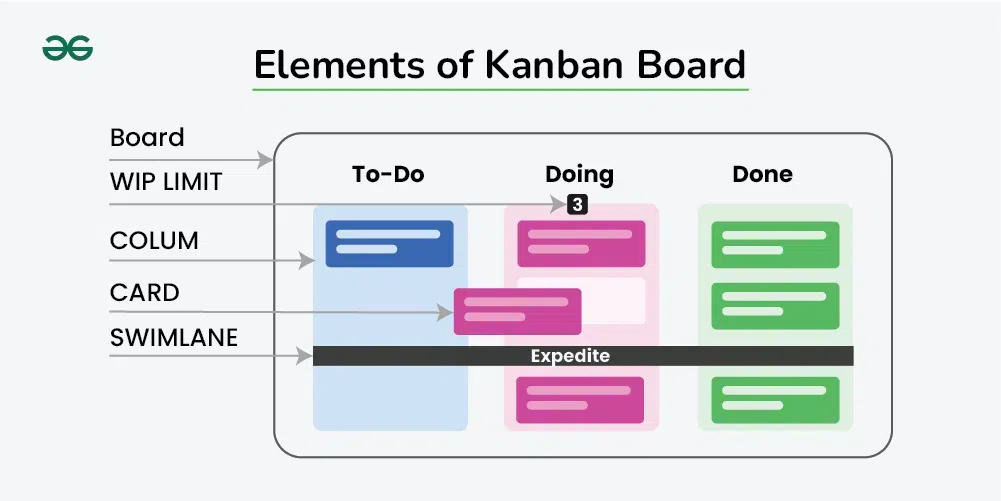
Elements of Kanban Board
- Visualization of the workflow using which various tasks, issues, bugs, and timelines are highlighted on the visual tool called ‘Kanban Board.’
- Limit the Work-In-Progress in which every column in the Kanban Board cannot have more than a specified number of tasks. This would prevent us from work overload.
- Measure and Manage the Flow of the project using the Pull-System approach so that execution is done only when it is required.
- Make the roles and responsibilities of the project flexible so that continuous delivery can be achieved without the time-boxed iterations.
**Scrum vs Kanban
Here are the following difference between Scrum and Kanban:
| Scrum | Kanban |
|---|---|
| It defines the role of each member of the Scrum team. | There is no role assigned to individuals. |
| It follows the iterative method. | It does not follow the iterative approach |
| To solve a problem, it breaks it into small tasks and then processes it further. | It does not break a problem into sub-problems. |
| It is a highly prescriptive approach. | It is not much prescriptive as compared to Scrum. |
| There is no visualization process to perform tasks. | There is a visualization process to perform tasks. |
| There are sprints that keep track of the progress of any project. | They use task cards to keep track of the progress of any project. |
| It is processed in successive sprints to complete a task. | It is used to optimize the task to complete a project. |
| Scrum Master is the problem solver in case of a problem. | All the members are allowed to pick a problem and solve it. |
| The process does not get disturbed if a team member leaves in between a sprint. | The flow of work gets disturbed if a team member leaves in between. |
| The velocity of the sprint is used to measure the production. | The time taken to finish the project is the measure of production. |
| “Velocity” through sprints is a production measurement metric. | “Cycle time” is a production measurement metric. |
Conclusion
Kanban came into existence as a part of the Lean Manufacturing System in the Automotive organization and became an integral part of modern software development projects. Throughout its evolution, the various contributions have refined it so that it can provide a perfect foundation for managing projects. The Agile and DevOps teams can easily implement the Kanban Methodology using tools such as Jira and Trello to execute the Agile Workflows for their projects.
Thus, it is a useful method to get time-based insights and visualize the project tasks. Therefore, with the continuous contributions going on, it has a wide scope for future trends in Project Management. With this, you have gained all the insights about Kanban and its historical journey in the field of Project Management. You can easily explore its advanced implementation for your Project Management Requirements.