Introduction to CI/CD (original) (raw)
Last Updated : 18 May, 2026
CI/CD (Continuous Integration and Continuous Delivery/Deployment) is a modern software development practice that automates the process of building, testing, and releasing applications. It plays a key role in DevOps by streamlining collaboration between development and operations teams.
- Automates code integration, testing, and deployment workflows.
- Reduces manual effort while improving software quality.
- Smaller, frequent updates replace large risky releases.
CI/CD Before Adoption
Before the adoption of CI/CD, software development and delivery were slow, manual, and prone to errors. Processes were less automated, making releases time-consuming and risky.
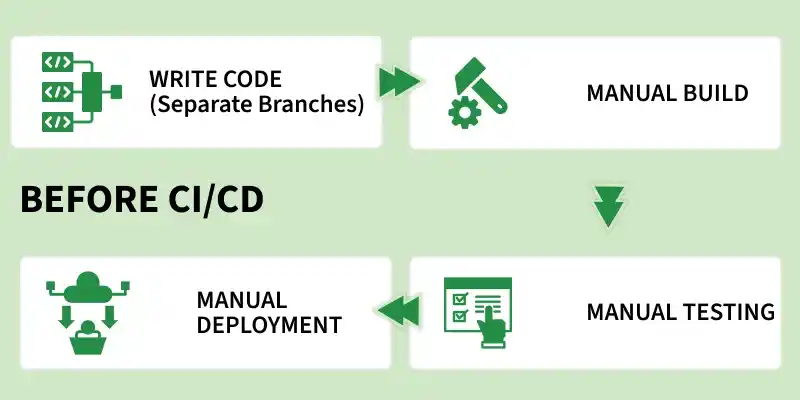
Before CI/CD
- All branches were merged at the end, which often caused big conflicts and broken builds.
- Testing and building the code were also manual, usually done at the final stage, so bugs were discovered very late and were costly to fix.
- Deployment was a long and risky process, taking days or even weeks, because everything was released together in one big update.
- Teams were also divided: developers wrote code, testers tested it, and operations managed servers.
CI/CD After Adoption
With CI/CD, the development process becomes automated, faster, and more reliable.
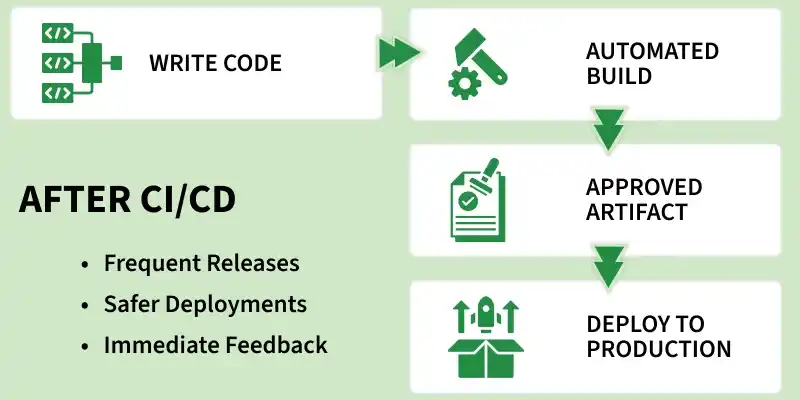
After CI/CD
- Developers commit code frequently to a shared repository.
- CI performs build and test automatically.
- Bugs are detected early and fixed quickly.
- Continuous Delivery ensures code is always release-ready.
- Continuous Deployment enables automatic production releases.
- Smaller, frequent updates replace large risky releases.
- Improves collaboration and transparency across teams.
Three Pillars of CI/CD
To effectively implement CI/CD, it is important to understand the differences between its three core concepts: Continuous Integration, Continuous Delivery, and Continuous Deployment.
1. Continuous Integration (CI)
Continuous Integration focuses on integrating code changes frequently to avoid conflicts and ensure code stability.
- **Goal: Prevent “integration hell” caused by late code merging.
- **Process: Developers merge code changes into the main branch frequently (often daily).
- **Automation: Each commit triggers an automated build and unit tests.
- **Outcome: If tests fail, the build is rejected and developers are notified immediately.
**Note: Both Continuous Delivery and Continuous Deployment are commonly abbreviated as “CD,” but they differ in release automation. Continuous Delivery requires manual approval before production release, while Continuous Deployment automates the release process completely.
2. Continuous Delivery (CD)
Continuous Delivery ensures that the application is always ready for release, with minimal manual effort.
- **Goal: Keep the codebase in a release-ready state at all times.
- **Process: After CI passes, code is deployed to a staging or testing environment.
- **Automation: Integration, system, and performance tests are executed automatically.
- **Release: Deployment to production is **manual, typically triggered when needed.
3. Continuous Deployment (CD)
Continuous Deployment takes automation a step further by removing manual intervention in releases.
- **Goal: Enable fully automated and faster production releases.
- **Process: After all tests pass, code is automatically deployed to production.
- **Automation: End-to-end pipeline runs without human involvement.
- **Requirement: Requires highly reliable and comprehensive automated testing.
CI Workflow
The CI workflow represents the automated process that starts when developers commit code and ends with build status.
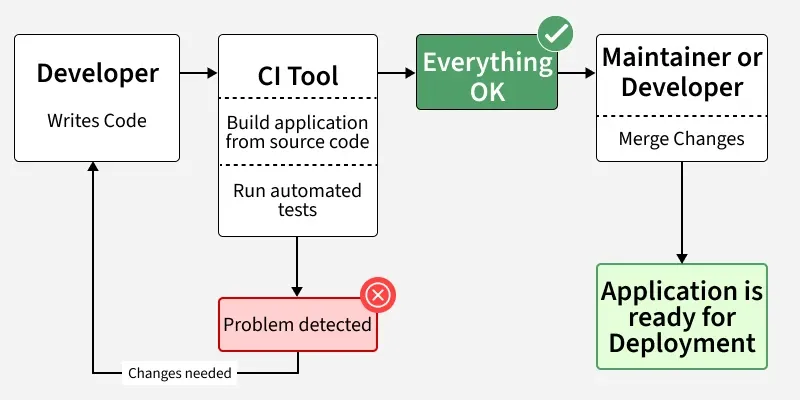
CI workflow
- Developer writes and commits code
- CI tool builds the application
- Automated tests are executed
- If issues occur -> “Problem detected” -> developer fixes code
- If successful -> “Everything OK” -> code is merged
- Application becomes ready for deployment
CI/CD Workflow
This workflow shows how Continuous Integration combined with Continuous Delivery/Deployment enables faster, safer, and more reliable software releases.
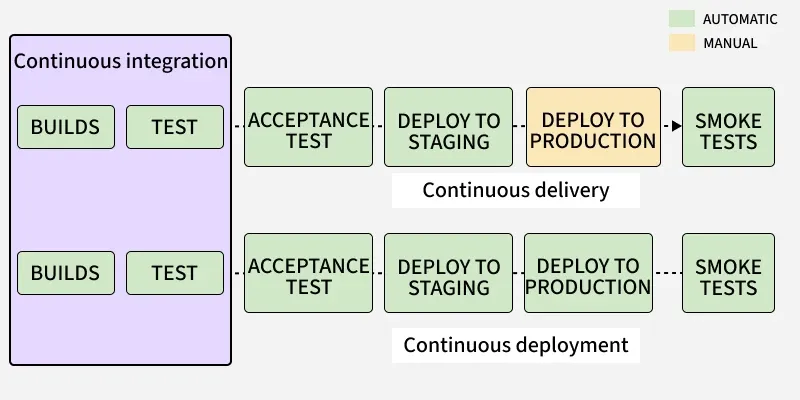
CI/CD Workflow
- CI performs build and test automatically.
- Code moves to **Acceptance Testing.
- Deployed to **Staging Environment.
- Further validation is done.
- **Continuous Delivery: Manual deployment to production.
- **Continuous Deployment: Automatic deployment to production.
- Smoke tests validate production release.
Various tools are used to implement CI/CD pipelines effectively.
- **Jenkins - Open-source automation server widely used for building CI/CD pipelines.
- **GitHub Actions - CI/CD tool integrated with GitHub repositories.
- **GitLab CI/CD - Built-in CI/CD solution within GitLab.
- **Concourse - Open-source tool focused on pipeline automation.
- **GoCD - Provides visualization and management of complex pipelines.
- **Spinnaker - Continuous delivery platform for multi-cloud deployments.
- **Screwdriver - Platform designed for scalable CI/CD workflows.
CI/CD Pipeline
A CI/CD pipeline is an automated workflow that enables teams to build, test, and deploy code efficiently and reliably.
In simple terms, it is a series of automated steps that help deliver software faster with fewer errors.
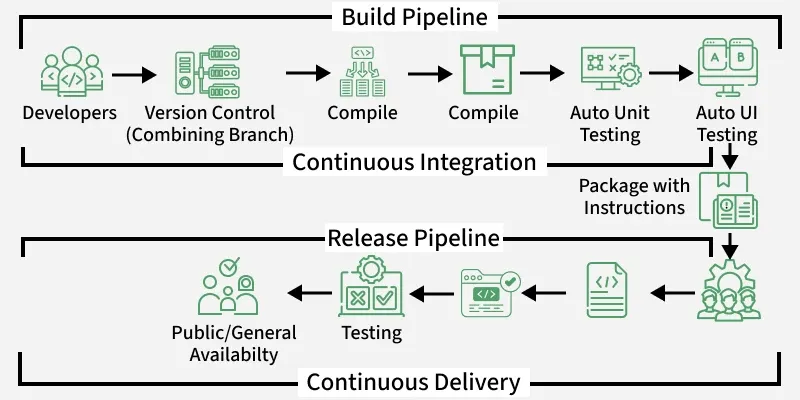
- Developers push code to version control.
- Code is compiled and built.
- Automated testing is performed.
- Application is packaged.
- Code moves through release pipeline.
- Delivered to users after validation.
Components of a CI/CD Pipeline
These components define how code moves from development to production.
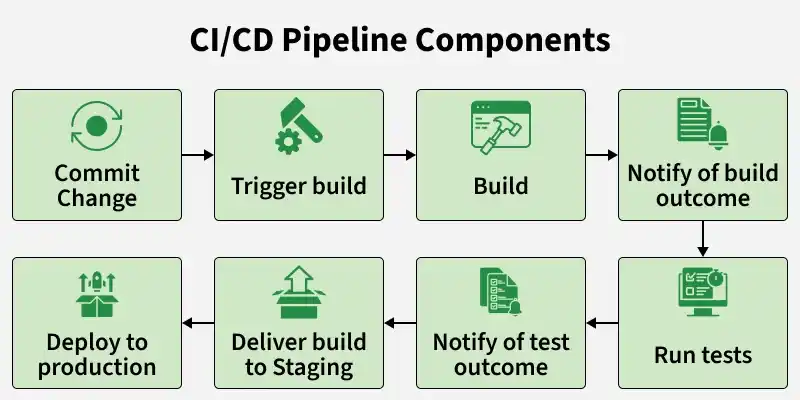
CI/CD Pipeline Components
1. Commit Change
This is the starting point where developers push code to a repository.
- Developers commit code to a version control system (e.g., Git).
- Code changes are tracked and versioned.
2. Build Trigger
The system automatically detects changes and starts the pipeline.
- Version control system detects new commits.
- Automatically triggers the build process.
3. Build
The application is compiled and prepared for execution.
- Code is compiled and packaged into a deployable artifact.
- Dependencies are resolved during this stage using tools such as Maven, Gradle, and Docker.
4. Build Outcome Notification
The system provides feedback about the build status.
- Notifies developers whether the build passed or failed.
- Helps identify issues early in the process.
5. Run Execution
Automated tests verify the quality and correctness of the code.
- Executes unit, integration, and end-to-end tests.
- Detects bugs and issues early in the pipeline and ensures the code meets quality standards.
6. Test Outcome Notification
The system reports the results of test execution.
- Notifies developers about test success or failure.
- Helps in quick debugging and issue resolution.
7. Deliver Build to Staging
The application is deployed to a staging environment for validation.
- Code is deployed to a production-like environment
- It allows final testing before release and helps identify issues before production deployment.
8. Deploy to Production
The final stage where the application is released to users.
- Code is deployed to the production environment.
- Makes the application and its features available to end users.
Best Practices for a Healthy Pipeline
Following best practices ensures efficient and reliable CI/CD pipelines.
- **Fast Feedback: Detect failures quickly to fix issues early.
- **Commit Frequently: Avoid large merges and integration conflicts.
- **Fix Broken Builds Immediately: Keep the main branch stable.
- **Environment Parity: Ensure staging matches production.
- **Infrastructure as Code (IaC): Use tools like Terraform or CloudFormation.