What is Jenkins? (original) (raw)
Last Updated : 30 Apr, 2026
Jenkins is an open-source tool that automates various stages of the software development lifecycle. It supports building, testing, and deploying applications across multiple environments, making it a critical component in CI/CD pipelines.
- **Automation: Automates repetitive tasks such as builds, tests, and deployments.
- **Extensibility: Over 1,800+ plugins to integrate with various tools like Docker, Kubernetes, Selenium, and Git.
- **Technology Agnostic: Supports multiple programming languages and tech stacks, including Java, Python, JavaScript, and more.
- **Ease of Setup: Provides a user-friendly web-based GUI for configuration.
- **Master-Slave Architecture: Enables distributed builds for improved performance and scalability.
Jenkins Architecture and Core Concepts
Jenkins follows a master-slave architecture, where the Jenkins server (master) manages build jobs and delegates their execution to agent nodes (slaves). This setup ensures efficient resource utilization and parallel execution.
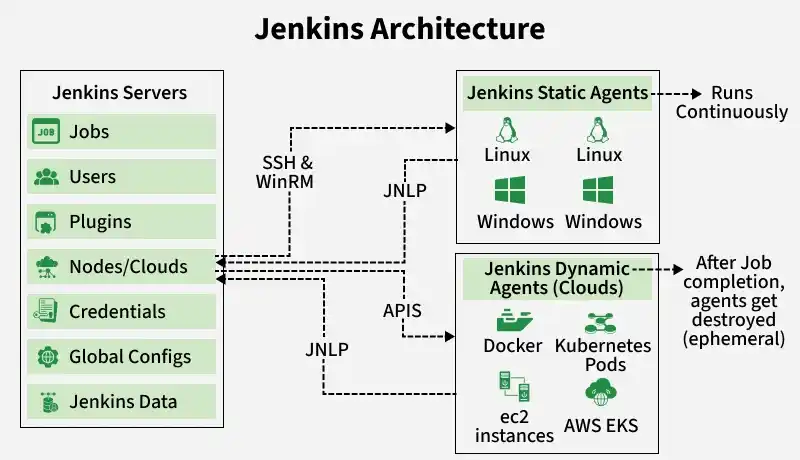
Jenkins Architecture
Master Slave Architecture
**1. Jenkins Controller
- **Central Brain: Acts as the management hub for the entire Jenkins environment.
- **Orchestration: Schedules build jobs and assigns tasks to agents.
- **Lifecycle Management: Handles plugin loading, configuration, and monitoring the health of the system.
**2. Jenkins Agent
- **The "Worker": A machine or container that executes the actual tasks (building, testing, etc.) assigned by the controller.
- **Permanent Agents: Dedicated, always-on machines reserved for specific workloads.
- **Ephemeral Agents: Temporary resources (like Docker containers) that spin up for a job and disappear once finished.
**3. Jenkins Node
- **Execution Environment: A generic term for any system (Controller or Agent) capable of running Jenkins jobs.
- **Health Monitoring: Jenkins monitors nodes and will take them offline if they fall below performance or disk space thresholds.
**4. Jenkins Job
- **Unit of Work: A single automated task, such as a script execution or a project build.
- **Efficiency: Automates repetitive manual steps to reduce human error and speed up the development cycle.
**5. Jenkins Plugins
- **Extensibility: Over 2,000 community-contributed tools that expand Jenkins' core functionality.
- **Integration: Connects Jenkins to external tools like GitHub, Slack, Docker, and various cloud providers.
**6. Jenkins Pipeline
- **Workflow as Code: A suite of plugins that lets you define the entire CI/CD process via a script (Jenkinsfile).
- **End-to-End Automation: Automatically chains together the building, testing, and delivery phases into one continuous flow.
Jenkins Workflow
Jenkins automates the entire CI/CD process through pipelines, which are structured as a series of stages.
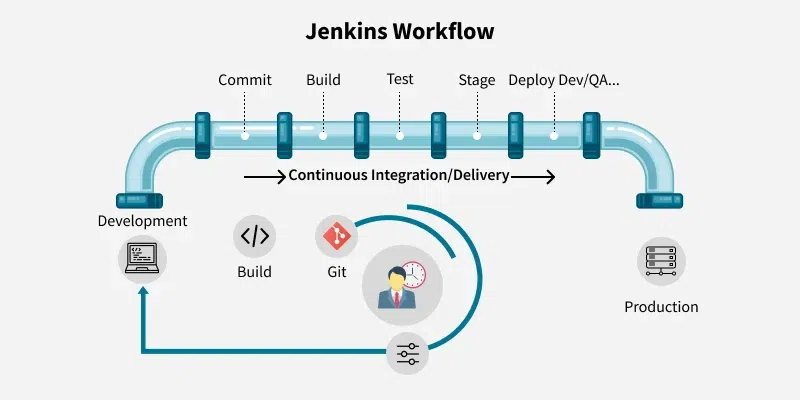
Jenkins workflow
- **Code Commit: Developers push changes to a version control system like Git.
- **Build: Jenkins compiles the code and generates artifacts.
- **Testing: Executes automated tests (unit, integration, or system tests).
- **Deployment: Deploys the tested build to staging or production environments.
- **Quality Gates: Verifies code quality at each stage to ensure standards are met.
Key Features of Jenkins
1. Pipelines
- Automate CI/CD workflows with declarative or scripted pipelines.
- Ensure smooth transitions from code commit to production deployment.
2. Plugin Support
- Plugins for source control (Git), build tools (Maven), and cloud integrations (AWS, Docker, Kubernetes).
3. Cross-Platform Compatibility
- Works across operating systems (Linux, Windows, macOS).
- Supports integration with cloud-based services.
4. Master-Slave Setup
- Ensures distributed execution for improved performance.
5. Support for Multiple Languages
- Compatible with Java, Python, Node.js, and more.
6. Scalability
- Efficient for both small projects and enterprise-level applications.
Jenkins Use Cases
- **Build Automation: Compile code, create build artifacts, and package applications.
- **Test Automation: Integrates with Selenium, TestNG, JUnit, and other tools to run automated tests.
- **Continuous Deployment: Automates the deployment process to various environments, including staging and production.
- **Reporting: Generates reports for test results, code coverage, and build statuses.
- **Integration with Cloud Services: Supports AWS, Azure, and Google Cloud for scalable CI/CD workflows.
CI/CD in Jenkins
Jenkins plays a pivotal role in CI/CD pipelines by enabling teams to automate and streamline the entire software delivery process.
- **Continuous Integration: Merges code changes frequently and triggers automated builds and tests.
- **Continuous Delivery: Keeps the code in a deployable state with manual approval for production deployment.
- **Continuous Deployment: Fully automates deployment to production upon successful test completion.