Characteristics and Benefits of Digital System (original) (raw)
Last Updated : 13 Mar, 2026
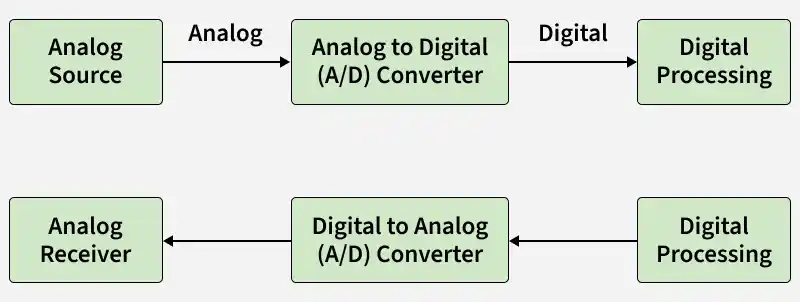
A Digital System is a system that processes, stores, and transmits information in the form of binary digits (0 and 1). It works using digital signals instead of continuous analog signals.
- A digital system uses binary values (0 and 1) to process information.
- It performs tasks like computation and control using digital circuits.
Characteristics of a Digital System
A digital system operates by processing information in the form of discrete values, typically represented using binary digits (0 and 1). Unlike continuous signal processing, digital systems handle data in distinct steps, which makes storage, transmission, and manipulation of information more reliable and systematic. These systems are programmable and flexible, allowing modifications through software without changing the hardware structure.
- Data is represented in a digital system as a vector of binary variables.
- They can provide accuracy (dynamic range) limited only by the number of bits used to represent a variable
- Digital systems are less prone to error than analog systems.
- Data representation in a digital system is suitable for error detection and correction.
- They are designed in a hierarchical manner using reusable modules.
**Benefits of Digital over Analog Systems:
Digital systems offer several advantages compared to analog systems in modern applications. They enable efficient data storage and long-distance transmission without significant degradation of signal quality. Digital signals can be regenerated accurately, ensuring consistent performance over time. These systems are compatible with modern computing and communication technologies, making integration with processors and digital networks seamless.
- It is economical, easy to design and high noise immunity.
- It is very well suited for both numerical and non-numerical information processing.
- Easy to duplicate similar circuits and complex digital ICs are manufactured with the advent of microelectronics Technology.
- Adjustable precision and easily controllable by Computer.