D Flip Flop (original) (raw)
Last Updated : 23 Jul, 2025
Prerequisite : Introduction to Sequential Circuit
Flip Flop is an electronic device or to be precise a kind of memory component that can hold one bit of data. A flip flop has two states, that is "SET" and "RESET". Those states are represented with the binary values 0 and 1. The flip flop remains in its current state until its receives a signal that switches it to opposite state. A clock or pulse signal may "trigger" the flip flop to change state.
**D Flip Flop
D flip flop is an electronic devices that is known as "delay flip flop" or "data flip flop" which is used to store single bit of data.
- D flip flops can be either synchronous or asynchronous.
- The clock signal is required for the synchronous version of D flip flops but not for the asynchronous one.
- The D flip flop has two inputs, data and clock input which controls the flip flop.
- When clock input is high, the data is transferred to the output of the flip flop.
- When the clock input is low, the output of the flip flop is held in its previous state.

Block Diagram of D Flip Flop
A D flip-flop is created by modifying an SR flip-flop. The S input is connected to the D input, and the R input is connected to the inverted D input. As a result, a D flip-flop functions similarly to an SR flip-flop, but with complementary inputs, preventing any possibility of an invalid intermediate state. One major issue with the SR flip-flop is the race around condition, which is eliminated in the D flip-flop due to the inverted inputs. The circuit diagram of the D flip-flop is shown in the figure below:
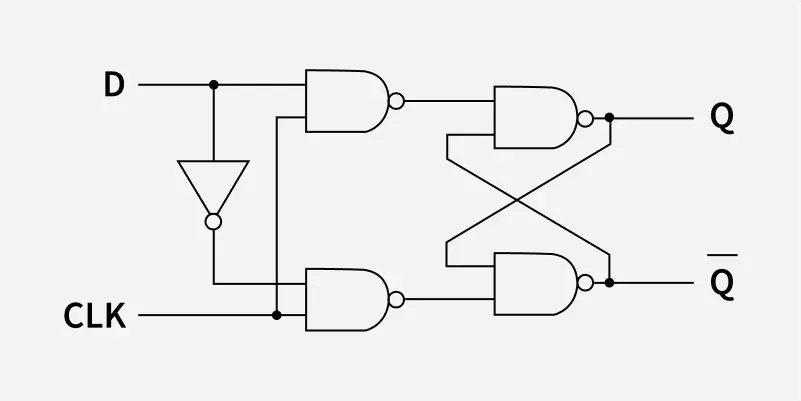
Logic Circuit of D Flip Flop
**Working of D Flip Flop
D flip flop consist of a single input D and two outputs (Q and Q'). The basic working of D Flip Flop is as follows:
- When the clock signal is low, the flip flop holds its current state and ignores the D input.
- When the clock signal is high, the flip flop samples and stores D input.
- The value that was previously fed into the D input is reflected at the flip flop's Q output.
- If D = 0 then Q will be 0.
- If D = 1 then Q will be 1.
- The Q' output of the flip flop is complemented by the Q output.
- If Q = 0 then Q' will be 1.
- If Q = 1 then Q' will be 0.

Truth Table of D Flip Flop
**Characteristic Table of D Flip Flop
The characteristic table of the D flip flop displays the behavior of the flip flop for each combination of input and current state. The characteristic table for a D flip flop is as follows.

Characteristics table of D Flip Flop
- D is the input, and Q is current state, Q(n+1) is the next state outputs.
- Q(n+1) will always be zero when D is 0, irrespective of current state of flip flop.
- When the input of the flip flop is 1, next state of flip flop will always be 1, regardless of the current state of flip flop.
**Characteristic Equation of D Flip Flop
The characteristics equation of D flip flop consist of a Boolean expression that explains the relationship between the input and output of the flip flop. The characteristic equation for a D flip flop is :
**Q(n+1) =D(n)
- Q(n+1) represents the output of flip flop at the next clock cycle.
- D(n) is the input to the flip flop at the current clock cycle, and n represents the current clock cycle.
- This characteristic equation of D flip flop states "**that the output of the flip flop at the next clock cycle will be equal to the input at the current clock cycle".
**D Flip Flop Excitation Table
Her, Q(n) represents the current state of the flip flop, and D(n) represents the current input of the flip flop. Where as Q(n+1) represents the next state of the flipflop.
- When the Q(n) is 0 and the D(n) is also 0, then the Q(n+1) becomes 0. This situation explains the condition of "hold" state.
- When the Q(n) is 0 but D(n) is 1, then the Q(n+1) becomes 1. This situation explains the condition of "set" state.
- When the Q(n) is 1 but D(n) is 0, then the Q(n+1) becomes 0. This situation explains the condition of "reset" state.
- When the Q(n) is 1 and the D(n) is also 1, then the Q(n+1) becomes 1. This situation explains the condition of "hold" state.

**Advantages of D Flip Flop
- D flip flop is very simple to design.
- The computation speed of D flip flop is very fast compared to other flip flops.
- D flip flop requires very few components to design which makes it simple to understand.
**Note: D flip flops are glitch prone. When input varies fast, flip flop output may glitch. Digital circuit glitches are hard to identify and fix.
**Application of D Flip Flop
D flip flop has numerous applications in digital system is described as follows:
- **Memory: D flip flop is used to create memory circuit for holding the data.
- **Registers: D flip flop is used to create register, which can hold data in digital system. By using the D flip flop the designer can built any size of register as per the requirement.
- **Counters: D flip flops are used to create the counters which counts the number of event occurred in the digital system.
- **Synchronous System: D flip flop is having in developing the synchronous system.